Designing Resilient Organizations and Systems
Golden Hook & Introduction
SECTION
Nova: If you spent your morning clearing endless emails just to feel like you did some actual work, we need to talk about why your day is designed to fail. We have built modern work around this illusion of control, and it is quietly suffocating our creativity and our organizations.
Atlas: Oh, I know that feeling all too well. It is like we are running on a treadmill that is slowly speeding up, but we are too terrified to step off and look at the control panel. We just keep running faster, hoping the machine eventually stops.
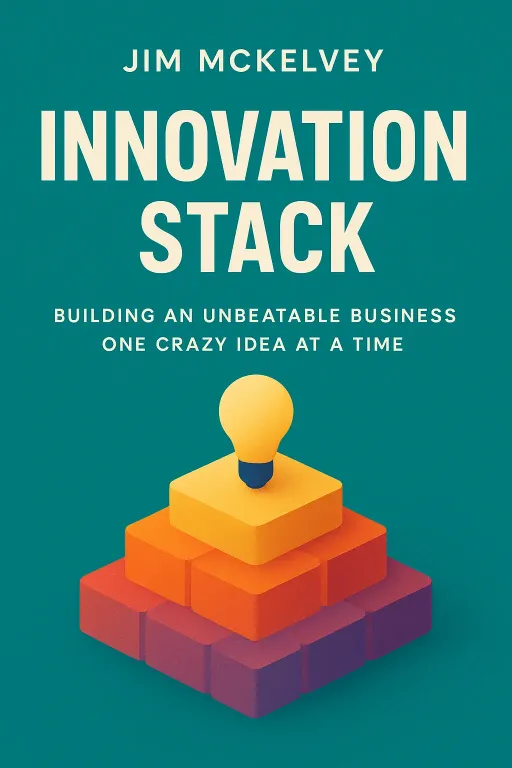
Nova: Exactly. And today, we are exploring how to completely rebuild that control panel. We are diving into two incredible books that challenge everything we think we know about building resilient, high-performing systems. First, we have The Innovation Stack by Jim McKelvey, the co-founder of Square. He shares this wild, high-stakes story of how a small startup survived a direct, existential attack from Amazon.
Atlas: Amazon? That is basically the ultimate boss fight for any business. Most companies just get flattened when Amazon decides to enter their space.
Nova: They do. But Square did something different, which we will unpack. And to help us understand the internal side of this, we are pairing it with Brave New Work by Aaron Dignan. Dignan is an organizational theorist who has spent years helping massive institutions dismantle their bureaucracy. He argues that we need to stop treating our companies like rigid machines and start treating them like living, evolutionary systems.
Atlas: That sounds like a massive shift. I imagine a lot of our listeners are sitting in offices right now, looking at their organizational charts, and wondering how on earth they can make a dent in that kind of rigid structure.
Nova: It is a huge shift, but it is incredibly practical once you see the patterns. Today, we are going to look at how these two ideas connect. We will explore how to build a system of interlocking habits that make you irreplaceable, and how to clear out the daily bureaucratic clutter that drains your mental energy.
The Innovation Stack and the Power of Interlocking Practices
SECTION
Atlas: Let us start with Jim McKelvey and Square. I am fascinated by this. How does a small mobile payment company stand its ground when a giant like Amazon decides to clone their product and undercut their prices?
Nova: It is one of the most dramatic stories in modern business. Back in 2014, Amazon launched a competitor to Square called Local Register. They copied the card reader, and then they did what Amazon always does. They cut their fees by thirty percent. In any standard business model, that is a death sentence.
Atlas: Definitely. If your main competitor has infinitely deeper pockets and just slashed their prices, you are usually done. Did Square panic and try to match the price cut?
Nova: That is the natural reaction, right? But McKelvey and his co-founder Jack Dorsey realized they literally could not afford to match Amazon's prices. If they did, they would go bankrupt. So, they did nothing. They kept their prices exactly where they were, and they waited for the blow to land.
Atlas: Hold on, they did nothing? That sounds incredibly risky. It is almost like standing still while a freight train is coming right at you. What was their actual strategy?
Nova: The strategy was built on what McKelvey calls an innovation stack. He realized that Square's survival did not depend on a single feature, like the little square plastic card reader. It depended on a web of fourteen different, interlocking decisions they had made since day one.
Atlas: Okay, tell me about this web. What actually made up this stack?
Nova: Think about what it took to make Square work for a small merchant, like a local coffee cart. Before Square, small businesses could not get credit card merchants because the banks required credit checks, expensive hardware, and long contracts. Square changed all of that. They offered free hardware. They made sign-up take only a few minutes. They had a low, flat-rate pricing system with no contracts. They even figured out how to pay merchants the very next day.
Atlas: I see. So it was not just the physical reader. It was the free hardware, the instant sign-up, the flat rate, and the fast payout.
Nova: Yes, and each of those pieces depended on the others. You cannot offer free hardware unless you have a massive volume of users. You cannot get a massive volume of users unless sign-up is incredibly simple. You cannot make sign-up simple unless you build an entirely new, automated fraud detection system. Every single solution they created solved a problem caused by the previous solution. That is the innovation stack.
Atlas: Oh, that makes perfect sense. So when Amazon cloned the card reader and dropped the price, they were only copying one single block of the pyramid. They did not copy the entire, interconnected foundation underneath it.
Nova: Exactly. Amazon copied the visible part, the pricing and the hardware. But they did not replicate the highly optimized, automated backend systems that made Square's low-margin business model actually profitable. To match Square's entire system, Amazon would have had to change how their own internal teams operated, which they were not willing to do. About a year after launching, Amazon quietly shut down their competitor and actually sent all their customers a free Square reader.
Atlas: Wow, that is a total surrender. It is like the ultimate validation of their system.
Nova: It really is. And the lesson here is that true resilience is not about having one secret weapon. It is about building a system of compounding, interlocking practices that are so tightly woven together that copying just one or two of them is completely useless.
Atlas: That is a powerful concept. I am thinking about how this applies to our listeners on a personal level. We often think we need to find that one killer skill, like learning a new programming language or getting a specific certification, to stand out in our careers. But maybe the real move is to build our own personal innovation stack.
Nova: That is the exact translation. A personal innovation stack is a unique combination of habits, skills, and perspectives that compound over time. For example, you might not be the absolute best writer in the world, and you might not be the top data analyst. But if you combine solid data analysis with compelling storytelling, and you add a deep understanding of user psychology, you have built a stack that is incredibly rare and very difficult for anyone else to replicate.
Atlas: Right, it is the intersection of those skills that creates the value. If someone tries to compete with you, they cannot just copy your technical skills. They would have to copy your communication style, your workflow, and your unique perspective. It makes you incredibly resilient to market changes.
Nova: It really does. It shifts you away from competing on raw effort and moves you toward competing on systemic uniqueness. You are no longer just a cog in the machine; you are your own unique ecosystem.
Breaking the Bureaucracy and Evolutionary Systems
SECTION
Atlas: That transitions us perfectly into Aaron Dignan's Brave New Work. If we want to build these unique personal stacks, we need the mental space to do it. But most of us are trapped in organizations that feel like they were designed to crush any form of unique thinking.
Nova: Dignan's core argument is that most modern organizations are still running on an operating system designed in the nineteenth century. We are using a blueprint created by Frederick Taylor during the Industrial Revolution, which was built to treat factories like giant, predictable machines and workers like replaceable parts.
Atlas: That sounds painfully familiar. The classic top-down hierarchy, where the people at the top make all the decisions, and the people at the bottom just execute them without questioning anything.
Nova: Yes, and we call that bureaucratic operating system Taylorism. It worked wonders when we were manufacturing physical goods on an assembly line where predictability was everything. But we do not live in that world anymore. We live in a world of extreme complexity, rapid change, and cognitive work. When you try to run a modern, creative organization using a rigid, machine-like operating system, you get bureaucracy, endless meetings, and decision paralysis.
Atlas: I guess that is why we end up with those ridiculous approval chains. You need five different managers to sign off on a basic email copy change. It is exhausting, and it completely kills any momentum.
Nova: It does. Dignan suggests that we need to stop treating organizations as machines that we can control and start treating them as evolutionary systems. Think about the difference between a traffic light and a roundabout.
Atlas: Oh, I like that comparison. A traffic light is rigid. It dictates exactly when you stop and when you go, regardless of whether there is actually any traffic coming from the other direction.
Nova: Exactly. It is a control-based system. It assumes the designers of the light can predict the flow of traffic perfectly. A roundabout, on the other hand, is an evolutionary, trust-based system. There are no lights telling you what to do. Instead, there are a few simple rules, like yield to the left. The drivers must be present, they must pay attention, and they must self-organize in real-time.
Atlas: And research shows that roundabouts are actually much safer and handle a higher volume of traffic than intersections with lights. They are just more efficient because they rely on the intelligence of the people in the system rather than a pre-programmed timer.
Nova: That is the essence of an evolutionary organization. It is about moving away from predicting and controlling, and moving toward sensing and responding. Instead of creating massive, rigid five-year plans, evolutionary organizations focus on creating simple rules that allow teams to adapt to changes as they happen.
Atlas: But wait, how do you actually implement this without causing absolute chaos? If you just tell everyone to self-organize, wouldn't a massive company just fall apart?
Nova: That is the common fear, but Dignan points out that self-organization is not the absence of structure. It is a different kind of structure. It is built on trust and radical transparency rather than control. He highlights companies like Buurtzorg, a Dutch pioneering healthcare organization. They have over fourteen thousand nurses working in self-managing teams of twelve. There is no traditional boss, no middle management, and a incredibly small headquarters.
Atlas: Fourteen thousand people with no middle management? That sounds impossible. How do they decide who does what, or how to handle budgets?
Nova: They use a set of simple, evolutionary practices. Each team is completely responsible for its own scheduling, hiring, and patient care. If a team has a conflict, they do not escalate it to a manager. They use a structured conflict-resolution process that they have all been trained in. They have access to real-time financial data for their team, so they can make informed financial decisions. The system works because they have replaced control with trust and capability.
Atlas: That is fascinating. It shows that when you give people autonomy and the right information, they actually step up and make smart decisions. They do not need a supervisor watching over their shoulder.
Nova: They really do not. In fact, Buurtzorg has been rated the best employer in the Netherlands multiple times, and their patient care outcomes are significantly better and cheaper than their bureaucratic competitors. It is a living proof that evolutionary systems are not just nicer places to work; they are fundamentally more resilient and efficient.
Systemic Connections and the Friction of Modern Work
SECTION
Atlas: This makes me wonder about the friction between these two concepts. On one hand, we have McKelvey's innovation stack, which is this beautifully integrated, almost proprietary system of practices. On the other hand, we have Dignan's evolutionary systems, which are all about open, self-organizing adaptability. How do those two ideas coexist?
Nova: They are actually two sides of the same coin. Both concepts are a direct rejection of the illusion of control. McKelvey realized he could not control Amazon's actions, so he built a resilient, interlocking system that could withstand external shocks. Dignan realizes that leaders cannot control the complex market, so they must build organizations that can adapt from the bottom up.
Atlas: Ah, I see. Both approaches are about building for resilience rather than predictability. They both accept that the world is messy and unpredictable, and instead of trying to force it into a neat little box, they build structures that thrive on that messiness.
Nova: Exactly. And the common enemy in both cases is unnecessary complexity, which we usually call bureaucracy. In a company, bureaucracy is like plaque in your arteries. It slows down communication, blocks decision-making, and eventually causes a system failure.
Atlas: That is a vivid image. And I think for our listeners, that plaque is what causes that daily, low-grade professional stress. It is not necessarily the actual work that is hard; it is the friction of trying to get the work done through a maze of outdated processes.
Nova: You hit the nail on the head. That friction is a massive drain on our cognitive space. If you spend half your day navigating office politics, filling out redundant forms, and sitting in status-update meetings, you have very little mental energy left for deep, strategic thinking or for building your own personal innovation stack.
Atlas: So, how do we start clearing out that plaque? Especially if we are not the CEO and we do not have the authority to completely rewrite our company's operating system?
Nova: We start small. Dignan talks about treating organizational change as a series of safe-to-try experiments. You do not need permission to change the entire company. You just need to look at your immediate sphere of influence and ask, what is one small, bureaucratic process that is slowing my team down, and how can we simplify it?
Atlas: That is incredibly empowering. It is about taking agency over your immediate environment. Instead of complaining about the system, you start hacking it in small, constructive ways.
Nova: Exactly. It is about carving out that cognitive space so you can focus on what actually matters.
Synthesis & Takeaways
SECTION
Atlas: This brings us to our practical application for today. We always want to leave our listeners with actionable wisdom they can use immediately. Nova, what is our tiny step for today?
Nova: Our tiny step is to identify one overly bureaucratic process in your current workday and simplify it to save cognitive space. This could be as simple as turning a recurring thirty-minute status meeting into a quick, written update in a shared document. Or it could be streamlining a folder structure so your team does not waste time searching for files. Find one source of systemic friction and eliminate it.
Atlas: I love that. It is a direct application of the roundabout principle. You are replacing a rigid, control-based process with a simpler, trust-based one. And what is our deep question for today?
Nova: The deep question is, how can you apply an innovation stack mindset to your own career, building unique, compounding habits that set you apart? Take some time to look at your current skill set. Do not just focus on being slightly better at your core job. Look at the adjacent skills, the unique perspectives, and the daily habits that you can combine to build a resilient, irreplaceable professional identity.
Atlas: That is a profound shift in perspective. It is about moving from a mindset of survival to a mindset of systemic growth.
Nova: It really is. When you stop trying to fit into a rigid, pre-defined box and start building your own unique, resilient system, you unlock a completely new level of professional clarity and focus. You are no longer just reacting to the chaos; you are navigating it with a sense of calm, grounded logic.
Atlas: That feels like the perfect place to wrap up today's conversation. Thank you all for joining us on this journey into resilient systems.
Nova: This is Aibrary. Congratulations on your growth!