Systems of Influence: Navigating Human Bias in Project and Information Management
Golden Hook & Introduction
SECTION
Nova: Imagine walking into a boutique, seeing a beautiful piece of jewelry that has been sitting on the shelf for months, and suddenly noticing the price tag has doubled. Your brain instantly clicks and says, oh, this must be incredibly valuable, I have to buy it! Why do our minds take these wild, automatic shortcuts, and how do these exact same psychological traps quietly derail our projects, our data systems, and our daily decisions? Welcome to the podcast. I am Nova, and today we are embarking on a fascinating journey into the hidden forces of persuasion. We are incredibly lucky to have systems thinker and data professional Auwal Ibrahim with us today. Auwal, it is so wonderful to have you here!
Auwal Ibrahim: Thanks, Nova. It is absolutely great to be here. You know, as someone who spends a lot of time looking at systems, data, and how organizations make decisions, I find this topic incredibly relevant. We like to think of ourselves as purely rational actors, especially when we are managing complex projects or analyzing data, but the reality is that human psychology is the ultimate underlying operating system. If we do not understand how that operating system works, we cannot design truly resilient solutions.
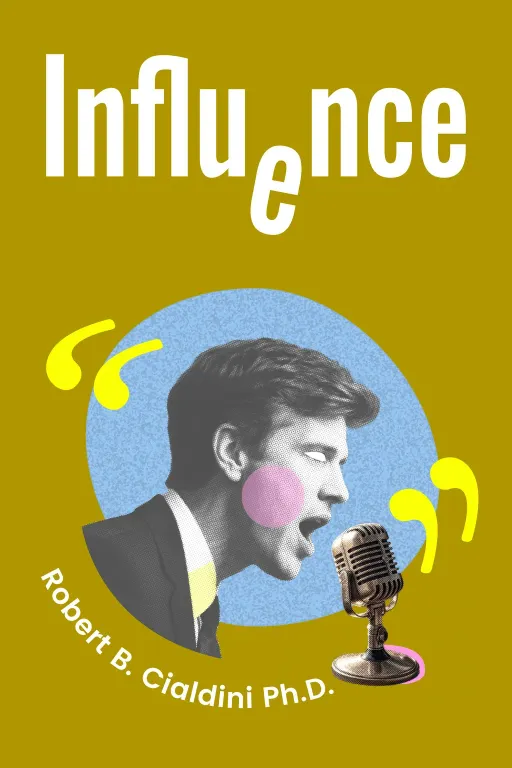
Nova: Oh, that is such a perfect way to frame it! The ultimate underlying operating system. I love that. Today, we are going to tackle Robert Cialdini's classic book,, from two really powerful perspectives. First, we will explore what Cialdini calls the weapons of influence—those automatic, click-whirr triggers like the contrast principle and how they affect information management. Then, we will dive deep into the systemic challenges of social proof and authority, looking at how things like pluralistic ignorance and blind obedience can creep into team dynamics and how we can build better safeguards against them. Ready to dive in?
Auwal Ibrahim: Let's do it, Nova. I am really excited to unpack these concepts and see how we can apply them practically.
Deep Dive into Core Topic 1
SECTION
Nova: Awesome! Let's start with this idea of automatic compliance. Cialdini talks about how animals and humans alike have these fixed-action patterns. It is like a pre-recorded tape in our brains. A trigger feature plays, and click, whirr, the behavior rolls out automatically. To show how this works in the human world, Cialdini tells this amazing story about a friend of his who owned an Indian jewelry store in Arizona. She had this allotment of turquoise jewelry that just would not sell. It was high quality, reasonably priced, but tourists just walked right past it. She tried everything—moving the display to a central area, telling her staff to push it hard, but nothing worked. Finally, the night before leaving on a buying trip, she left a frustrated, scribbled note for her head saleswoman that said, mark everything in this display case, price times one-half, just to get rid of it. But guess what? The saleswoman misread the scribbled fraction and thought it said price times two! When the owner returned a few days later, every single piece of turquoise had sold out—at double the original price! Isn't that just wild?
Auwal Ibrahim: It really is a classic example of a heuristic in action. In this case, the tourists were using a simple mental shortcut: expensive equals good. Because they did not have deep expertise in turquoise quality, they relied on a single data point—the price—to represent the entire value of the item. In systems thinking, we see this all the time. When people are faced with high cognitive load or complex information, they naturally look for simplified indicators to make quick decisions.
Nova: Exactly! It is like our brains are constantly looking for ways to save energy. And Cialdini points out that in our increasingly complex, fast-paced modern life, we actually need these shortcuts more than ever. But the danger is when these triggers are exploited. Take another famous study Cialdini mentions: the Xerox machine experiment by Harvard psychologist Ellen Langer. She wanted to see how people waiting in line to use a library copier would react to someone trying to cut in. In the first scenario, the researcher asked, "Excuse me, I have five pages. May I use the Xerox machine because I am in a rush?" And ninety-four percent of people said yes. In the second scenario, they just asked, "Excuse me, I have five pages. May I use the Xerox machine?" Without giving a reason, compliance dropped to sixty percent. But here is the kicker: in the third scenario, they asked, "Excuse me, I have five pages. May I use the Xerox machine because I have to make some copies?" Now, that is a completely meaningless reason—everyone in line had to make copies! Yet, ninety-three percent of people complied! Just the word "because" acted as a trigger feature, launching automatic compliance.
Auwal Ibrahim: That is a profound insight for anyone working in project management or information systems. It shows that the structure of our communication often triggers compliance before the actual substance is even processed. In a project environment, if a leader says, "We need to implement this new software because it is our new strategic directive," team members might automatically fall into line without critically evaluating whether the software actually solves the underlying problem. The word "because" bypasses our critical thinking. As systems thinkers, we have to be incredibly disciplined about demanding real, evidence-based reasons, rather than just accepting the linguistic triggers of compliance.
Nova: Yes! We have to listen for those empty "becauses." And it is not just words; it is also how information is sequenced. Cialdini talks about the contrast principle. If we present two things in sequence, and the second item is fairly different from the first, we tend to perceive it as much more different than it actually is. Cialdini gives the example of a real estate salesman named Phil. Phil would take prospective home buyers to see a couple of incredibly run-down, overpriced houses first. These were what the company called setup properties. They weren't actually meant to be sold; they were just there to make the genuine properties in the company's inventory look absolutely spectacular by comparison. Once the buyers saw the dumpy houses, their eyes would light up when they walked into a perfectly average home, and they would buy it on the spot!
Auwal Ibrahim: Oh, the contrast principle is a massive force in project scoping and information management. Think about how project estimates or budgets are presented. If a consultant presents an initial proposal that is wildly expensive and complex, and then retreats to a slightly less expensive, but still highly priced option, the second option suddenly feels like an incredible bargain. It is a classic negotiation tactic, often called the rejection-then-retreat technique. But from an information management perspective, this can lead to terrible decision-making. If we are not careful, we end up evaluating options based on their relative contrast to a bad alternative, rather than their absolute utility and alignment with our actual goals.
Nova: That is so true! We lose our objective baseline because our perception is being manipulated by the sequence. It is like putting one hand in cold water, one hand in hot water, and then putting them both in lukewarm water. The lukewarm water feels hot to one hand and cold to the other!
Auwal Ibrahim: Exactly. And to counteract that in project management, we have to establish clear, objective evaluation criteria we look at the options. We need to lock in our requirements, our budget thresholds, and our key performance indicators in a vacuum, so to speak, so we aren't swayed by the contrast of whatever the vendor or the team presents first. It is all about building structural safeguards into our decision-making processes.
Deep Dive into Core Topic 2
SECTION
Nova: That is such a practical, brilliant safeguard, Auwal. And it leads us beautifully into our second major topic, which is how these psychological principles play out in social and organizational systems. Let's talk about social proof. Cialdini defines this as our tendency to look at what other people are doing to determine what is correct, especially when we are uncertain. But this can go terribly wrong in what psychologists call pluralistic ignorance. Cialdini discusses the famous, tragic case of Catherine Genovese in New York, who was attacked and killed over a prolonged period with thirty-eight neighbors watching from their windows, yet nobody called the police. For years, people blamed urban apathy. But researchers Bibb Latané and John Darley realized it was actually a systemic psychological phenomenon. In an ambiguous situation, everyone looks to see how others are reacting. Because nobody else is panicking, everyone assumes everything is fine, and collective inaction ensues. To prove this, they did an experiment where they had smoke seep into a room under a door. When participants were alone, seventy-five percent reported the smoke. But when they were in a group of three, and the other two were confederates instructed to ignore the smoke, only ten percent of the actual participants reported it! They just sat there, breathing in smoke, because everyone else seemed calm!
Auwal Ibrahim: Wow. That smoke experiment is a chilling metaphor for project management. How many times have we seen a project heading toward a complete disaster, yet in status meetings, everyone sits in silence? Nobody wants to be the first to raise their hand and say, "Hey, there is smoke coming from under the door." We look around the room, see our colleagues looking calm and nodding, and we think, well, if they aren't worried, I guess I shouldn't be either. It is pluralistic ignorance in corporate clothing. The system itself suppresses critical information because of our natural reliance on social proof.
Nova: Oh, absolutely! It is like a collective hypnosis. We think, surely someone else would have said something if there was a real problem. And this gets amplified tenfold when you add the principle of authority into the mix. Cialdini dedicates a whole chapter to how deeply we are programmed to obey authority figures. He talks about the famous Milgram experiments, where ordinary people administered what they believed were lethal electric shocks to a screaming learner, simply because a researcher in a gray lab coat told them, "The experiment requires that you continue." But there is also a healthcare example that Cialdini shares that is just mind-blowing. It is called the rectal earache case. A physician ordered ear drops to be administered to a patient's right ear, but he abbreviated "right ear" as "R ear" on the prescription. The duty nurse read the prescription, and instead of administering the drops to the patient's ear, she proceeded to put the drops into the patient's anus! Neither the nurse nor the patient questioned it, because a doctor—the ultimate authority figure—had ordered it!
Auwal Ibrahim: That is an unbelievable story, but it perfectly illustrates the danger of automatic obedience. When an authority figure speaks, our critical thinking often goes completely offline. We stop processing the information and just execute the command. In data governance and technology leadership, this is a massive risk. If a senior executive or a highly paid external consultant says, "This data model is correct," or "This system architecture is the way to go," the team often stops auditing the work. They stop asking the hard questions. As a leader, I always try to remind myself that my title can actually be a barrier to truth. If people are too intimidated or too conditioned to question my decisions, we are going to make catastrophic mistakes, just like administering ear drops in the wrong place!
Nova: Right! It is directed deference. We look at the symbols of authority—the titles, the clothing, the status—rather than the actual substance of what is being said. Cialdini even shares data showing that we actually perceive people with prestigious titles as physically taller! It is like our brains literally distort reality to match the hierarchy.
Auwal Ibrahim: It is a fascinating cognitive bias, but from a systems perspective, it is highly dangerous. To build truly robust systems, we have to decouple authority from truth. We need to create environments where data and evidence are the ultimate authorities, not the person with the highest salary in the room. We have to actively design feedback loops and channels for constructive dissent.
Nova: Yes! And that actually reminds me of another story Cialdini tells about a highly successful waiter named Vincent. Vincent realized that if he wanted to maximize his tips, he had to establish himself as both an authority and a trustworthy ally. When a large party would order, he would wait for the first person to choose a dish, and then he would lean in, look around conspiratorially, and say, "I'm afraid that is not as good tonight as it usually is. May I recommend instead this other dish?" which happened to be slightly less expensive. By seeming to argue against his own financial interest, he instantly proved his honesty and his deep expertise to the customers. Once they trusted him completely, he could suggest the most expensive wines and desserts, and they would comply without a second thought!
Auwal Ibrahim: That is a masterclass in influence. Vincent understood that true authority isn't just about having a title; it is about establishing credibility and trust. He used a small, calculated concession to build a bridge of trust, which then allowed him to guide the system to his desired outcome. In project management, we can learn a lot from that. If we are transparent about our mistakes, or if we admit when a project has a risk or when a data point is uncertain, we build immense credibility. Then, when we say, "We need to pivot," or "We need to invest more resources here," the stakeholders actually believe us because we have proven we aren't just blindly pushing an agenda. We are acting as trustworthy guides.
Synthesis & Takeaways
SECTION
Nova: Oh, I love that so much, Auwal. It is about building authentic, ethical influence rather than relying on manipulation or mindless compliance. This has been such an incredibly rich conversation. We have covered the automatic "click-whirr" triggers like the turquoise jewelry store, the power of "because" in the Xerox experiment, the contrast principle in project scoping, and then how social proof and authority can create dangerous blind spots like pluralistic ignorance and automatic obedience. If you had to synthesize all of this into a core philosophy for our listeners, especially those managing projects or working with complex systems, what would it be?
Auwal Ibrahim: I think the core takeaway is that we must design our systems and our workflows with human nature in mind, rather than assuming perfect rationality. We need to build what I call psychological circuit breakers. If we know that people naturally fall into pluralistic ignorance when they are uncertain, we have to design meetings where dissent is structured and required. If we know that people blindly obey authority, we have to actively invite feedback and create flat communication channels where data speaks louder than titles. Ultimately, understanding the psychology of persuasion isn't about manipulating others; it is about understanding our own vulnerabilities so we can build better, more honest, and more effective systems for our communities.
Nova: That is beautiful. A psychological circuit breaker. What a powerful concept! And for our listeners who want to start implementing this today, what is one simple, actionable step they can take in their very next meeting or project?
Auwal Ibrahim: I highly recommend introducing a practice called the pre-mortem. Before you launch a new project or make a major decision, gather your team and say, "Imagine we are one year in the future, and this project has failed catastrophically. Now, let's spend thirty minutes writing down exactly how and why it failed." This simple exercise completely bypasses social proof and pluralistic ignorance. It gives everyone permission—and indeed, makes it a game—to look for the smoke under the door and call out the risks without fear of looking like they aren't team players. It is a simple, highly effective way to break the spell of automatic compliance.
Nova: Oh, that is an absolute gold nugget of advice! The pre-mortem. I am definitely going to use that. Auwal, thank you so much for sharing your incredible insights, your systems-thinking perspective, and your warmth with us today. This has been an absolutely delightful and eye-opening conversation.
Auwal Ibrahim: Thank you, Nova. It was an absolute pleasure. I hope it helps everyone build more resilient and thoughtful systems in their own work.
Nova: And to all of our listeners out there, thank you for tuning in! Remember, the next time you hear a "because," or feel the urge to follow the crowd, take a deep breath, activate your critical thinking, and check for those psychological circuit breakers. Until next time, keep learning, keep growing, and let's keep building better systems together!