Unlocking Influence: Master the Art of Persuasion & Negotiation
Golden Hook & Introduction
SECTION
Nova: Atlas, what's the first thing that comes to your mind when I say "negotiation"?
Atlas: Honestly? Sweaty palms, a slight panic, and the sudden urge to just give in and buy whatever they're selling, just to make it stop.
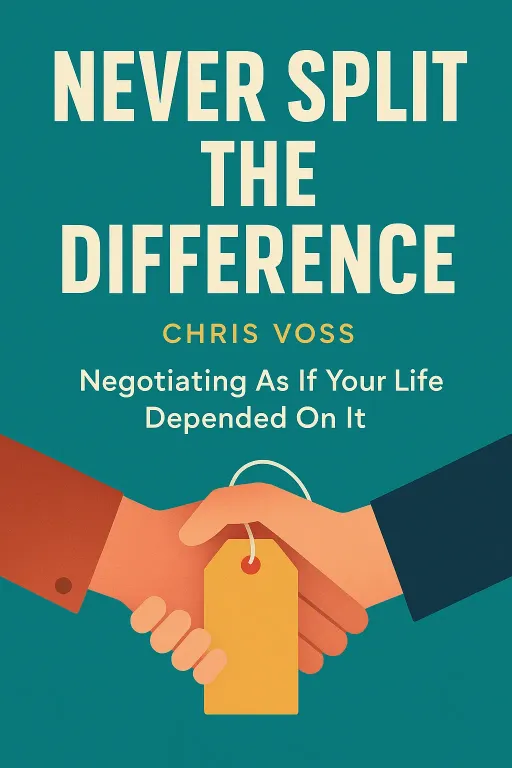
Nova: You're not alone! That visceral reaction is exactly why we need to talk about today's deep dive into influence and persuasion. We're unlocking the secrets of two incredible minds. First, Chris Voss, the former lead international hostage negotiator for the FBI, whose book "Never Split the Difference" completely upends traditional negotiation advice.
Atlas: Wait, a hostage negotiator? I'm trying to get my kids to eat their vegetables, not defuse a bomb. How does that translate to, you know, normal life?
Nova: That's the magic! Voss took those high-stakes, life-or-death scenarios and distilled them into principles applicable to every conversation. And then, we have Robert Cialdini's groundbreaking work, "Influence: The Psychology of Persuasion." What's fascinating about Cialdini is that he spent years going "undercover"—working in car dealerships, telemarketing firms—to understand the subtle triggers that sway our decisions.
Atlas: So, one is about navigating overt conflict, and the other is about the hidden currents? That makes me wonder how much of my daily life is just... one big persuasion experiment.
Nova: Exactly! Both books, despite their wildly different origins, reveal a profound truth: true influence isn't about manipulation. It's about deeply understanding human behavior and building bridges of mutual benefit. And that's where we start today, by stepping into the high-pressure world of tactical empathy.
The Art of Tactical Empathy in Negotiation (Voss)
SECTION
Nova: Voss introduces this concept of "tactical empathy." It's not about agreeing with someone. It's about understanding, acknowledging, and even verbalizing their emotions and perspective, without necessarily endorsing them. It's a powerful tool to disarm and influence, even in the most intense situations.
Atlas: That sounds rough. So, I need to understand why someone is being unreasonable, even if I think they’re totally out of line? My instinct is usually to just argue my point harder.
Nova: And that's precisely what Voss says to do. He teaches techniques like "mirroring," which is simply repeating the last one to three words someone just said, or "labeling," where you verbalize the emotion you perceive, like "It sounds like you're feeling frustrated."
Atlas: Okay, but how does repeating someone's words actually help? That feels almost... passive-aggressive, or like I'm just mocking them.
Nova: It’s counter-intuitive, right? But it works because it signals active listening. It encourages them to elaborate, and critically, it makes them feel heard. Voss tells a gripping story about a bank robber in Brooklyn who had taken hostages. The robber was agitated, making demands. Voss used mirroring. The robber would say, "I want a car to get out of here!" Voss would respond, "Get out of here?"
Atlas: Just like that? And it worked?
Nova: It did! The robber would then elaborate, "Yeah, I need to get out of here because I can't go back to jail." Voss then used labeling: "It sounds like you're worried about going back to jail." This wasn't agreement; it was acknowledging the underlying emotion. This simple act of being heard de-escalated the situation, built a strange kind of rapport, and ultimately led to the hostages' peaceful release. The cause was the robber's fear, the process was Voss's tactical empathy, and the outcome was a non-violent resolution.
Atlas: Wow, so you're telling me repeating someone's last three words and saying "It sounds like you're worried" can actually disarm a bank robber? That feels almost too simple, or even manipulative, especially for our listeners who are trying to build meaningful connections, not just win.
Nova: That's the critical distinction. It’s not manipulation; it's about validating their reality, even if you don't agree with it. When people feel understood, their amygdala—the part of the brain responsible for fight-or-flight—calms down. This allows for more rational thought. Voss also talks about the "accusation audit," which is getting ahead of potential negative perceptions. For example, before a project pitch, you might say, "I know what you're thinking: this project sounds too expensive, too risky, and probably won't deliver on time."
Atlas: Oh, I love that! So, instead of waiting for the objections, you just put them all out there yourself. That's a total power move, but it also feels incredibly vulnerable.
Nova: It is! But it disarms because it shows you've considered their perspective. It builds trust. It's about predicting and neutralizing the emotional landmines before they explode. And speaking of subtle forces, while Voss handles the overt conflict, Cialdini reveals the subtle, almost invisible forces that guide our decisions long before any direct negotiation begins.
The Six Principles of Ethical Persuasion (Cialdini)
SECTION
Nova: Cialdini’s work is a masterclass in understanding the psychological triggers that influence us, often unconsciously. He identified six universal principles, but let's dive into two of the most powerful: Reciprocity and Social Proof.
Atlas: Okay, so tactical empathy helps in a direct confrontation. What do these principles do in the everyday, less dramatic scenarios?
Nova: They shape our daily lives, often without us even realizing it. Reciprocity is the unconscious urge to repay favors. If someone gives us something, we feel compelled to give something back. It's a deep-seated social norm.
Atlas: So, if I bring cookies to a team meeting, I'm basically setting myself up for everyone to agree with my next proposal? That's... brilliant and slightly terrifying for anyone who's trying to build frameworks and wants to have impact.
Nova: That’s the ethical tightrope! Cialdini recounts studies where waiters who simply left a small mint with the bill saw their tips increase by 3% to 4%. If they left two mints, tips jumped by 14%. But if they left one mint, paused, and then came back to offer a second, saying, "For you nice people, here's an extra mint," tips skyrocketed by 21%. It’s a small, unasked-for gift that creates a powerful sense of obligation.
Atlas: Wow. That's a huge difference for such a tiny gesture. So, it's not about the size of the gift, but the act of giving itself that triggers that reciprocal feeling?
Nova: Precisely. It’s the unexpected, personalized nature of the gift. It taps into our ingrained need to balance the scales. Now, let's pivot to Social Proof. This is our tendency to look to others to determine appropriate behavior, especially when we're uncertain.
Atlas: That's why I always check reviews before buying anything online! So, it’s not just about what think, it's about what I.
Nova: Exactly! Cialdini highlights how powerful this is. Think about those "most popular item" labels on restaurant menus, or even how canned laughter on sitcoms makes us more likely to find a joke funny. In one classic study, researchers had a single person look up at an empty spot on a busy New York City street. Few people stopped. But when five people looked up, 80% of passersby stopped and looked up too.
Atlas: That's incredible! So, if I want to encourage a new initiative at work, getting a few key people on board first could create a ripple effect. It's about painting a picture of what "everyone else" is already doing.
Nova: It’s about creating that psychological comfort. People are more likely to follow a path that appears well-trodden. It's why testimonials and case studies are so effective in brand storytelling—they leverage social proof. It's not just saying your product is good; it's validating it.
Synthesis & Takeaways
SECTION
Nova: So, when we bring Voss and Cialdini together, we see a complete picture of influence. Voss gives us the tools to navigate and transform existing conflicts, to de-escalate and find common ground even in high-stakes moments. Cialdini reveals the subtle, underlying psychological currents that shape our decisions, showing us how to ethically build an environment where agreement and collaboration are more likely to occur naturally.
Atlas: So, it's about building bridges, not just winning battles. For our listeners who are constantly building frameworks and seeking mastery, it sounds like these aren't just "tricks," but deep insights into human nature. It's about understanding the "why" behind human behavior.
Nova: Absolutely. True influence, as Nova's Take suggests, is about understanding human behavior and building bridges of mutual benefit. It's about using these insights not to manipulate, but to create better outcomes for everyone involved. Every negotiation, every interaction, is an opportunity for growth, not just a win-lose scenario.
Atlas: That reminds me of the "healing moment" from our content—recognizing that every negotiation is an opportunity for growth. It's about embracing the messy middle, as our own growth recommendations remind us.
Nova: Exactly. So, for our listeners, here's a challenge: before your next important conversation or interaction this week, identify one principle we discussed today—mirroring, reciprocity, or social proof. Subtly activate it. Pay attention to the response. Observe the difference.
Atlas: I love that. It turns theory into immediate action. And as a strategic analyst, I’m all about those actionable insights.
Nova: This is Aibrary. Congratulations on your growth!