The Persuasion Paradox: Why Logic Alone Won't Influence Outcomes
Golden Hook & Introduction
SECTION
Nova: Imagine trying to convince someone, armed with undeniable facts, airtight logic, and a perfectly reasoned argument… only to watch your brilliant idea crash and burn. Sound familiar?
Atlas: Oh, it sounds like every Monday morning meeting I've ever had. Honestly, it’s frustrating. You put in the work, you have the data, and still, it’s like talking to a wall.
Nova: Exactly! That gut-wrenching feeling of your best ideas going unheard, your meticulously crafted proposals gathering dust. We often assume that if our logic is sound, victory is inevitable. But that, my friend, is our blind spot.
Atlas: A blind spot? So you're saying it's not about logic, but about something I'm?
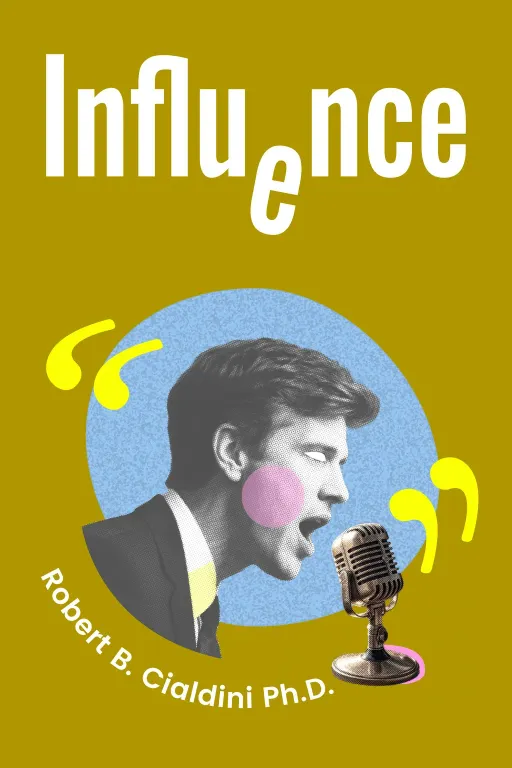
Nova: Precisely. And it's a problem that two monumental works of psychology help us untangle: Robert Cialdini's "Influence: The Psychology of Persuasion" and Daniel Kahneman's "Thinking, Fast and Slow." What's fascinating about Kahneman's "Thinking, Fast and Slow" is that it’s the culmination of decades of groundbreaking research on human judgment and decision-making that actually earned him a Nobel Memorial Prize in Economic Sciences, even though he's a psychologist.
Atlas: Wow, a Nobel for a psychologist in economics? That instantly tells me we're dealing with some seriously deep insights into how our brains actually work, not just how we they work.
Nova: Absolutely. And when you combine that with Cialdini's decades of research into the universal principles that move people to action, you start to see a much richer picture of what persuasion truly is. It's not just about winning an argument; it's about genuinely connecting with and guiding others.
The Blind Spot of Logic: Why Facts Aren't Enough
SECTION
Nova: So, let's unpack this 'blind spot.' We're taught to be rational, to value evidence. Why does that often fall short when we're trying to influence outcomes?
Atlas: Yeah, I guess that makes sense. We’re often told to “be rational” or “think logically.” It’s almost ingrained in us as the superior way to approach things. Why isn't it enough?
Nova: Because humans aren't purely logical machines, Atlas. We're a complex blend of reason and emotion, conscious thought and unconscious biases. Our blind spot is the assumption that everyone else operates from the same purely rational playbook we've meticulously designed. We present facts, figures, and flawless reasoning, expecting an equally rational response, but often, we get a shrug, a polite no, or even outright resistance.
Atlas: So you’re saying facts don't matter at all? Like, if I'm trying to convince my team to adopt a new, more efficient workflow, the data showing it saves 15% time and 10% cost is irrelevant? That seems a bit out there.
Nova: Not irrelevant at all! The facts are crucial, they're the foundation. But they're not the building. Imagine a brilliant engineer, let's call her Sarah, who has developed an innovative, cost-saving solution for her company's manufacturing process. She's spent months on this, meticulously crunching numbers, running simulations, proving its efficacy. She presents it to the leadership team, graphs, projections, testimonials from early tests—the works.
Atlas: Sounds like a slam dunk.
Nova: You'd think so, right? But as she finishes, there's a collective, almost palpable, silence. Then, one manager pipes up, "Well, it sounds… complicated." Another says, "Our current system, while imperfect, is familiar." Sarah is baffled. The numbers are undeniable! The logic is impeccable! But the project gets shelved, or worse, "tabled for further discussion" indefinitely.
Atlas: Ugh, I’ve been there. It’s like they just didn’t it, or they weren’t listening. But how do you even begin to identify those "unspoken" fears in a high-stakes environment? Is it just guessing?
Nova: That’s where the insights from Cialdini and Kahneman become so powerful. Sarah focused on System 2 thinking – the slow, deliberate, logical part of the brain. But the managers were likely operating from System 1 – fast, intuitive, emotional. Their unspoken fears weren't about the numbers; they were about disruption, the stress of learning something new, losing a sense of control, or even perceived threats to their own department's established processes. Those are powerful, non-rational drivers.
Atlas: Wow, that’s actually really inspiring. It re-frames those frustrating moments not as my failure to be logical enough, but my failure to understand the deeper human currents at play.
Unlocking Non-Rational Persuasion: Cialdini & Kahneman's Insights
SECTION
Atlas: That makes sense. It’s like we're speaking different languages. So, how do we learn to speak the language of genuine influence? Is there a Rosetta Stone for this 'non-rational' side?
Nova: There absolutely is, and it starts with understanding what Daniel Kahneman calls our two systems of thought. System 1 is our intuitive, emotional, automatic self. It's what makes you swerve to avoid an accident without thinking, or instantly recognize a friend's face. System 2 is our slow, deliberate, analytical self. It's what you use to solve a complex math problem or plan a strategic business move. Most of the time, System 1 is in control, making quick judgments, and System 2 only steps in when System 1 encounters a problem it can't solve easily.
Atlas: So you’re saying we're wired to respond to certain cues almost automatically? Like, it's not even a conscious choice?
Nova: Precisely. Emotional appeals often bypass System 2 entirely, going straight for the intuitive System 1. And Cialdini's work masterfully outlines the universal principles that tap into these System 1 responses. Let's take 'Social Proof' for example. This is the principle that we often determine what is correct by finding out what other people think is correct. We look to others for cues on how to act, especially when we're uncertain.
Atlas: Okay, so… social proof. Like when you see a long line outside a restaurant, you assume it must be good? Even if you’ve never heard of it?
Nova: Exactly! Now, let's go back to our non-profit example. A charity is trying to get donations for a vital cause. Their initial approach, rooted in the blind spot, is to send out pamphlets filled with statistics about the problem, logical arguments for why their solution is effective, and a breakdown of how every dollar is spent. All very System 2.
Atlas: And probably not getting the traction they hoped for.
Nova: Barely a trickle. Then, they shift their strategy. Instead of just facts, they start sharing stories. They feature a short video of a single mother, tearfully thanking the charity for the assistance that changed her family's life. They show images of hundreds of happy volunteers, all wearing the charity's T-shirt, working together. And crucially, they put a small line at the bottom of their appeal: "Join the thousands of generous donors who have already made a difference."
Atlas: Oh, I see. So the single mother's story is an emotional appeal, hitting System 1. And "thousands of generous donors" is the social proof! It's not just about what the charity, it's about what and how it makes.
Nova: You've got it. The donations dramatically increase. It's not manipulation; it's understanding that people are moved by testimonials, by seeing others they can relate to taking action. It validates their own potential decision as correct and safe.
Atlas: That makes me wonder… how does that connect to building 'strong relationships' if we're tapping into these unconscious levers? Isn't there a fine line between persuasion and manipulation? For someone like me, who's driven by impact and building genuine connections, I wouldn't want to feel like I’m tricking people.
Nova: It’s a critical distinction, Atlas. When Cialdini talks about these principles, it’s not about trickery. It’s about ethical application. If you genuinely believe in your idea or product, understanding these principles allows you to present it in a way that resonates with how people make decisions, not just how we they would. It means aligning your message with their existing motivations, values, and even their psychological shortcuts.
Atlas: So, it’s like... instead of just pushing my logical solution, I need to consider what my team – maybe stability, or peer recognition, or avoiding extra hassle – and frame my solution in a way that speaks to those deeper, non-rational needs. It's about empathy, really. Understanding their underlying needs, not just their surface-level objections.
Nova: Exactly! It's about shifting your approach from merely presenting facts to genuinely connecting with and guiding others, addressing the true underlying needs and motivations that often go unsaid.
Synthesis & Takeaways
SECTION
Nova: So, what we're really seeing here is that the persuasion paradox isn't about abandoning logic. It's about understanding its limitations and complementing it with a profound awareness of deeper psychological drivers. It's about connecting with people where they actually are, not where we wish they were.
Atlas: That’s a great way to put it. For anyone who's trying to drive impact, whether it's in a meeting room, a design studio, or a financial analysis firm, this understanding isn't manipulative. It’s about being more effective and, frankly, more empathetic in leading change and fostering collaboration. You're not just presenting data; you're building bridges to how people actually think and feel.
Nova: Absolutely. It helps you navigate the invisible currents that shape decisions, allowing your best ideas to not just be heard, but to truly influence outcomes. It’s about leveraging psychology for good, to ensure your valuable contributions don't get lost in translation.
Atlas: Honestly, that sounds like a game-changer.
Nova: It can be. So, here’s a challenge for our listeners: Think about a recent situation where you tried to persuade someone, and it didn't quite land. How might understanding their non-rational motivations have changed your approach, and what was the true underlying need you could have addressed?
Atlas: That's a powerful question. I'm already replaying a few scenarios in my head.
Nova: That’s the goal: to spark that reflection, to shift your perspective.