Beyond the Surface: Unmasking the Psychology of Persuasion
Golden Hook & Introduction
SECTION
Nova: What if I told you that most of your daily decisions aren't truly 'yours'? That unseen forces, subtle psychological nudges, are constantly shaping your reality, from what you buy to who you vote for?
Atlas: Whoa, Nova, that's a bold claim right out of the gate. Are we talking about some kind of mind control here, or just really good marketing?
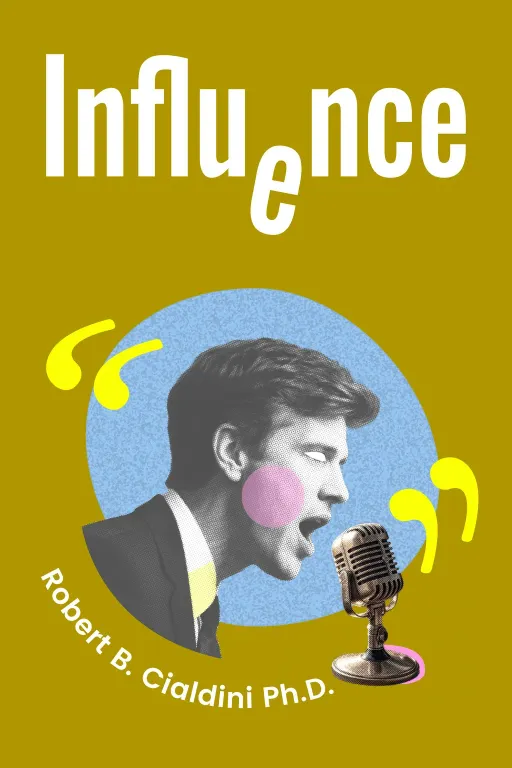
Nova: Not mind control, Atlas, but something far more pervasive and subtle. We're diving into the psychology of persuasion today, drawing heavily from Robert Cialdini's seminal work, "Influence: The Psychology of Persuasion." What's fascinating is Cialdini didn't just theorize about this; he spent years going undercover in sales organizations, advertising firms, and fundraising groups, observing these tactics firsthand to truly understand how they work in the wild.
Atlas: That's a fascinating approach for an academic – getting his hands dirty. So, these aren't just theories, but battle-tested strategies. But how do these individual 'nudges,' as you called them, really play into the bigger picture of societal systems, which is what often interests our discerning listeners?
Nova: Exactly. That's where we'll bridge Cialdini's micro-persuasion principles with Donella H. Meadows' "Thinking in Systems," to see how these individual levers combine and interact to create feedback loops of influence on a much grander scale. The core of our podcast today is really an exploration of the hidden architecture of human decision-making, from the intimate nudge to the grand societal current, unveiling the psychological triggers that shape our world.
Atlas: Okay, so we're talking about understanding the very fabric of influence. I'm ready.
The Six Pillars of Influence: Cialdini's Micro-Persuasion
SECTION
Nova: So, let's start with Cialdini's foundational six principles. Think of them as the universal language of compliance, the psychological shortcuts our brains use. The first is Reciprocity. It's the deep-seated human tendency to repay in kind what another person has provided us.
Atlas: Oh, I love that. The 'you scratch my back, I'll scratch yours' principle.
Nova: Exactly. Think of the classic Hare Krishna example from Cialdini’s book. They used to give people a 'free' flower at airports. You didn't ask for it, but suddenly, you felt a strong, almost uncomfortable obligation to donate to them when they asked. That small, unasked-for gift triggered reciprocity.
Atlas: I've seen that! The 'free gift' that isn't really free. But how does that translate into, say, a business context? For our listeners dissecting corporate strategies, where's the hidden reciprocity at play?
Nova: In business, it’s everywhere. Think of "free trials," "complimentary consultations," or even companies offering "exclusive content" like whitepapers or webinars. They're not just being generous; they're subtly triggering that sense of obligation, making you more likely to reciprocate by buying their product or service later.
Atlas: That’s a great way to put it. I get the individual trigger, but sometimes, as a 'truth-seeker,' I wonder if these principles are always used ethically. Can't reciprocity be weaponized, especially in disinformation campaigns, where someone offers a seemingly helpful piece of information that actually has a hidden agenda?
Nova: Absolutely. Like any powerful tool, these principles can be used for good or ill. Recognizing them is the first step to navigating that ethical tightrope. Which brings us to the second principle: Commitment and Consistency. Once we make a choice or take a stand, we feel a strong pressure to behave consistently with that commitment.
Atlas: So you’re saying it's about getting people to take that first tiny step, making it harder to back out later. That feels very relevant to how online communities draw people in, through small agreements that build up.
Nova: Precisely. Cialdini gives the example of researchers who asked residents to display a tiny 'Drive Carefully' sign in their window. A few weeks later, when asked to put up a huge, ugly 'Drive Carefully' billboard in their yard, a significantly higher percentage of those who agreed to the small sign also agreed to the large one. Their initial small commitment made them consistent with a larger request.
Atlas: That’s incredible. It’s like the snowball effect of compliance. But how does 'social proof' then amplify that, especially online?
Nova: Social proof is our tendency to look to others to determine appropriate behavior, especially when we're uncertain. If everyone else is doing it, it must be right. Think of canned laughter on sitcoms – producers use it because they know if you hear others laughing, you're more likely to find it funny yourself. Or, online, seeing thousands of likes or shares on a post, regardless of its accuracy, lends it credibility.
Atlas: That’s why I always check reviews, then. But what about the dark side of social proof – echo chambers and the spread of misinformation, where everyone around you seems to believe something, so you start to believe it too? That’s a real concern for anyone trying to understand disinformation.
Nova: It’s a huge concern, and it highlights how these principles can be stacked. That leads us to Authority: we tend to defer to perceived experts or figures of authority. Think of the infamous Milgram experiment, where subjects obeyed instructions to administer what they believed were painful electric shocks to others, simply because an authority figure in a lab coat told them to.
Atlas: The uniform effect! That's powerful. But is it just about perceived authority, or actual expertise? In today's fragmented information landscape, who even an authority anymore, and how do we discern genuine expertise from a well-produced facade?
Systems of Persuasion: Meadows' Macro-Framework for Understanding Influence
SECTION
Nova: That's a brilliant question, Atlas, and it naturally leads us from individual triggers to how these principles interact within larger systems. This is where Donella H. Meadows' "Thinking in Systems" becomes so crucial, because individual acts of persuasion don't happen in a vacuum.
Atlas: I’ve been thinking about this. If Cialdini gives us the individual levers, Meadows shows us the engine room, how those levers are connected and what kind of pressure they exert.
Nova: Exactly. Meadows explains that systems are full of feedback loops – where an action, like a persuasive message, can feed back to amplify or dampen itself. Think of a simple thermostat: if the room gets too cold, the heater kicks on, warming the room, which then turns the heater off. That's a balancing feedback loop. But imagine if the heater kept getting hotter and hotter the colder it got. That's a runaway, or reinforcing, loop.
Atlas: Okay, so a persuasive message isn't just a one-off event; it can kick off a chain reaction. How would a Cialdini principle, say 'scarcity,' play out in a systemic way, creating one of these feedback loops?
Nova: Take scarcity, which is our tendency to value things more when they are perceived as limited. In a systemic context, a "limited time offer" for a popular product can create individual urgency. But if enough people respond, it can trigger collective panic buying. The perceived scarcity drives up demand, which makes the product even scarce, which further increases demand. It's a reinforcing feedback loop that can lead to speculative bubbles, like in the housing market, or even runs on essential goods during a crisis.
Atlas: That's 'matrix thinking' right there – seeing the invisible connections. For someone trying to understand disinformation science, these feedback loops must be absolutely central. How does 'liking' as a Cialdini principle fuel a systemic issue like, say, political polarization?
Nova: Excellent question. Liking, the principle that we are more easily persuaded by people we like or find attractive, combines powerfully with social proof in online social systems. People naturally gravitate towards groups where they feel liked and where others share their views. This creates an ideological echo chamber—a reinforcing feedback loop.
Atlas: So, it's not just that I like someone, it's that my liking encourages me to engage with similar content, which then reinforces my initial liking and commitment to that group’s beliefs. It's a self-perpetuating cycle.
Nova: Precisely. And Meadows teaches us that these feedback loops can have enormous power. Small changes at the 'leverage points' within these systems can create disproportionately large outcomes. Understanding these loops allows us to see how subtle psychological nudges can aggregate into widespread societal trends, shaping collective actions and belief systems. It’s about seeing the architecture of influence.
Atlas: That’s such a hopeful way to look at it. It goes beyond just being aware; it's about understanding how to intervene.
Synthesis & Takeaways
SECTION
Atlas: This is powerful, Nova. It makes you realize that understanding these principles isn't just about protecting yourself from being influenced, but also about understanding the forces shaping society. For our 'ethical strategists' and 'discerning analysts,' what's the key takeaway here?
Nova: The profound insight is that influence isn't just a transaction; it's a dynamic system. These psychological triggers are always at play, shaping collective actions in ways we often don't perceive. The concrete anchor here is that once you recognize these feedback loops, you gain the power to not just resist unethical persuasion, but to ethically design systems that promote better outcomes. It's about becoming a conscious architect of influence, rather than an unconscious participant.
Atlas: That's an empowering thought. So, for our listeners, the tiny step we can all take this week is to simply observe. Pick one public discourse, one advertisement, or even a social media interaction, and try to identify just one of Cialdini's six principles at play. See how it subtly nudges you or others.
Nova: Exactly. Just observe. Because awareness is the first step to true agency.
Atlas: A fantastic challenge. And a great way to start seeing 'Beyond the Surface.'
Nova: Absolutely. This is Aibrary. Congratulations on your growth!