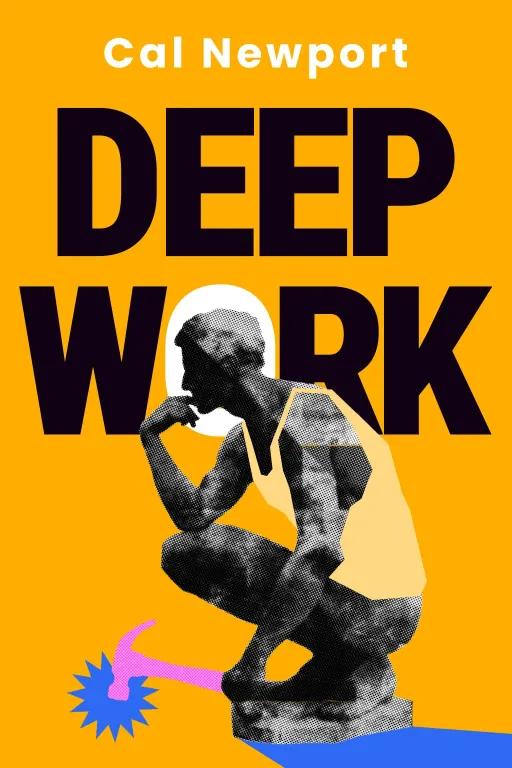
Mastering Your Mind: The Art of Focus and Flow
Golden Hook & Introduction to the Battle for Attention
SECTION
Nova: We’re often told that multitasking is a superpower. You know, juggling emails, phone calls, a presentation, and maybe even planning dinner all at once. It feels productive, right? Like you’re crushing it!
Atlas: Oh man, it absolutely does. I mean, who feel a certain rush from having ten tabs open and switching between them like a digital ninja? It’s the modern badge of honor, isn’t it?
Nova: It is. But what if I told you that this perceived superpower is actually one of the biggest saboteurs of your true potential? That the very act of constantly switching context is eroding your capacity for genuine, impactful work?
Atlas: Whoa. That’s a bold claim, Nova. I imagine a lot of our listeners, myself included, are probably thinking, "But how else do I get everything done?" It feels like the only way to keep up in our always-on world.
Nova: Exactly! And that's precisely why today, we’re diving headfirst into "Mastering Your Mind: The Art of Focus and Flow." We’re pulling wisdom from three seminal works: Cal Newport’s academically rigorous "Deep Work," Mihaly Csikszentmihalyi’s groundbreaking "Flow: The Psychology of Optimal Experience," and Nir Eyal’s incredibly practical "Indistractable." These aren't just popular self-help books; they're widely acclaimed for fundamentally shifting our understanding of productivity and well-being, offering profound insights from different angles.
Atlas: So you're saying these brilliant minds, from a computer science professor like Newport, to a pioneering psychologist like Csikszentmihalyi, and a behavioral design expert like Eyal, all converged on this idea that our current approach to work and life is… flawed? That’s really interesting. It makes me wonder what they all saw that we're missing.
Nova: They saw a battle for our most precious resource: our attention. And they offer a toolkit, not just for getting more done, but for experiencing life more richly.
Deep Dive into Core Topic 1: The Essence of Deep Work and Flow
SECTION
Nova: So let's start with the foundation. Cal Newport defines "deep work" as professional activities performed in a state of distraction-free concentration that push your cognitive capabilities to their limit. These efforts create new value, improve your skill, and are hard to replicate. He contrasts this with "shallow work"—non-cognitively demanding, logistical tasks often performed while distracted.
Atlas: Okay, so it’s not just about sitting down and working. It’s about you’re working. What does it like to do deep work? Is it just… hard? Because that sounds like a lot of effort without immediate gratification.
Nova: It effort, but it’s fulfilling effort. And here’s where Mihaly Csikszentmihalyi's concept of 'flow' comes in. Flow is that state of complete absorption in an activity, characterized by focused motivation and enjoyment. When you're in flow, time melts away, self-consciousness disappears, and you perform at your peak. Think of a surgeon meticulously performing a complex operation, a musician lost in a solo, or a coder debugging a tricky piece of code.
Atlas: Oh, I know that feeling! It’s like when you’re so engrossed in something, you look up and three hours have passed, and you didn't even notice. But I always thought that was just a happy accident, something that happens rarely. Can you actually flow? Or is it only for those "creative types" or high-stakes professionals?
Nova: Absolutely not just for them! Csikszentmihalyi identified key conditions for flow: clear goals, immediate feedback, and a balance between the challenge of the task and your skill level. If the challenge is too high, you get anxiety; too low, you get boredom. The sweet spot is where you're stretched but not overwhelmed. The beauty is that by intentionally setting up conditions for deep work—like eliminating distractions and focusing on a single, challenging task—you dramatically increase your chances of entering a flow state.
Atlas: So it's not purely accidental; there’s a science to it. That makes sense. It’s like, if you prep the stage properly, the performance is more likely to be spectacular. But Nova, in our hyper-connected world, just getting 30 minutes of time feels like trying to find a unicorn! How do we even begin to protect these precious deep work blocks?
Deep Dive into Core Topic 2: Mastering Attention in a Distracted World
SECTION
Nova: And that naturally leads us to the biggest enemy of both deep work and flow: distraction. This is where Nir Eyal's "Indistractable" offers a crucial roadmap. Eyal argues that becoming indistractable isn't about willpower, but about understanding the psychology of distraction and designing your environment. He breaks distractions into two main categories: external triggers and internal triggers.
Atlas: Okay, external triggers I get. Notifications, constant emails, Slack pings, open-plan offices… that's the obvious stuff. But internal triggers? My is distracting me? That sounds a bit out there. What do you mean by that?
Nova: Yes, your brain! Eyal says all human behavior is driven by a desire to escape discomfort. Internal triggers are those uncomfortable feelings: boredom, anxiety, loneliness, uncertainty, fatigue. That little itch to check your phone, for example, often isn't because a notification, but because you're feeling a moment of boredom or mild anxiety about what you be missing. It's a way to escape that internal discomfort.
Atlas: Wow, that’s actually really insightful. I totally know that feeling. Like, if I’m waiting in line, or there’s a lull in conversation, my hand just instinctively reaches for my phone. It’s not a conscious decision; it’s an automatic response to a moment of quiet or slight unease. So how do we even begin to tackle something so ingrained?
Nova: Eyal offers a four-step framework. First,: This means recognizing the discomfort that precedes distraction and reframing your response. Instead of reaching for your phone when bored, acknowledge the boredom and use it as a cue to do the deep work you planned. Second,: Traction is action that pulls you towards what you want. You literally schedule time for deep work, for reflection, for family—making it non-negotiable.
Atlas: So basically you’re saying, instead of letting my mood dictate my actions, I should let my values dictate my schedule? That’s a great way to put it. What are the other two steps?
Nova: Third,: This is about proactively managing your environment. Turning off notifications, closing irrelevant tabs, setting boundaries with colleagues. And fourth,: These are pre-commitments you make to yourself. An effort pact, a price pact, or an identity pact. For example, an effort pact could be putting your phone in another room during deep work.
Atlas: That sounds like a lot of self-control. I imagine a lot of our listeners are thinking, “This is all well and good, but what if you just… don't have that iron willpower?” It’s easy to say, but hard to implement consistently, especially for someone in a high-stakes environment where interruptions are constant.
Nova: And that's precisely Eyal's point and why his work has garnered such widespread praise. It's not about brute-force willpower; it’s about. It's about understanding the psychological levers so you can engineer your environment and your responses. You're making it to do the right thing and to do the distracting thing. It’s about being intentional, not just reactive.
Synthesis & Takeaways: Designing Your Distraction-Proof Life
SECTION
Nova: So, bringing it all together, we have Newport showing us the of deep work, Csikszentmihalyi revealing the of flow, and Eyal giving us the to defend against distraction. It’s a powerful, integrated toolkit for anyone wanting to truly master their mind.
Atlas: It sounds like it’s about much more than just productivity. It’s about reclaiming agency over your own life and attention. So, what’s the tiny step a listener can take to start applying these concepts? Where do we begin this journey?
Nova: Start small. Schedule just 30 minutes of fiercely protected 'deep work' into your day. Turn off. Put your phone in another room. Close out all other tabs. Treat it like a sacred appointment. And then, ask yourself the deep question: What internal triggers—those feelings of boredom, anxiety, or unease—often lead you to distraction, and how can you begin to reframe your response to them? Recognize that discomfort, and instead of reaching for the easy escape, use it as a cue to lean into what truly matters.
Atlas: That’s actually really inspiring. It’s not about becoming a robot who never gets distracted, but about becoming more aware and intentional. It reminds me of that healing moment from the books – that gaining control over your attention is a continuous journey, not a destination. Each moment of mindful focus is a win.
Nova: Exactly. It's an ongoing art, a practice. And the more you practice, the more profound your experiences become, the more valuable your output will be, and the richer your life will feel. Mastering your attention isn't just about getting more done; it's about living a life of deeper engagement and meaning.
Atlas: This has been incredibly insightful, Nova. It really makes you think about how much of our lives we passively let slip away to distraction.
Nova: It absolutely does, Atlas. And the power to change that is entirely within our grasp.
Atlas: This is Aibrary. Congratulations on your growth!