The Physiology of Self-Trust: How Your Body Holds the Key to True Confidence
Golden Hook & Introduction
SECTION
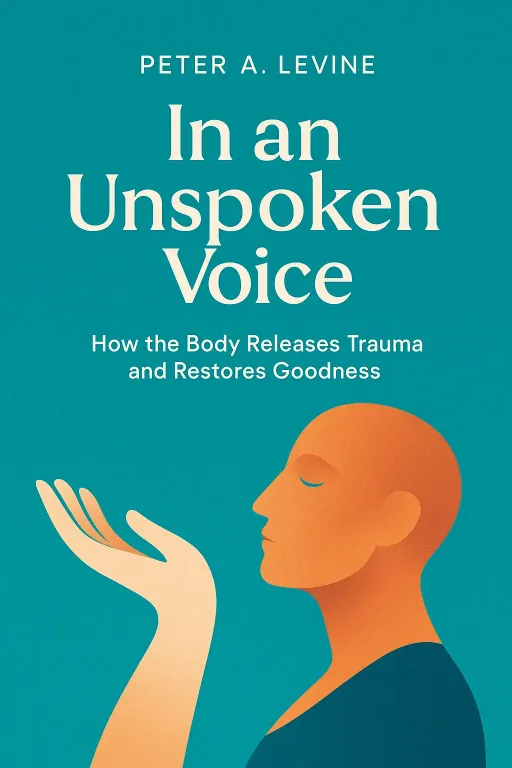
Nova: Have you ever had a moment where you needed to be completely confident—maybe giving a high-stakes presentation or standing up for yourself—but instead, your throat tightened, your hands went cold, and your mind went completely blank? We’ve all been told to just think positive or fake it till you make it, right? But what if the secret to true, unshakable confidence isn't in your head at all? What if it's written in the unspoken language of your body? Welcome to the show! I'm Nova, and today we are diving into Peter Levine's incredible book,. And joining me is our favorite analytical thinker, Thandi! Thandi, we are so glad you're here.
Thandi: Thanks, Nova! I am absolutely thrilled to be here. You know, as someone who loves looking at complex systems, this book blew my mind. We often treat the mind and the body as separate entities, but Levine shows us that they are part of a single, deeply integrated feedback loop. When we talk about confidence, we usually treat it as a cognitive software update—like, if I just change my thoughts, I'll feel confident. But Levine's work suggests that if the hardware, which is our nervous system, is running a threat program, no amount of positive thinking is going to override it.
Nova: Oh, that is such a brilliant way to frame it! The software versus the hardware. And today, we're going to tackle this from two fascinating perspectives. First, we'll explore the biology of the freeze response and why our bodies must physically discharge stress to regain confidence. Then, we'll map out the nervous system using Polyvagal theory and the SIBAM model to show how we can actively build deep, systemic self-trust from the body up.
Thandi: It's a complete paradigm shift, Nova. We're moving from a top-down approach of trying to control our minds, to a bottom-up approach of listening to the unspoken voice of our bodies. I can't wait to get into the mechanics of how this actually works.
The Trap of the Frozen State
SECTION
Nova: Let's start with a story that Peter Levine shares right at the beginning of the book, and it's actually about his own life. Back in 2005, on a beautiful, warm morning in Southern California, Peter was walking in a crosswalk when he was suddenly struck by a car driven by a teenager. Just imagine the sheer shock of that moment. One second you're walking to a friend's birthday party, and the next, you're lying on the hot asphalt, completely paralyzed and disoriented.
Thandi: It's the ultimate system shock. And what's fascinating is how his body immediately went into a primitive survival state. He describes feeling this raw, muscular power of his survival instincts, but physically, he was completely helpless.
Nova: Exactly. And then, the first responder on the scene—an off-duty paramedic—starts asking him all these highly cognitive questions. You know, "What's your social security number? What day is it?" And Peter felt his system starting to panic and shut down because his brain was being forced to do high-level cognitive processing when his body was still screaming, "Danger!"
Thandi: That is a classic system mismatch! His lower brain centers, the brain stem, were dealing with mortal terror, and the paramedic was trying to engage his prefrontal cortex. It's like trying to run a heavy graphics program when the computer's power supply is failing. But then, a pediatrician arrived on the scene. She did something completely different, didn't she?
Nova: Yes! She was this incredibly calming, compassionate presence. She just sat down on the asphalt next to him, held his hand, and embodied pure kindness. She didn't demand cognitive answers. She just let him feel safe. And because of that safe environment, Peter was able to focus inward. In the ambulance, he started to shake and tremble violently. Now, normally, paramedics or doctors might try to stop the shaking or give a sedative to calm the patient down, right?
Thandi: Right, because we look at shaking as a symptom of pathology or weakness. But Peter, being a trauma expert, knew that this shaking was actually his nervous system's natural way of discharging the massive amount of survival energy that had been mobilized during the crash. He actually told the paramedic, "Please don't stop me. I'm shaking it off so I don't get PTSD." And you know what? By the time he got to the hospital, his heart rate had returned to normal. He completely avoided developing PTSD.
Nova: It is so wild to think about! Shaking as a form of self-regulation. And it's not just humans, is it? Levine talks about how wild animals do this all the time.
Thandi: Yes! He mentions a conversation he had with Andrew Bwanali, a park biologist in Malawi. Bwanali observed that when wild animals are captured and then released, they tremble and breathe deeply before they run back into the wild. If they don't shake off that terror, if they suppress that response, they literally won't survive. They will die of shock or remain in a state of permanent paralysis.
Nova: Wow. "As they go in, so they come out." That's what the military medics used to say, right? If you enter a traumatic event in a state of frozen terror, you have to physically exit through that same doorway of shaking and mobilization.
Thandi: Precisely. From a systems perspective, when a threat occurs, the body mobilizes a massive amount of energy for fight or flight. If we can't fight or flee—like Peter being pinned to the ground, or a wild animal being held down—the body has to use its third option: immobilization, or the freeze response. It's like slamming on the gas pedal and the brakes at the exact same time. The engine is roaring with energy, but the car isn't moving. If you don't safely release that energy, the system remains under intense internal pressure.
Nova: And that trapped pressure is what destroys our confidence! When we are stuck in a chronic, low-grade freeze state, we feel empty, cold, or numb. We walk around, but we don't feel fully alive. We lose our "reflex of purpose," as Pavlov called it.
Thandi: Exactly, Nova. Think about how this applies to daily life. If you have a terrifying experience—maybe a car accident, a medical procedure, or even a highly stressful confrontation at work—and you are forced to "keep it together" and suppress your natural physical reactions, you are essentially trapping that survival energy. Your body remains convinced that the danger is still happening. So when you try to step up and be confident, your body says, "No way, we are in survival mode. Keep your head down. Freeze." True confidence requires a nervous system that knows it is safe.
Nova: That makes so much sense! We can't feel confident if our body's internal alarm system is constantly blaring. We have to learn to listen to that unspoken voice and let the body complete its natural cycles of activation and release.
The Polyvagal Map of Confidence
SECTION
Nova: Now, this brings us to our second core topic: how do we actually map this out and build that deep, systemic self-trust? To do that, we have to look at Stephen Porges's Polyvagal Theory, which Peter Levine uses as a map for therapy. Thandi, as our systems expert, how do you see this map?
Thandi: Oh, it is a beautiful, elegant map of human biology, Nova. Essentially, Porges discovered that our autonomic nervous system doesn't just have two states—sympathetic fight-or-flight and parasympathetic rest-and-digest. It actually has three distinct evolutionary branches, and they operate in a strict hierarchy.
Nova: Ooh, a hierarchy! Tell us more.
Thandi: Okay, so at the very bottom, the oldest evolutionary branch is the unmyelinated vagus nerve, which controls the immobilization or shutdown response. This is the "play dead" response we see in reptiles. When we feel a threat of imminent death or overwhelming helplessness, this system takes over. We freeze, our heart rate drops, we dissociate, and we feel numb.
Nova: Right, like being "scared stiff."
Thandi: Exactly. The middle branch is the sympathetic nervous system, which is all about mobilization—fight or flight. This is where we get that rush of adrenaline, a racing heart, and the urge to run or fight. And then, at the very top, the newest evolutionary branch is the myelinated vagus, which controls our social engagement system. This system is unique to mammals. When we feel safe, this system active-calms our heart, relaxes our facial muscles, and allows us to connect, communicate, and feel a sense of belonging and goodness.
Nova: That is so fascinating! So, the social engagement system is like our natural shield against getting overwhelmed by fight-or-flight or shutdown. But it can only run when we feel safe.
Thandi: Yes! And our nervous system is constantly scanning the environment for safety or danger through a process Porges calls "neuroception." It's an unconscious, bottom-up evaluation. If our neuroception detects safety, the social engagement system stays online, keeping our primitive survival systems in check. But if we detect threat, the higher system shuts down, and we revert to fight-or-flight. If that fails, we drop all the way down to the freeze and shutdown state.
Nova: Wow. And when we are locked in that shutdown state, we are physically incapable of receiving social support or feeling confident. The hardware is literally blocking those signals!
Thandi: Exactly. And this is why traditional talk therapy can sometimes fail for deep trauma. If a person is locked in a physiological shutdown, their social engagement system is offline. You can't just talk them into feeling safe or confident. You have to work from the bottom up to bring the system back online.
Nova: This is beautifully illustrated by the story of Sharon, a New York executive who survived the tragic events of September eleventh in the North Tower of the World Trade Center. Sharon was on the eightieth floor when the plane hit, and as she was being led down the staircase, she got trapped on the seventieth floor behind a locked door. In that moment, her body desperately wanted to run, but she was physically trapped. Her system went into a massive, paralyzed freeze response.
Thandi: Just imagine the sheer volume of survival energy mobilized in her body to run down eighty flights of stairs, suddenly hitting a brick wall. That energy had nowhere to go.
Nova: Right. She survived, but years later, she was living in a state of constant numbness and panic attacks. She couldn't ride the subway, she couldn't enjoy life, and she felt completely disconnected from her body. When she came to therapy with Peter Levine, she would talk about the event with this eerie, emotional detachment. Her mind was telling the story, but her body was completely shut down.
Thandi: But Peter didn't focus on her verbal story, did he? He watched her body's unspoken voice.
Nova: Yes! He noticed that as she was talking, her hands made this very subtle, expansive gesture. He asked her to put the words aside and just focus on the physical sensation of her hands. As she did, a spontaneous image of the Hudson River appeared in her mind, from that beautiful, perfect autumn morning before the attack. By holding that image and focusing on the physical sensation of her hands, she felt a tentative wave of relief.
Thandi: That is the SIBAM model in action! SIBAM stands for Sensation, Image, Behavior, Affect, and Meaning. These are the five channels of our experience. Sharon's mind was stuck in a loop of terrifying and the of being trapped. But by starting with the physical of her hands and the of that gentle movement, she began to open up a different channel.
Nova: It's like finding a backdoor into the system! Peter then guided her to locate the tight, stuck sensations in her gut and throat. To help her dissolve those stuck sensations, he had her make a low, resonant "voo" sound. And as she did, she felt this sudden burst of energy coming from deep inside her belly, and her legs started to feel a powerful urge to run.
Thandi: This is the critical moment! Her body was finally accessing that trapped mobilization energy from the staircase. But instead of letting it overwhelm her into a panic attack, Peter had her imagine running, unfettered, in her favorite park. She felt her legs trembling and moving in place, completing that interrupted escape response in a safe environment.
Nova: And the result was miraculous. By completing that physical action, she uncoupled the fear from the immobility. Her system finally realized, "I escaped. I am safe. I survived." She regained her aliveness, her panic attacks stopped, and she was finally able to ride the subway again and go hear her favorite music. She reclaimed her life!
Thandi: It's a perfect demonstration of bottom-up processing, Nova. By changing the and completing the of running, Sharon was able to transform her emotional from terror to relief, which ultimately rewrote the of her experience. She went from feeling like a helpless victim to feeling deeply, physiologically empowered. That is the ultimate foundation of true confidence. It's the body knowing, at a cellular level, "I can handle this. I can navigate threat and return to safety."
Nova: Oh, that is so beautiful, Thandi. It really shows that confidence isn't about never feeling fear or stress. It's about trusting our body's capacity to move the stress and find our way back to equilibrium.
Synthesis & Practical Takeaways
SECTION
Thandi: Absolutely, Nova. If we synthesize everything we've discussed today, the core message is that our body is a self-regulating system with an innate capacity for healing and resilience. True confidence and self-trust are not mental constructs we can force upon ourselves; they are the natural byproducts of a nervous system that feels safe and connected.
Nova: Yes! And we don't have to be trauma survivors to apply these principles to our daily lives. We can all learn to listen to the unspoken voice of our bodies to build our own reservoir of embodied confidence. So, Thandi, for our listeners who want to start building this self-trust today, what is one practical, actionable tool they can use?
Thandi: Well, my absolute favorite takeaway from Levine's work is the "Voo" sound exercise. It's a simple, incredibly powerful way to stimulate your vagus nerve and send an instant "safety" signal to your brain stem.
Nova: Oh, I love the "Voo" sound! Can you guide us through how to do it?
Thandi: I would love to! It's very simple. You can do this sitting comfortably in a chair. You take a deep, easy breath in, and then, on the exhale, you make a sustained, low-frequency sound, like a foghorn: "Voooooo." You want to focus on feeling the physical vibration of that sound in your belly and chest. You let the sound go all the way to the end of your breath, then pause, let your next breath ride in naturally, and just notice the sensations in your body.
Nova: Hmm, even just thinking about it makes me want to take a deep breath. It's like a gentle, internal massage for your organs, isn't it?
Thandi: It really is! Because ninety percent of the vagus nerve fibers are sensory—meaning they carry information from the body to the brain—that physical vibration in your belly literally tells your brain stem, "We are safe. We can relax." It's a fantastic tool to use right before a stressful meeting, a public speaking event, or anytime you feel your system starting to tighten up and freeze.
Nova: That is such a wonderful, practical tool. Instead of trying to argue with our anxious thoughts, we can just make the "Voo" sound and let our biology do the rest.
Thandi: Exactly. We work with our biology, not against it.
Nova: Well, we are just about out of time, but I want to leave our listeners with a beautiful quote from the book that really encapsulates Peter Levine's message: "Trauma is a fact of life. It does not, however, have to be a life sentence." And the same goes for our fears and our doubts. They don't have to define us.
Thandi: That is so powerful, Nova. Our bodies have this incredible, unspoken wisdom. If we can just learn to listen to them, to let them shake off the old stress and find their natural rhythm, we can unlock a level of confidence and goodness that we never thought possible.
Nova: Thank you so much, Thandi, for sharing your wonderful, analytical insights with us today. This has been such an eye-opening conversation!
Thandi: Thank you, Nova! It was an absolute pleasure.
Nova: And thank you to all of our listeners out there. Remember to take a deep breath, listen to your body, and maybe give a little "Voo" today. Until next time, keep shining, and we'll talk to you soon!