The Sacred Fungus: Science, Spirituality, and What Mushrooms Reveal About Us
Golden Hook & Introduction
SECTION
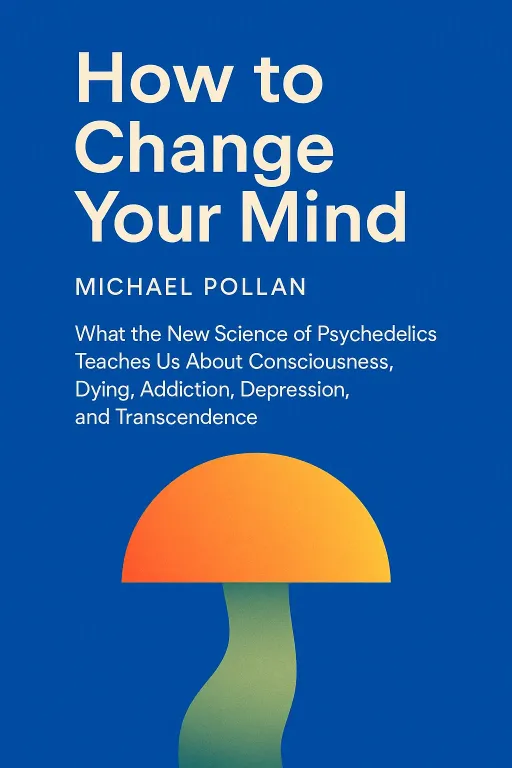
Nova: Picture this: It's 1957. You open Life magazine, the most popular magazine in America, and there it is—a headline that reads 'Seeking the Magic Mushroom' with a story about a Manhattan banker who traveled to a remote Mexican village and experienced 'mushrooms that cause strange visions.' That article was the West's first mainstream introduction to psilocybin, and it opened a door that was quickly slammed shut. But now, that door is creaking open again. And that's what we're here to talk about, using Michael Pollan's incredible book, 'How to Change Your Mind.'
Jesse W: It's such a powerful starting point. That idea of a 'magic mushroom' captures the blend of wonder and fear that has surrounded these substances for so long.
Nova: It really does. And I'm so thrilled to have you here, Jesse. As someone who runs a spirituality space, working with books, plants, and meditation to help people find meaning, you are the perfect person to discuss this with. What does it mean to you when a mainstream journalist like Michael Pollan takes this topic on so seriously?
Jesse W: It feels like a validation, honestly. For so long, these experiences were pushed to the fringes, seen as either dangerous or unserious. Pollan's work brings it back to the center and says, 'No, there is something profoundly important here that deserves our attention.' He's using the language of science and journalism to explore what spiritual traditions have known for centuries: that our consciousness is far more vast than we realize.
Nova: Exactly. He’s building a bridge. And today we'll dive deep into this from two powerful perspectives. First, we'll explore how science is finally validating the 'mystical experience' in a clinical setting. Then, we'll witness how this 'trip treatment' is offering profound peace to those facing life's greatest challenge: their own mortality.
Deep Dive into Core Topic 1: The Scientific Validation of the Mystical
SECTION
Nova: So, let's start with that bridge. For decades, these substances were demonized, associated with the counter-culture and moral panic. But Pollan points to the year 2006 as the start of a true renaissance. And at the heart of it is a groundbreaking study from Johns Hopkins University led by a researcher named Roland Griffiths.
Jesse W: I've read about this. It’s fascinating.
Nova: It's absolutely mind-bending. So, the researchers brought in healthy volunteers—people who'd never used psychedelics before. This wasn't about treating a disorder; it was about exploring consciousness itself. They gave them a high dose of psilocybin, the active compound in magic mushrooms, had them lie on a couch with eyeshades on, and listen to a curated playlist of classical and spiritual music. They weren't looking for psychosis; they were looking for... something else.
Jesse W: The 'set and setting' that Pollan talks about so much. It wasn't a party. It was a carefully held, intentional space.
Nova: Precisely. It was designed for an inward journey. And the results were staggering, Jesse. Two-thirds of the participants rated the experience as one of the top five most spiritually significant moments of their entire lives. A third ranked it as single most significant. Think about that—more significant than the birth of a child or the death of a parent.
Jesse W: Wow. That's not a subtle finding. That's a life-altering event happening in a laboratory.
Nova: Exactly. And the study's title itself was a bombshell in the scientific community. It was called: 'Psilocybin Can Occasion Mystical-Type Experiences Having Substantial and Sustained Personal Meaning and Spiritual Significance.'
Jesse W: Just hearing that title gives me chills. 'Spiritual significance' as a clinical endpoint. That's the bridge, right? It's science developing a language for something mystics and meditators have talked about for millennia—that sense of unity, of timelessness, of profound, ineffable insight.
Nova: Yes! Pollan notes how this helped distinguish these substances from common 'drugs of abuse.' This wasn't about getting high; it was about getting... somewhere else. It was about noetic quality—the feeling that you are gaining access to objective truths about reality.
Jesse W: And it highlights that the substance is just a key. The experience itself is shaped by the intention and the environment. The couch, the music, the supportive guides... it's a modern, secular ritual. That's something we try to create in our meditation space—the right container for an internal journey. It seems the same principles apply, whether the journey is aided by a plant teacher or by breathwork.
Nova: That's such a beautiful way to put it. It's not the key, but the door it opens and the room you find yourself in. And that idea of a 'modern, secular ritual' is the perfect bridge to our next point. Because this research isn't just academic. It's being used to help people in the most profound way imaginable.
Deep Dive into Core Topic 2: Healing Through Ego Dissolution
SECTION
Nova: And that naturally leads us to the story of Patrick Mettes, which for me, was one of the most moving parts of the entire book.
Jesse W: I'm ready. These personal stories are where the data comes to life.
Nova: They really are. Patrick was a 53-year-old television news director. In 2010, he was diagnosed with a rare and aggressive bile duct cancer that had already spread to his lungs. He was facing a terminal diagnosis, and as Pollan writes, he was filled with anxiety, depression, and a deep, understandable fear of death.
Jesse W: The ultimate existential dread.
Nova: The ultimate. He enrolls in a psilocybin trial at NYU, hoping for some relief. During his session, guided by therapists, he describes this incredible journey. At first, it's turbulent. But then, he feels himself being 'birthed again,' and he's washed over by this wave of unconditional love. He even visualizes his cancer, these spots in his lungs, and in that state, he feels they're 'no big deal.'
Jesse W: He's seeing his physical reality from a completely different perspective.
Nova: A completely different plane of existence. At one point, he feels he's dying, letting go. But then he's flooded with this profound sense of connection—to his wife, to his family, to the entire universe. He comes out of it utterly transformed.
Jesse W: That's just... so powerful. What Pollan calls 'ego dissolution.' In so many spiritual traditions, from Buddhism to Sufism, the ego—our rigid sense of a separate self, with its history and its fears—is seen as the source of our suffering. To have that boundary temporarily dissolve, to feel part of a larger, loving whole... that's the goal of so many hours of meditation or prayer.
Nova: And the outcome is what's truly mind-blowing. Months later, even as he is physically declining and knows he is dying, Patrick tells his therapist, 'I am the luckiest man on earth.'
Jesse W: Wow. Just let that sink in. 'The luckiest man on earth.' While dying of cancer.
Nova: It's a complete reframing of his story. He didn't change the fact that he was dying, but he changed his relationship it. The psilocybin experience gave him a new vantage point, an 'overview effect' on his own life.
Jesse W: He went from being a victim of his cancer to being a conscious participant in his own life and death. That's the essence of spiritual growth, isn't it? Finding meaning and acceptance, even in the midst of profound suffering. He found a way to love his life, all of it, right up to the very end. It's not about escaping reality, but about becoming more fully present within it.
Nova: That's it exactly. He was able to live his final months with a sense of peace and joy that, by all rational accounts, should have been impossible. It’s a testament to the mind's power to transcend circumstance.
Synthesis & Takeaways
SECTION
Nova: So we have these two incredible poles we've discussed. On one end, the rigorous, data-driven science of Johns Hopkins, proving these mystical states are real, reproducible, and deeply meaningful.
Jesse W: And on the other, the deeply human, heart-wrenching story of Patrick Mettes, showing the life-changing, and life-ending, power of that very same experience.
Nova: And the mushroom, the plant, is the catalyst. It's the key that unlocks the door.
Jesse W: It's this beautiful intersection of nature, science, and spirit. It shows us that these profound states of being are part of our human birthright, and there are tools—some ancient, some now being rediscovered by science—that can help us access them.
Nova: Absolutely. And I think Pollan's ultimate message, and our takeaway for everyone listening, isn't that everyone should rush out and try psychedelics. The legal and personal risks are still very real.
Jesse W: Right. That's not the point at all. The point is about recognizing the value of these states of consciousness. The book shows us that our default, everyday mind—with its constant chatter, its worries, its rigid stories, its ego—is just one channel on the television of consciousness. There are other channels, other ways of being.
Nova: I love that metaphor. So what's the final thought you'd want to leave our listeners with, drawing from this?
Jesse W: I think the real question Pollan leaves us with, and the one I'd leave for our listeners, is this: What is one rigid story you tell yourself about your life, your work, or your fears? A story that feels solid and unchangeable. And what would it feel like to just... let it go, even for a moment? To see it from a new perspective, as Patrick saw his cancer, and ask what other possibilities might exist beyond that story.
Nova: A perfect, powerful thought to end on. You don't need a substance to begin that journey of inquiry. Jesse, thank you so much for bringing such a wonderful and heartfelt perspective to this.
Jesse W: It was my absolute pleasure. It’s a conversation that feels more important now than ever.