The Growth Lever: Mastering Acquisition and Retention for Early Success.
Golden Hook & Introduction
SECTION
Nova: Most people think if you build a great product, users will flock to it and stay forever. That's a myth. The reality is far more strategic, and frankly, a little manipulative, in the best possible way.
Atlas: Manipulative? That's a strong word, Nova. I imagine many of our listeners, who are busy building out their own visions, would certainly hope that a superior product sells itself. But I'm guessing you're here to tell us that hope isn't a strategy.
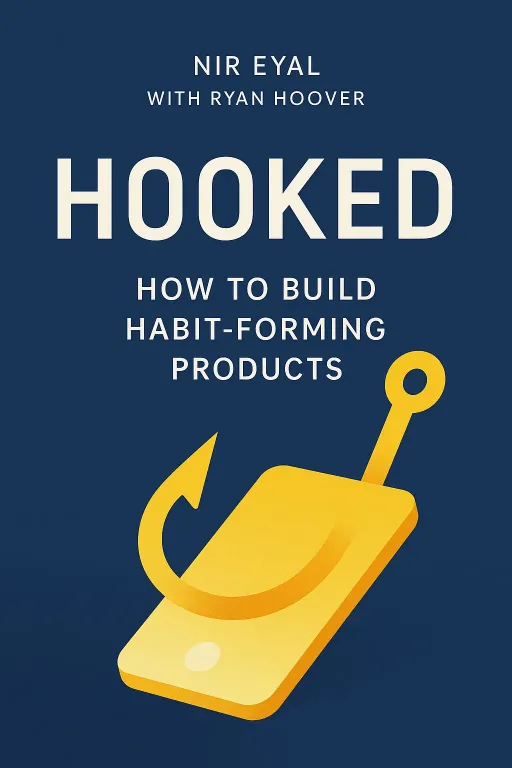
Nova: Exactly. And we're going to dive into two foundational texts today that dismantle that myth and give us the actual blueprint. First up, we have Nir Eyal's groundbreaking book,. Eyal actually started his career in the video game and advertising industries, which gave him a unique lens into how user behavior is engineered, long before 'habit-forming' became a Silicon Valley buzzword.
Atlas: That's fascinating because it flips the usual 'build it and they will come' narrative on its head. And then, complementing that, we have by Gabriel Weinberg and Justin Mares. Weinberg, of course, is the founder of DuckDuckGo, so he's not just theorizing; he's built a successful company by mastering these very principles.
Nova: Precisely. The core of our podcast today is really an exploration of the twin engines of sustainable business growth: how to not only magnetize users to your product but also to engineer their enduring loyalty.
The Psychology of Habit Formation: Deconstructing the Hook Model
SECTION
Nova: So let's start with Eyal's Hook Model. It's a simple, four-step process: Trigger, Action, Variable Reward, Investment. It's about creating an internal loop that keeps users coming back without conscious thought. Think about your smartphone. The 'trigger' could be a notification, an external cue. But often, it's an internal one – boredom, loneliness, uncertainty.
Atlas: Oh, I know that feeling. That little ping on my phone often isn't the real trigger; it's the momentary lull in my day, that tiny urge to fill a void. But how do companies specifically design for those internal triggers? They can't exactly install a chip in my brain to know I'm bored.
Nova: They don't need to. They design products that those internal discomforts. Take Instagram, for example. The internal trigger might be a fear of missing out, or the desire for social connection. The 'action' is opening the app and scrolling. The 'variable reward' is the unpredictable stream of likes, comments, and engaging content – sometimes it's great, sometimes it's mediocre, and that variability keeps us coming back. It bypasses our rational decision-making.
Atlas: That sounds a bit out there. Are you saying these companies are intentionally making us addicted? For an architect building a market, that sounds like a double-edged sword. You want engagement, but not at the cost of user well-being or ethical concerns.
Nova: That's a critical point, and Eyal himself addresses it. He argues the Hook Model is a tool, morally agnostic. It can be used for good, like Duolingo making language learning habitual, or for less ethical purposes. The 'investment' phase is key here – when users put something into the product, like time, data, effort, or social capital, they're more likely to value it and return. Think of building a Spotify playlist or curating your LinkedIn profile. That personal investment locks you in.
Atlas: So basically you're saying that the more we pour into a product, the harder it is to leave, almost like a sunk cost fallacy, but for our digital lives. I can see how that would build a loyal base, but for someone trying to validate a new market, how do you even begin to identify these triggers and rewards in a nascent product?
Nova: That's where deep user empathy comes in. It's not about guessing; it's about understanding the user's pain points, their unfulfilled desires, and then designing your product as the most elegant solution. It's about observing behavior, not just asking what people want. What problem are they trying to solve when they reach for your product, even implicitly?
Atlas: That makes me wonder, then, for a new product, should you even focus on the 'investment' and 'variable reward' until you've successfully identified the core trigger and action? Or is it all a simultaneous design process?
Nova: It's iterative, but the trigger and action are foundational. You can't reward or get investment from a user who isn't performing the desired action in the first place. You need to understand that initial spark, that problem you're solving. Once that's clear, you can start layering in the rewards and opportunities for investment. It’s like building a house; you need a solid foundation before you start decorating.
Atlas: That's a great analogy. It means that initial user research, that deep listening to what's being said, as our listener profile suggests, is even more critical than I might have initially thought. It's not just about features, it's about fundamental human needs.
Nova: Exactly. And the most successful products don't just solve a problem; they become the solution to an internal trigger, almost unconsciously. That's the power of the Hook Model.
Systematic Customer Acquisition: Navigating the 19 Traction Channels
SECTION
Nova: And that naturally leads us to the second key idea we need to talk about, which often acts as the front-end to habit formation: how do you get those initial users to even your hook? That's where Weinberg and Mares's comes in. They argue against the 'one true growth channel' mentality, instead presenting 19 distinct channels, from viral marketing to SEO to offline ads.
Atlas: Right, like the idea that if you just get enough PR, you'll be set. But I imagine a lot of our listeners, especially those building from the ground up, feel overwhelmed by the sheer number of options. How do you systematically test and identify the most effective channels without burning through your resources doing everything at once?
Nova: That's the beauty of their 'Bullseye Framework.' You start by brainstorming all 19 channels, then you narrow it down to the most promising three based on your product and target market. Then, you run cheap, quick tests on those three to see which one performs best. Once you find your 'bullseye channel,' you go all-in until it's exhausted, then repeat the process. It's about disciplined experimentation.
Atlas: Okay, so it's not about picking one; it's about testing, measuring, and iterating. That makes sense for someone who's strategic and values validation. Can you give an example of how a relatively obscure channel might become a bullseye?
Nova: Absolutely. Think about something like 'offline events.' For a SaaS product, that might seem counterintuitive. But a company targeting, say, architects, might find that sponsoring or hosting workshops at industry conferences, where they can directly demonstrate their software to their ideal users, is incredibly effective. It's not about mass appeal; it's about finding where your specific audience congregates and engaging them authentically. Or, for a niche product, 'community building' might be the bullseye, fostering a dedicated forum or user group.
Atlas: I can see how that would bypass some of the noise of mainstream advertising. It’s about being where your market already is, rather than trying to drag them to you. That feels much more aligned with building a market from the ground up than just hoping for virality. So the key is not just knowing the 19 channels, but having a rigorous process to identify the few that truly resonate with your specific audience and product.
Nova: Precisely. And what's interesting is how these two books, 'Hooked' and 'Traction,' really complement each other. 'Traction' gets people, and 'Hooked' keeps them in your product. You can acquire a million users, but if they don't form a habit, they'll churn. And you can have the most habit-forming product in the world, but if no one knows it exists, it won't matter.
Atlas: That's a perfect example of why you can't just focus on one side of the coin. It's like having an amazing storefront but no products inside, or vice-versa. You need both the magnet and the sticky floor.
Nova: Exactly. It's the synergy that creates true growth. You need to understand the psychological hooks to retain, and the strategic channels to acquire. Neglecting either is a recipe for struggle.
Atlas: So for any new venture, the question isn't just "what problem am I solving?" but "how will I get people to know about it, and how will I make sure they stick around once they do?" It's a holistic view of building a market, not just a product.
Nova: Absolutely. It's about building a system, not just a single component. And that system relies heavily on both human psychology and disciplined execution.
Synthesis & Takeaways
SECTION
Nova: So, what we're really talking about today is a powerful combination: the psychological insights behind why people engage, paired with the practical strategies to reach them. It's the difference between a fleeting trend and a sustainable enterprise.
Atlas: That's actually really inspiring. Because for anyone trying to build something impactful, it's not enough to just have a great idea. You need to understand the human element – what drives behavior – and then have a systematic approach to connect that solution with the people who need it most. It's about designing for human nature and then strategically validating how to reach those humans.
Nova: Exactly. And for our listeners today, The Architect, The Validator, The Negotiator, your 'tiny step' for this week is to identify one internal or external trigger for your product – or even a product you admire – and brainstorm three ways you could optimize that trigger to lead to a desired action. It's about starting to see the invisible threads that connect users to products.
Atlas: That's a brilliant way to put it. Because ultimately, it's about creating value, and value is only realized when it's used consistently. It’s about building those fundamental connections, not just making noise.
Nova: Indeed. And when you master both acquisition and retention, you're not just building a product; you're building a loyal community and a sustainable market. That's the ultimate impact.
Atlas: Couldn't agree more. This is Aibrary. Congratulations on your growth!