The Feedback Loop Fallacy: How to Design for True User Engagement.
Golden Hook & Introduction
SECTION
Nova: What if the reason you can't put down your phone, or keep coming back to that one app, isn't about your willpower, but about someone else's brilliant design?
Atlas: Whoa. Hold on. Are you telling me my late-night scrolling isn't a personal failing, but a carefully engineered outcome? That's… deeply unsettling, and yet, I'm intrigued.
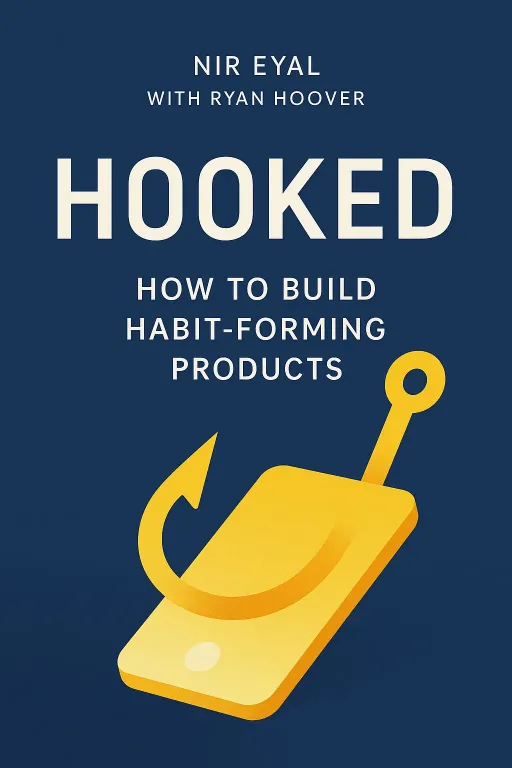
Nova: Absolutely. Today, we're dissecting the very fabric of our digital lives, drawing profound insights from two titans of behavioral design: Nir Eyal's groundbreaking "Hooked: How to Build Habit-Forming Products" and B. J. Fogg's incredibly practical "Tiny Habits: The Small Changes That Change Everything." Eyal's work emerged from his deep dive into the Silicon Valley giants, revealing the precise psychological levers they pull, while Fogg, a Stanford research psychologist, literally pioneered the field of 'captology' – the study of computers as persuasive technology.
Atlas: So, we have the macro-level, almost industrial-scale habit formation from Eyal, and then the micro, personal-scale habit formation from Fogg. I'm curious how these seemingly different approaches converge, especially for our listeners who are trying to design products and experiences that truly resonate and stick.
Nova: That's precisely the journey we're embarking on. Let's start with Eyal's "Hook Model," because it really lays bare the often invisible architecture of our digital world.
Unpacking the 'Hook Model': The Psychology of Product Habit Formation
SECTION
Nova: Eyal posits that successful products don't just sell features; they sell solutions to internal discomforts, and they do it by creating habits. He outlines a four-stage cycle: Trigger, Action, Variable Reward, and Investment. It's a loop that, once established, keeps users coming back without conscious thought.
Atlas: So you're saying every single app I'm addicted to has this secret sauce? Give me an example, Nova, make it real. How does this 'hook' actually work in the wild?
Nova: Let's consider a popular social media platform, one we all probably use daily. The first stage is the. This can be external, like a notification ping, a friend tagging you, or an email. But the more powerful triggers are internal – feelings like boredom, loneliness, uncertainty, or the need for validation. You feel a pang of boredom, and subconsciously, your mind reaches for the app that has reliably solved that discomfort in the past.
Atlas: Oh, I know that feeling. That little mental itch, and then, I'm opening the app before I even realize it. That's the trigger.
Nova: Exactly. That internal discomfort primes you for the. This is the simplest behavior done in anticipation of a reward. On a social media app, it's scrolling through your feed, liking a post, or tapping on a story. It has to be easy, almost mindless, requiring minimal cognitive effort. The less thought, the quicker the loop.
Atlas: Right, like that satisfying slide of the thumb. It's so effortless, it barely registers as a decision.
Nova: Which brings us to the. This is the unpredictable element that keeps us coming back. It's not a guaranteed reward every time; it's the of a reward. On social media, it's the unexpected funny meme, the insightful comment, the flattering like, or the surprising news update. That variability is what makes it so compelling, tapping into our primal hunting instincts. Our brains are hardwired for novelty and surprise.
Atlas: Ah, the slot machine effect! You never know what you're going to get, so you keep pulling the lever. That's actually really interesting, because for our listeners building products, it means designing for a certain level of delightful unpredictability.
Nova: Precisely. And the final stage, often overlooked, is. This is when users put something into the product that increases the likelihood of them coming back. It could be time, data, effort, or social capital. On our social media app, it's uploading a photo, writing a post, inviting friends, customizing your profile, or even just curating your feed. These investments load the next trigger, making the product more valuable and sticky.
Atlas: That sounds a bit manipulative, Nova. For someone trying to build a product that genuinely helps users, like many of our listeners, where's the line between habit-forming and just… trapping people? It feels like we're talking about exploiting psychological vulnerabilities.
Nova: That's a crucial point. The Hook Model is a tool, neutral in itself. A hammer can build a house or be used destructively. Eyal himself emphasizes that ethical design is paramount. The goal isn't to trick users, but to help them form habits around products that. Think of Duolingo, for instance. It uses triggers, actions, variable rewards, and investment to help people develop a valuable skill. The difference lies in the designer's intent and whether the habit provides genuine value to the user long-term. It's about aligning intrinsic motivation with product design.
The Power of 'Tiny Habits': Making Desired Behaviors Stick
SECTION
Nova: Speaking of building positive habits, that actually leads us perfectly to our second big idea, one that offers a slightly different, perhaps more gentle, path to engagement: B. J. Fogg's "Tiny Habits."
Atlas: Tiny habits? As in, 'don't try to boil the ocean, just heat a cup of water' kind of tiny? For our listeners who are often trying to implement massive strategic shifts, 'tiny' sounds almost… too small.
Nova: That's the brilliance of it! Fogg's core premise is that behavior happens when Motivation, Ability, and a Prompt converge. If you want a behavior to happen reliably, you either need high motivation, or you make the action incredibly easy. His method champions the latter. The idea is to make the desired behavior so small, so effortless, that you can't possibly fail at it.
Atlas: Okay, so, what's a 'tiny habit' in action? Give me a real-world example that our listeners, the strategists and architects, can actually visualize.
Nova: Let's imagine a company trying to get its employees to regularly use a new, powerful CRM system. Instead of "learn the whole CRM dashboard for an hour every day," a tiny habit might be: "After I open my email in the morning, I will click on the CRM icon." That's it. Just click the icon. Or for a new user onboarding to a complex SaaS product, it could be "After I log in, I will click on the 'create new project' button." The key is to make it ridiculously small, then immediately celebrate that tiny win.
Atlas: That makes sense. It lowers the barrier to entry significantly. I can see how that would be powerful for onboarding new users or getting teams to adopt new processes, especially when the motivation might not be super high initially. But how does this 'tiny' approach square with Eyal's 'Hook' which seems to demand more from the user, with all those triggers and investments?
Nova: That's where they beautifully complement each other. Think of Tiny Habits as the on-ramp, and the Hook Model as the highway. Tiny Habits are exceptional for a new behavior. They build initial momentum and competence, reducing the ability barrier. Once that tiny habit is established, and the user experiences a small win, that can serve as the initial prompt, or even a mini-trigger, to engage with a product that then uses the Hook Model to sustain that engagement.
Atlas: So, for example, a product could use a tiny habit to get a new user to simply open the app daily, and then once inside, the app's design takes over with its variable rewards and investment opportunities to keep them engaged. It's about getting them over that initial hump.
Nova: Exactly! It's about reducing the friction for the action in the Hook Model to almost zero, especially for new or hesitant users. Tiny Habits help you get started, and the Hook Model helps you stay started.
Synthesis & Takeaways
SECTION
Nova: So, what we're really seeing here is that true user engagement isn't a happy accident. It's the result of deeply understanding human psychology and intentionally designing experiences that either subtly guide us into beneficial loops, or gently nudge us with achievable, tiny steps. It's about designing for human nature, not fighting against it.
Atlas: For our listeners, the architects and catalysts building products and teams, this means understanding both the macro-level psychological levers that create those powerful feedback loops, and the micro-level ease of adoption that gets people over the initial hurdle. It's about building something lasting by building habits, not just features.
Nova: It’s about creating value that users genuinely want to integrate into their lives, and then making it effortless and rewarding to do so. It shifts the focus from simply attracting users to them, by making your product an indispensable part of their routine.
Atlas: Absolutely. So, what tiny habit could you design for yourself, or for your product, this week, that could start a massive chain reaction of engagement? Think about that one small, easy action.
Nova: That's a powerful question to leave our listeners with.
Atlas: It is. This is Aibrary. Congratulations on your growth!