Stop Guessing, Start Knowing: The Science of Consumer Motivation
Golden Hook & Introduction
SECTION
Nova: What if every 'rational' decision you've ever made was actually just a clever disguise for something far more primal? We're talking about the silent forces shaping your choices, your customers' choices, and the entire market, right under our logical noses.
Atlas: Whoa, Nova. Are you saying my morning coffee choice wasn't a carefully weighed decision about caffeine and productivity, but some ancient lizard brain impulse? Because that feels like a personal attack.
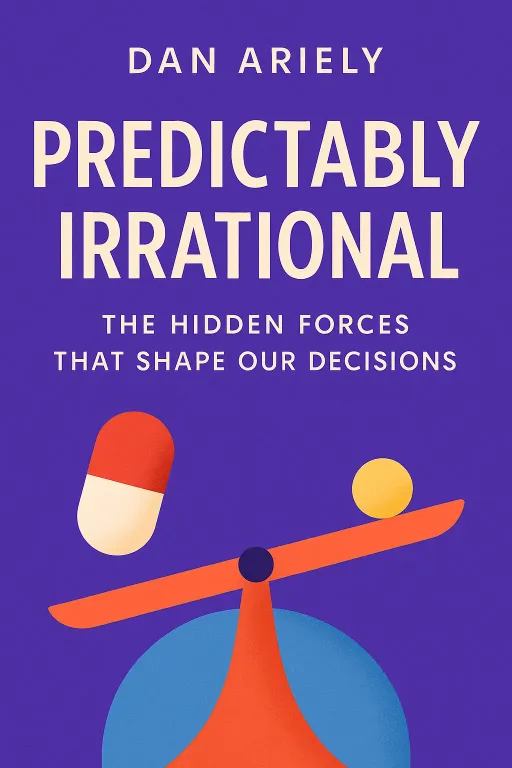
Nova: Exactly! It’s not about attacking, Atlas, it’s about illuminating. Today, we're pulling back that curtain with insights from two pivotal works: Dan Ariely's 'Predictably Irrational' and Nir Eyal's 'Hooked.' What's fascinating about Ariely is his unique journey into behavioral economics; his own experience with a severe burn injury profoundly shaped his research into how pain and decision-making intertwine, revealing just how deeply our physical and emotional states influence our choices.
Atlas: That's a powerful origin story. It makes you realize these aren't just abstract theories, but insights born from deep human experience. For our listeners who are constantly innovating and driving marketing campaigns, understanding that underlying human element, beyond just the spreadsheets, feels like the real secret weapon.
Nova: It absolutely is. Because the moment you stop guessing and start knowing how those unconscious drivers operate, your entire strategy shifts.
The Illusion of Rationality: Understanding Predictably Irrational Decisions
SECTION
Nova: So, let's dive into that first big idea from Ariely: we are predictably irrational. Our decisions are often illogical, yes, but crucially, they're not random. They follow consistent, observable patterns. This is a game-changer for anyone in marketing or product development.
Atlas: I guess that makes sense. We all like to think we're these perfectly logical beings, weighing pros and cons like a supercomputer. But then I remember how I impulse-bought a novelty ice cream maker last week. It’s still in the box.
Nova: And you're not alone! Ariely's work is filled with brilliant examples. Take the 'decoy effect.' Imagine you're subscribing to an economic magazine. Option A: Online-only for $59. Option B: Print-only for $125. Option C: Print and Online for $125. Most people choose C.
Atlas: Okay, I see that. Option B, print-only at the same price as print-and-online, seems completely redundant. It makes option C look like a steal.
Nova: Precisely! But here's the kicker: if you remove option B, the 'decoy,' suddenly most people pick option A, the online-only. The decoy wasn't there to be chosen; it was there to make another option look overwhelmingly better. It subtly manipulated your perception of value.
Atlas: Whoa. So you're saying our brains are actually wired to be influenced by these seemingly irrelevant choices? That's kind of unsettling. For our listeners who are designing product tiers or pricing strategies, this is huge. It means it's not just about the value of your product, but how you frame the options around it.
Nova: Exactly. It’s about understanding relative value, not absolute value. Our brains love comparisons, and we're often too lazy to do the complex math, so we take mental shortcuts. Another classic is the power of 'free.' Ariely found that people would choose a free chocolate over a cheap, high-quality one, even if the cheap one was objectively better value. The word 'free' triggers an emotional response that bypasses rational calculation.
Atlas: That's a great way to put it. It’s like the classic 'buy one, get one free' deal. You’re not thinking about whether you actually two of something; the 'free' just screams too good to pass up. So, it's moving beyond just 'what's the best price' to 'how does this price make people in comparison to other options?'
Nova: You've got it. It's understanding that System 1 thinking – the fast, intuitive, emotional brain – is often making the call, and System 2 – the slow, logical, analytical brain – comes in later to rationalize it.
Engineering Engagement: The Hooked Model and Habit Formation
SECTION
Nova: And this brings us beautifully to our second core idea, which often acts as a counterpoint to what we just discussed, but also builds on it: how do we ethically use these insights to build truly engaging products and services? This is where Nir Eyal's 'Hooked' model comes in. It's a four-step framework for building products people can't put down.
Atlas: I'm curious about the 'ethically' part. Because when you talk about building products people 'can't put down,' it makes me think of some less-than-ethical practices out there. For innovators trying to build something genuinely valuable, where's the line between ethical engagement and addiction?
Nova: That's a critical question, Atlas, and Eyal addresses it head-on. The Hooked model isn't about tricking people; it's about understanding how habits are formed and using that knowledge to create products that solve real problems and improve users' lives. If your product doesn't genuinely serve a need, the 'hook' won't stick. The four steps are: Trigger, Action, Variable Reward, and Investment.
Atlas: Okay, so break those down for us. Give us an example that makes it clear.
Nova: Absolutely. Let's take social media, for instance, because it's a very common habit-forming product. The can be external – a notification on your phone, or internal – feeling bored or anxious. You see the notification or feel that urge.
Atlas: So the trigger is the cue that tells you what to do next. Got it.
Nova: Then comes the. This is the simplest behavior done in anticipation of a reward. On social media, it's scrolling through your feed. It requires minimal effort.
Atlas: Right, like that instant gratification. What's next?
Nova: The. This is the crucial part that keeps you coming back. When you scroll, you don't know what you'll find. It could be an interesting post, a funny meme, an update from a friend, or nothing at all. That unpredictability, that variability, makes it incredibly compelling. Our brains are wired to seek out those variable rewards. It’s the same mechanism that makes slot machines so addictive.
Atlas: Wow, that's kind of heartbreaking, but it makes so much sense. That gives me chills. So it's the uncertainty that keeps us engaged, that constant anticipation. And then the final step?
Nova: The. This is when the user puts something into the product, which then makes them more likely to use it again. On social media, this could be posting your own content, commenting, building your profile, inviting friends. These investments load the next trigger, making the cycle even stronger. You’ve put in effort, so you have more to lose by leaving, and more to gain by continuing.
Atlas: So basically you're saying that by understanding these four steps, businesses can design experiences that naturally integrate into our lives and become habits. That’s actually really inspiring, because if applied ethically, it means building products that genuinely resonate and are sticky for the right reasons. It's about designing for deep engagement, not just fleeting attention.
Nova: Precisely. It's about creating value, solving problems, and then making the path to that solution as seamless and rewarding as possible. It moves beyond mere clicks to genuine engagement and loyalty.
Synthesis & Takeaways
SECTION
Nova: So, what we've really explored today is the power of understanding the human operating system, not just its surface-level logic. First, recognizing that our decisions are predictably irrational, and then, how we can ethically design for engagement by understanding the habit-forming process.
Atlas: It’s about building trust and value, not just chasing clicks. For our listeners who seek depth and aim to make a significant mark, this isn't just about optimizing conversion rates. It’s about truly understanding the psychology of your audience, so you can connect with them on a deeper, more resonant level.
Nova: Absolutely. Stop guessing what people do, and start knowing what they do. The secret weapon isn’t more data, it’s deeper empathy and psychological insight.
Atlas: That gives me chills. How might reframing your current marketing campaigns to speak to System 1 thinking rather than just System 2 logic transform your approach this week? We’d love to hear your thoughts on this.
Nova: Share your insights with us. We're always looking to extend the conversation.
Atlas: This is Aibrary.
Nova: Congratulations on your growth!