Architecting Strategic Tech Leadership
Golden Hook & Introduction
SECTION
Nova: A brilliant tech stack is completely worthless if it fails to build a competitive moat. In fact, obsessing over flawless code might actually be holding your career back from achieving true strategic impact.
Atlas: Oh, that is going to sting a lot of developers who pride themselves on clean architecture.
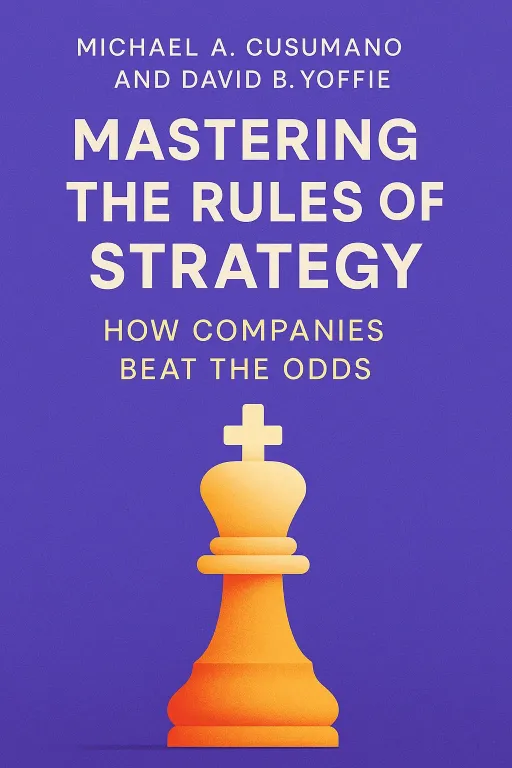
Nova: It is a tough pill to swallow, but it is the reality of the modern tech landscape. Today we are diving into the minds of the people who shaped the industry. We are looking at Michael Cusumano and David Yoffie's widely acclaimed work, The Making of a Master Strategist, alongside Elad Gil's definitive guide, High Growth Handbook. Both books reveal that the most successful tech leaders are those who can bridge the gap between deep technical execution and high-level business strategy.
Atlas: I can see how that would resonate with anyone who is trying to step up their game. A lot of highly skilled engineers and technical managers reach a point where they realize that just being good at the technical stuff isn't enough to get them a seat at the table. They want to make a real impact, but they get stuck in the weeds.
Nova: Exactly. Cusumano and Yoffie spent decades studying leaders like Bill Gates and Andy Grove. They found that these master strategists succeeded because they possessed a dual-engine. They balanced a massive, long-term vision with a ruthless, almost obsessive focus on tactical execution.
Atlas: That sounds great in theory, but how does someone actually balance those two things without losing their mind? It feels like you are constantly being pulled in two opposite directions.
The Dual-Engine of Tech Leadership
SECTION
Nova: The key factor is understanding that vision and execution are not separate tasks. They are two sides of the same coin. Let's look at Bill Gates in the mid-1990s. Microsoft was dominating the desktop, but Gates realized they were completely missing the rise of the internet. Netscape was rapidly gaining ground, and the entire landscape was shifting under Microsoft's feet.
Atlas: Right, I remember hearing about this. That was a massive threat to their operating system monopoly.
Nova: Absolutely. Instead of just talking about it or holding endless meetings, Gates wrote a legendary internal memo titled The Internet Tidal Wave. He didn't just lay out a vague vision of the future. He assigned specific, ruthless tactical actions to every single division. Windows had to build a browser directly into the operating system. Office had to save files as HTML. He mobilized the entire company with extreme tactical urgency to meet a long-term strategic threat.
Atlas: Wow, that is a massive pivot. He basically redirected a giant ship on a dime. But how do you keep your team from burning out when you make a shift like that?
Nova: That is where Andy Grove's approach at Intel becomes so valuable. Grove's entire philosophy was built around what he called strategic inflection points. When Intel was losing the memory chip market to Japanese competitors in the mid-1980s, Grove had to make a brutal decision. He chose to abandon the very product that Intel was founded on—memory chips—and bet the entire company on microprocessors.
Atlas: That sounds incredibly risky. It is like jumping out of a plane and trying to sew a parachute on the way down.
Nova: It was a massive gamble. There is a famous story where Grove asked Intel's co-founder, Gordon Moore, what would happen if they were kicked out and the board brought in a new CEO. Moore said the new CEO would immediately get them out of memories. Grove looked at him and said, why shouldn't we walk out the door, come back in, and do it ourselves?
Atlas: That is such a powerful way to reframe the problem. It strips away all the emotional baggage of the past.
Nova: Yes, and Grove combined that terrifying vision with strict operational discipline. He implemented Objectives and Key Results, or OKRs, to ensure every single employee was aligned with this new direction. The breakthrough moment comes when you realize that vision without execution is just hallucination, and execution without vision is just aimless busywork.
Atlas: I imagine a lot of listeners are nodding along to this, but also wondering how it applies to them if they aren't running a multi-billion dollar company. How does a team lead or an engineering manager apply this dual-engine?
Nova: Look at it this way. Every time you write a line of code or design a system, you are making a strategic decision. If you don't understand the long-term business goals of your company, you are building in the dark. You might write the most beautiful, elegant code in the world, but if it doesn't help the company win its market, you have failed as a strategic leader.
Scaling through Modular Design
SECTION
Atlas: Okay, so we need to connect the tech to the business strategy. That makes perfect sense for giant historical figures, but what about modern hyper-growth? How do today's startups manage this transition when everything is moving at warp speed?
Nova: That is where Elad Gil's High Growth Handbook comes in. Gil has advised some of the biggest names in tech, and he talks about how scaling a company is a completely different skill set from building a product. He argues that you have to design your organization in a modular way, almost like writing software.
Atlas: It's kind of like transitioning from a monolith architecture to microservices, right?
Nova: That is a perfect analogy. In the early days of a startup, everyone does everything. It is a monolith. But as you scale, you have to break the organization into modular units with clear communication channels and defined responsibilities. If you don't, the system collapses under its own weight.
Atlas: I've seen that happen. You get these massive bottlenecks because the founders or the early engineering leads want to be involved in every single decision. They want to review every line of code, approve every design.
Nova: Yes, the desire for control is a massive bottleneck. Gil emphasizes that a true strategic leader has to shift their focus from product architecture to organizational architecture. You are no longer writing the code; you are designing the system that writes the code.
Atlas: So basically you're saying the leader's primary product becomes the company itself?
Nova: Precisely. You are designing the roles, the hiring processes, the financing strategies, and the communication loops. And just like technical debt, organizations accumulate what Gil calls organizational debt. This happens when you make quick, messy fixes to your team structure to solve an immediate problem, but those fixes slow you down later.
Atlas: That is a fascinating concept. Can you give an example of organizational debt?
Nova: A classic example is promoting someone to a management role just because they were an early employee, even if they don't have the leadership skills. Or creating a weird, overlapping reporting structure to avoid hurting someone's feelings. It works in the short term, but as the company grows, those decisions create massive friction and political infighting.
Atlas: That sounds like a nightmare. It is like trying to run a high-performance engine with sand in the gears.
Nova: It is. And as a technical leader transitioning into strategy, you have to be able to identify and clean up that organizational debt just as aggressively as you would clean up legacy code. You have to be willing to redesign the team, redefine roles, and sometimes make the hard decision to bring in outside talent who have experience operating at a larger scale.
Mapping the Strategic Moat
SECTION
Atlas: Let's talk about the practical side of this. If someone is listening to this and wanting to transition from a technical executor to a strategic leader, where do they start tomorrow morning?
Nova: The first step is mapping your current project's strategic moat. A strategic moat is the unique value that your tech stack provides that competitors cannot easily replicate.
Atlas: Wait, when people talk about moats, they usually mean things like brand recognition or massive capital. How does a tech stack provide a moat?
Nova: Proprietary code is rarely a moat anymore. Anyone can copy a feature or rebuild a database. What actually matters is how the technology creates systemic advantages. Think about proprietary data loops. Does your system collect unique data that makes your product smarter over time, creating a feedback loop that competitors can't match?
Atlas: Oh, I see. It is like search engines or recommendation algorithms. The more people use them, the better they get, which makes it harder for a newcomer to catch up.
Nova: Exactly. That is a data moat. Another one is high switching costs. If your technology is deeply integrated into the customer's daily workflow, it becomes incredibly painful for them to switch to a competitor, even if that competitor is slightly cheaper or has a shiny new feature.
Atlas: That is a great point. It is why enterprise software is so hard to displace. Once a company's data and processes are locked into a system, the cost of moving is just too high.
Nova: Yes, and as a tech leader, you should be actively looking for ways to build these moats into your architectural decisions. For example, are you building your product as a platform with APIs that encourage other developers to build on top of it? If you do that, you are creating a network effect. The value of your product increases with every new developer who joins the ecosystem.
Atlas: That makes perfect sense, but how does an individual engineer start thinking this way? If they are assigned a ticket to build a specific feature, how do they connect that to a strategic moat?
Nova: The next layer is to start asking why. Don't just ask how to build the feature. Ask how this feature helps the company win. Does it reduce customer churn? Does it open up a new market? Does it collect data that we can use to improve our core algorithms? Dedicate thirty minutes daily to focused learning about your company's business model and your competitors.
Atlas: That sounds like a great habit. It helps you lift your head up from the keyboard and see the bigger picture.
Nova: It really does. When you start having those conversations with product managers and business leaders, they stop seeing you as just a coder who translates requirements into software. They start seeing you as a strategic partner who can help them design the future of the company.
Synthesis & Takeaways
SECTION
Atlas: This has been an incredibly eye-opening discussion. It feels like the transition to strategic leadership isn't about leaving your technical skills behind. It is about applying those same analytical, systems-thinking skills to the business and the organization.
Nova: That is the ultimate insight. The same mind that can design a complex, distributed software system can design a high-performing organization. You just have to change your inputs and your goals.
Atlas: We've covered some incredible ground today. We looked at how Bill Gates and Andy Grove balanced long-term vision with ruthless tactical execution. We explored Elad Gil's insights on modular organizational design and managing organizational debt. And finally, we discussed how to map and build strategic moats into your technology.
Nova: To wrap up, let's leave our listeners with one concrete action. Tomorrow, take thirty minutes to look at your current project. Don't look at the code. Look at the business. Try to identify the strategic moat. If you can't find one, start thinking about how you can help build it.
Atlas: That is a great challenge. This is Aibrary. Congratulations on your growth!