Debugging the Mind: A Founder's Guide to Unconscious Bias
Golden Hook & Introduction
SECTION
Prof. Eleanor Hart: Batuhancan, welcome. I want to start with a question for you. As a software engineer and a founder, you spend your life building logical, predictable systems. But what happens when the most critical component in any system—the human being—is running on buggy, unconscious code?
Batuhancan: That's a great question, Eleanor. It's the fundamental challenge of everything we do. You can write the most elegant, perfect code in the world, but the moment a human interacts with it, you introduce a level of unpredictability that is both fascinating and, honestly, a little terrifying. We're constantly trying to anticipate user behavior, but we often find they do things we never expected, for reasons that aren't immediately logical.
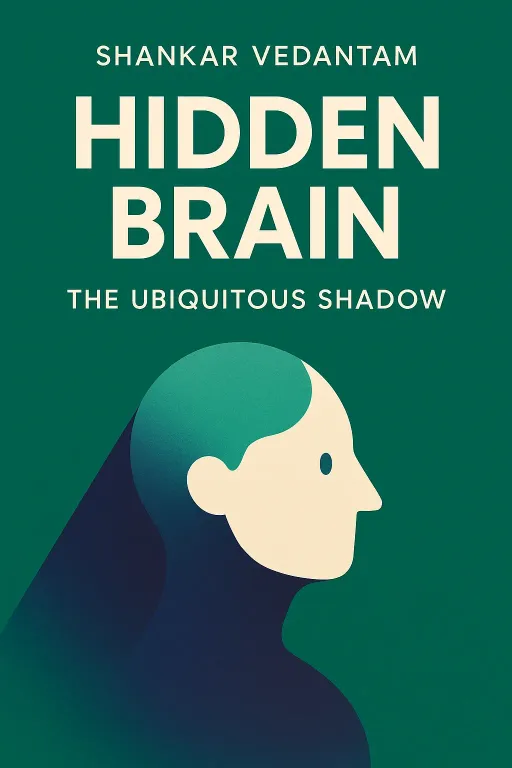
Prof. Eleanor Hart: Exactly. And that's the core idea behind the book we're diving into today, Shankar Vedantam's "Hidden Brain." He uses this wonderful metaphor of a "hidden brain" to describe the unconscious drivers, the mental shortcuts, and the deep-seated biases that operate without our permission. It’s like a hidden operating system that's constantly running in the background, influencing our decisions.
Batuhancan: A buggy operating system, it sounds like. Full of legacy code from a much earlier version of humanity.
Prof. Eleanor Hart: That’s the perfect way to put it. So today, I thought we could do a kind of debugging session on the human mind. Today we'll dive deep into this from two perspectives. First, we'll explore the 'Myth of Intention'—how our brains can lead us to catastrophic errors even when we're trying our best. Then, we'll discuss 'Heuristics as Faulty Algorithms,' uncovering the hidden code that subtly manipulates our daily choices in everything from the stock market to the office coffee pot.
Deep Dive into Core Topic 1: The Myth of Intention
SECTION
Prof. Eleanor Hart: So let's start with that first, terrifying idea: the 'Myth of Intention.' This is the gap between what we consciously want to do and what our hidden brain actually does. And there's no story in the book that illustrates this more powerfully, or tragically, than the case of Toni Gustus.
Batuhancan: I'm ready. It sounds intense.
Prof. Eleanor Hart: It is. In 1986, a 29-year-old woman named Toni Gustus was brutally raped in her own apartment. During the assault, she made a conscious, powerful vow to herself. She stared at her attacker's face and thought, "I am not going to forget this face." She was determined to bring this man to justice.
Batuhancan: So her intention was crystal clear: memorize, identify, and ensure the right person is caught.
Prof. Eleanor Hart: Precisely. She gave the police a detailed description, they created a composite sketch, and eventually, they presented her with a photo array. In it was a man named Eric Sarsfield. She picked him out. Later, in court, she pointed at him and identified him as her rapist. She was certain. But the book describes a fascinating, and chilling, moment that happened before the trial. Toni was sitting in church, wrestling with a tiny sliver of doubt. But in the peace and safety of the church, a feeling of comfort washed over her, and a thought solidified in her mind: "It is him." That feeling of comfort erased the doubt.
Batuhancan: Wow. So an external emotional state—the safety of the church—helped to overwrite a logical uncertainty. That's a critical bug.
Prof. Eleanor Hart: It's a huge bug. Based almost entirely on her confident testimony, Eric Sarsfield was convicted and sent to prison. He spent thirteen years behind bars, always maintaining his innocence. Then, in the year 2000, the Innocence Project got involved. They ran a DNA test on the evidence from the crime scene.
Batuhancan: And it wasn't him.
Prof. Eleanor Hart: It wasn't him. The DNA proved Eric Sarsfield was innocent. Toni Gustus, a woman with the purest of intentions, who believed with all her heart she was doing the right thing, had identified the wrong man. Her memory, under the trauma of the event and the subtle influence of her own mind, had failed her completely.
Batuhancan: That is absolutely devastating. From a systems perspective, it's a classic case of 'garbage in, garbage out.' The justice system, which is supposed to be a logical process, received faulty data from a sincere but compromised source—the human memory under extreme stress. The system then processed that data and produced a catastrophic output: a wrongful conviction.
Prof. Eleanor Hart: And Vedantam's point is that this isn't about Toni being a bad person. He defines unconscious bias as any situation where "people’s actions were at odds with their intentions." Her intention was justice; her action created a profound injustice.
Batuhancan: You know, the most chilling part for me is that her confidence actually over time, especially in that church. It's like the system wasn't just processing bad data; it was reinforcing its own error. In tech, we see this in feedback loops. A team might develop a small bias for a certain technology or a certain type of hire. That bias leads to a few decisions, which are then seen as successful, which in turn reinforces the original bias. Over time, that small, irrational preference becomes an accepted 'truth' that no one questions. Toni's brain created a feedback loop that solidified a false memory.
Prof. Eleanor Hart: That's a brilliant connection. The hidden brain doesn't just make a mistake; it often doubles down on it, seeking evidence to confirm its initial, flawed judgment. It prioritizes feeling certain over being correct.
Batuhancan: Which is a terrible way to run a company, or a justice system. It highlights the absolute necessity for external validation. The DNA test was the system's 'unit test'—an objective check that doesn't care about feelings or confidence. It just checks the facts. It makes me think about hiring. An interviewer can walk out of a meeting feeling absolutely certain about a candidate, but that feeling could be based on unconscious biases—they look like someone you know, they went to the same school. You need a structured process, multiple interviewers, and objective skill tests to protect the system from one person's buggy 'hidden brain.'
Prof. Eleanor Hart: Exactly. You have to build a system that accounts for human fallibility. Because as the Toni Gustus case shows, good intentions are never enough.
Deep Dive into Core Topic 2: Heuristics as Faulty Algorithms
SECTION
Prof. Eleanor Hart: So if the Gustus case is a catastrophic system crash caused by a major bug, what about the thousands of smaller, subtle bugs that run in the background of our minds every single day? This brings us to our second idea: 'Heuristics as Faulty Algorithms.' Heuristics are just mental shortcuts our brain uses to make quick decisions. But they can be triggered, and manipulated, by the most trivial things.
Batuhancan: I'm with you. These are the little functions that run automatically, the ones we didn't write but are part of the core OS.
Prof. Eleanor Hart: Perfectly put. Let me give you two quick, fascinating examples from the book. First, the stock market. Psychologists Adam Alter and Daniel Oppenheimer studied the performance of companies right after their IPO. They found that companies with simple, easy-to-pronounce names—like 'Jillman' or 'Clearman'—consistently outperformed companies with complex, hard-to-pronounce names, like 'Aegeadux' or 'Xagibdan.'
Batuhancan: You're kidding. Just based on the name?
Prof. Eleanor Hart: Just the name. On the first day of trading, the fluent names beat the disfluent ones by over 11 percent. The hidden brain's algorithm is simple: cognitive ease, or fluency, feels familiar and safe. Cognitive strain feels foreign and risky. So, investors unconsciously felt that a company named 'Xagibdan' was a riskier bet, even if its fundamentals were solid.
Batuhancan: That is incredible. It's literally the foundation of user experience design and A/B testing. We are constantly tweaking these supposedly 'irrelevant' variables—the color of a button, the font size, the wording of a headline—because we know they trigger unconscious heuristics in users that dramatically affect their behavior and our conversion rates. We're essentially exploiting these built-in mental algorithms.
Prof. Eleanor Hart: You are. And here's an even more direct example of that. Researchers in an office in England set up a beverage station with an honor box for payment. For ten weeks, they tracked how much money was collected. But each week, they put a different picture above the price list. On even-numbered weeks, it was a picture of flowers. On odd-numbered weeks, it was a picture of a pair of human eyes, just watching.
Batuhancan: Let me guess. The money collected went way up during the 'eyes' weeks.
Prof. Eleanor Hart: Way up. Nearly three times as much money was collected when the eyes were 'watching.' And here's the kicker: when the office workers were surveyed later, none of them could recall the pictures changing at all. They were powerfully influenced by a cue they never consciously registered.
Batuhancan: That's amazing. The 'watching eyes' is a design intervention. It triggers a deep, primal algorithm that says 'I am being observed, I must adhere to social norms.' It also makes me think about building a company culture. The official mission statement on the wall is the 'picture of flowers.' It's nice, but mostly ignored. The real culture is shaped by the 'watching eyes'—the unwritten rules, the behaviors that get rewarded, the subtle cues in the environment that signal what's truly valued and what's risky. That's the code that's actually running the organization.
Prof. Eleanor Hart: That's so true. The book quotes the author saying, "Applying heuristics... to situations for which they have not been designed is a recipe for trouble." Our brain's shortcut for 'fluency equals safety' wasn't designed for the stock market, but it runs anyway. The 'being watched' heuristic wasn't designed for a picture, but it runs anyway.
Batuhancan: And as founders and engineers, our job is to either design systems that work with these heuristics, like in UX, or build safeguards that prevent them from causing harm, like in our hiring processes. We can't rewrite the brain's source code, but we can build a better application layer on top of it.
Synthesis & Takeaways
SECTION
Prof. Eleanor Hart: So, as we wrap up, it feels like we've looked at two different kinds of bugs in our mental software. We've seen the catastrophic failures, like with Toni Gustus, where good intentions lead to disaster. And we've seen the subtle, everyday manipulations from our own faulty algorithms, like judging a stock by its name.
Batuhancan: Absolutely. It seems the common thread is that our brains are not the perfectly rational, logical computers we'd like to think they are. They're full of legacy code, shortcuts, and biases that were probably very useful for survival on the savanna but can be disastrous in a modern boardroom or a courtroom.
Prof. Eleanor Hart: Vedantam argues that the first, and most important, step is simply awareness. You can't fix a bug you don't know exists. By shining a light on these hidden processes, we give our conscious, rational mind a chance to intervene.
Batuhancan: I agree. Awareness is the first step of debugging. You have to see the error log before you can write the patch.
Prof. Eleanor Hart: So, as our final thought, what's the one thing you'd want our listeners to take away from this conversation?
Batuhancan: I think it's a question. The question for everyone listening, especially if you build things or lead people, is this: what systems can you create that account for this buggy human OS? How can you build processes—for hiring, for decision-making, for collaboration—that have 'DNA tests' and 'unit tests' built in, to protect your organization, and yourself, from the invisible pull of the hidden brain?
Prof. Eleanor Hart: A powerful and practical challenge. Batuhancan, thank you so much for helping us debug the hidden brain today.
Batuhancan: It was my pleasure, Eleanor. A fascinating topic.