The Interconnected World: Finding Patterns in Human History.
Golden Hook & Introduction
SECTION
Nova: What if everything you thought you knew about why some civilizations thrived and others didn't was fundamentally upside down? What if it wasn't about who was smarter or stronger, but something far more elemental, something written into the very land beneath our feet?
Atlas: Wow, that's a bold claim right out of the gate, Nova. I imagine many of our listeners, myself included, have always leaned into explanations about cultural ingenuity or intrinsic drive. Are you saying those aren't the whole story?
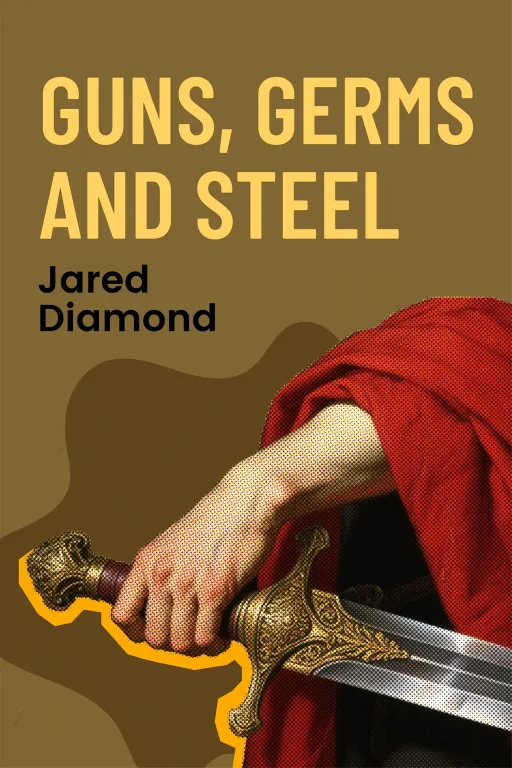
Nova: Not the whole story at all, Atlas. In fact, we're talking about a massive blind spot in how we traditionally view human history. Today, we're tearing down those old assumptions, thanks to two monumental works that have profoundly reshaped our understanding of humanity. We’re diving into Jared Diamond's Pulitzer-winning "Guns, Germs, and Steel," which masterfully weaves together fields from anthropology to biology, and Yuval Noah Harari's "Sapiens," a global phenomenon that re-examines humanity's entire journey from a breathtaking perspective.
Atlas: Both authors are known for their audacious, sweeping narratives, aren't they? They don't just tell history; they explain it unfolded the way it did, with implications for every aspect of our lives today. Diamond, a geographer and ornithologist, brought a rigorous scientific lens to human societies, challenging long-held beliefs, while Harari, a historian, introduced us to the radical idea that our collective imagination is actually our superpower. It’s fascinating how two such different academic backgrounds converged on such expansive, impactful ideas.
Nova: Absolutely. And when you put them together, they offer a truly profound understanding of the interconnected world. We’re going beyond the surface to uncover the deep currents that shaped civilizations, currents that still influence our global structures today.
Environmental Determinism and the Roots of Inequality
SECTION
Nova: So let's start with that blind spot. For centuries, when people looked at why certain societies became dominant—why Europe, for instance, ended up colonizing much of the world, rather than vice versa—the answers often defaulted to inherent cultural superiority, or even racial explanations. Diamond, in "Guns, Germs, and Steel," says that's simply wrong.
Atlas: Okay, but how? I mean, it's easy to look at, say, the industrial revolution and think, "Well, they must have been more innovative, more driven." It’s a compelling narrative, even if it feels a little self-congratulatory.
Nova: It is, and it’s a convenient one. But Diamond’s core argument is that the trajectory of human history, particularly the differential rates of development across continents, was overwhelmingly shaped by geographical and environmental factors. It was a matter of luck in terms of what resources were available.
Atlas: Luck? That's quite a statement. Can you give us an example of what kind of "luck" we're talking about?
Nova: Think about the Fertile Crescent, that crescent-shaped region stretching from the Persian Gulf to the Mediterranean. About 10,000 years ago, this region was a biological goldmine. It had an unparalleled abundance of wild annual grasses, like wild wheat and barley, that were easily domesticable. And crucially, it was also home to a high concentration of the "Big Five" domesticable mammals: goats, sheep, pigs, cattle, and horses.
Atlas: Oh, I like that, the "Big Five." We often think of domestication as a human achievement, but you're saying the raw materials were already there, waiting?
Nova: Precisely. These plants provided high-calorie, storable food, and the animals offered meat, milk, fertilizer, hide, and critically, muscle power for plowing and transport. In other parts of the world, like sub-Saharan Africa or the Americas, the native plants were harder to domesticate, or the large mammals either weren't present or were impossible to tame. For instance, North America had plenty of large mammals, but none were suitable for domestication like the horse or cow.
Atlas: So, the ability to settle down, farm efficiently, and have beasts of burden wasn't just a choice, it was dictated by what nature provided?
Nova: Exactly. This environmental endowment gave these societies a massive head start. Food surpluses meant larger populations, which in turn meant more people could specialize—not everyone had to farm. You could have artisans, scribes, soldiers, innovators. These dense, settled populations also led to the development of writing, complex political structures, and eventually, immunity to a host of animal-borne diseases that later devastated populations in areas without such long exposure.
Atlas: That makes me wonder, then, Nova, how do those ancient geographical advantages still echo in modern global inequalities? Is it fair to say that the seeds of modern economic power were literally sown thousands of years ago, based on where the best wild plants and animals happened to be? Because that sounds like a profoundly different way to look at current global economic and social structures.
Nova: It really is. That initial environmental advantage created a cascade of effects. Societies in Eurasia, with their agricultural head start, developed more complex technologies, more sophisticated political organization, and resistance to more diseases. When they eventually encountered societies in the Americas or Australia, which had developed in relative isolation without those same environmental gifts, the outcome was often devastatingly predictable. The "guns, germs, and steel" were direct consequences of that deep historical, environmental luck of the draw. This isn't about blaming anyone; it's about understanding the systemic, long-term forces that shaped our world.
The Power of Shared Fictions and Collective Consciousness
SECTION
Nova: But even with all those environmental advantages—the fertile lands, the domesticable animals—how did millions of people, strangers to each other, organize themselves into empires and nations? How did they cooperate on a scale far beyond what any other animal can achieve? This is where Harari steps in with "Sapiens."
Atlas: What do you mean? Animals cooperate in groups, right? Like ant colonies or wolf packs.
Nova: They do, but only on a relatively small scale, typically with individuals they know personally or are genetically related to. Harari identifies our unique human ability to believe in "shared fictions" or "collective myths" as the key. These are things that exist purely in our collective imagination, yet they allow us to cooperate flexibly in vast numbers.
Atlas: Okay, "shared fictions" sounds a bit abstract. What does that actually like in practice? Are we talking about ancient gods, or something more mundane like, say, a sports team?
Nova: Both, actually! Think about money. A dollar bill is just a piece of paper, or a number on a screen. It has no inherent value. Yet, billions of people across the globe believe in its value, and that shared belief allows us to trade goods and services, build economies, and fund colossal ventures. It's a fiction we all agree to believe in.
Atlas: So, the very foundations of our global economy—things we take as absolute reality—are essentially elaborate stories we all agree to tell each other? That's… mind-bending. I always thought money was a concrete thing, not a collective hallucination.
Nova: It's a very powerful and useful hallucination! Or take corporations. A company like Apple or Google isn't a physical entity; you can't touch it or point to it. It exists as a legal fiction, a network of contracts and laws that we, as a society, agree to recognize. This shared belief allows millions of employees and investors to coordinate their efforts, creating products and services on a scale unimaginable for a single individual or even a small tribe.
Atlas: That's a great way to put it. So, our ability to tell and believe in these stories—from ancient religious myths that united early communities, to the modern fictions of nations and human rights, or even the concept of a "brand"—is what truly allowed us to build complex societies and dominate the planet?
Nova: Exactly. It's our unique cognitive revolution. We can imagine things that don't physically exist, and then convince millions of others to believe in them, too. That collective agreement, that shared fiction, is the glue that holds large-scale human societies together. It's what allows us to go from small bands of hunter-gatherers to globalized economies.
Atlas: This is fascinating, Nova. Especially for anyone looking to build complex systems or drive innovation. But how does this 'fiction-building' ability influence our ethical responsibilities, particularly with new 'fictions' like Artificial Intelligence emerging? If we can create these powerful shared beliefs, what does that mean for guiding technological advancement responsibly?
Nova: That's the deep question, isn't it? These fictions are incredibly powerful tools. They can be used to build magnificent civilizations, foster cooperation, and solve global problems. But they can also be used to justify inequality, oppression, and conflict. Think of the "fiction" of nationalism, for example, and the conflicts it has sparked. As we create new "fictions"—like the capabilities and roles of AI in society—we have an immense ethical responsibility to understand the power of these collective beliefs and to guide them towards human flourishing, not just unchecked advancement.
Synthesis & Takeaways
SECTION
Nova: So, when we put Diamond and Harari together, we get this incredibly nuanced picture of human history. On one hand, we have the material, environmental canvas that dictated the initial opportunities and constraints for civilizations. On the other, we have our uniquely human capacity to paint our own realities onto that canvas through shared fictions.
Atlas: It's like the environment gives us the clay, but our collective imagination shapes it into everything from a simple pot to a magnificent sculpture. And both forces are profoundly influential, often in ways we don't consciously recognize.
Nova: Precisely. Understanding these deep historical currents—both the geographical hand we were dealt and the stories we tell ourselves—is crucial. It allows us to see current global economic and social structures not as inevitable or natural, but as products of these interwoven historical forces. It shifts the conversation from inherent superiority or blame to systemic understanding.
Atlas: And for those of us driven by societal impact, by the desire to build better systems and a more ethical future, this kind of understanding is empowering. It means we can look at inequalities not as fixed, but as consequences of historical patterns and shared beliefs that can, perhaps, be re-examined and reshaped. It's about being more intentional with the narratives we create, isn't it? Our collective imagination is a tool, not just a default setting.
Nova: Exactly. It urges us to critically examine the "fictions" we live by, the foundational beliefs of our societies, and to ask if they are truly serving human flourishing. Because if we understand how these powerful stories were constructed, we also understand that we have the agency to write new ones.
Atlas: That's a powerful thought, Nova. It really makes you rethink the hidden forces at play in every aspect of our lives.
Nova: Absolutely. So, what "fictions" are you living by, and how might understanding their origins reshape your view of the world?
Nova: This is Aibrary. Congratulations on your growth!