The 'History' Trap: Why You Need to See the Past as a Living Force
Golden Hook & Introduction
SECTION
Nova: You know, it’s wild how much of our lives we spend living in the past, without even realizing it. And I don’t mean just nostalgia or remembering old times. I mean actively, fundamentally shaped by forces that happened centuries, even millennia ago.
Atlas: Whoa, hold on. Are you saying we’re all just puppets of ancient history? Because that sounds a bit…out there. I thought history was, you know, over. Like, done. Settled.
Nova: Exactly! That’s the trap. We often treat history like a dusty old book, full of dates and names, completely disconnected from our present. But the past isn't just about what happened; it's about things are the way they are today. And understanding that 'why' is absolutely crucial for navigating our current world.
Atlas: Okay, so it’s not just trivia, it’s like... a hidden operating system for everything around us. I like that.
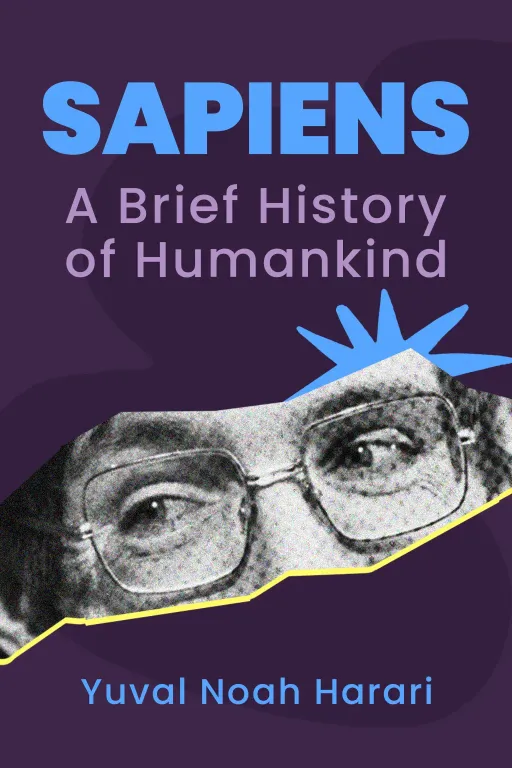
Nova: Precisely. And two incredible books really illuminate this idea, fundamentally shifting how we view progress and challenging assumptions about human nature. We're talking about by Yuval Noah Harari, and by Jared Diamond.
Atlas: Harari, the historian who can make prehistory feel like a thriller. And Diamond, the polymath who connects everything from bird watching to global power dynamics. Both incredibly acclaimed, but also with their fair share of polarizing reviews, which always makes for a fascinating discussion.
Nova: Absolutely. Harari, with his background in world history, has this unique ability to synthesize vast amounts of information into compelling narratives, making complex ideas incredibly accessible. And Diamond, a geographer, physiologist, and ornithologist, brings this incredibly multidisciplinary lens to human development, which gives his arguments a weight that's hard to ignore. They both offer profound insights into the 'why' behind our world.
Atlas: So, where do we even begin with such epic scope?
The Power of Shared Fictions: Harari's Sapiens and the Fabric of Reality
SECTION
Nova: Well, let's start with Harari. His central argument in is truly mind-blowing. He posits that our unique superpower as a species, the thing that allowed us to dominate the planet, isn't our big brains or opposable thumbs. It's our ability to create and believe in "shared fictions."
Atlas: Shared fictions? So like… Santa Claus? Or the Tooth Fairy for adults?
Nova: In a way, yes! But far more profound and impactful. Think about money, for example. What is a dollar bill? It's just a piece of paper, right? But we collectively agree it has value, and that shared belief allows billions of people to cooperate, trade, and build complex economies. Nations, laws, corporations, human rights—these are all shared fictions. They don't exist in nature, but because enough of us believe in them, they become incredibly powerful realities.
Atlas: That’s wild. So basically, you’re saying that the entire framework of our modern society, from our jobs to our governments, is built on a collective hallucination? That kind of makes me wonder if anything is truly 'real.'
Nova: It’s not about them being 'fake' in a negative sense. It's about recognizing their constructed nature. Consider human rights. A lion doesn't have human rights. A river doesn't have human rights. These are concepts we invented, and they’ve become incredibly powerful tools for organizing vast numbers of strangers and creating a more just society, at least in theory.
Atlas: So you're saying these fictions allow for cooperation on a scale no other animal can achieve? Like, we can't all know each other personally, but we can all agree that this green piece of paper means something.
Nova: Exactly! A chimpanzee troop can only grow to about 50 individuals because they rely on personal relationships. Humans, through shared fictions, can build cities of millions, nations of billions. We believe in the same gods, the same laws, the same currency, and that allows us to work together, even if we've never met. It's the ultimate social lubricant.
Atlas: That’s actually really inspiring, if you think about it. It means we have the power to change these fictions. If we collectively decide a new fiction is better, or an old one is no longer serving us, we can theoretically rewrite the operating system.
Nova: Precisely. Acknowledging their fictional nature gives us agency. It's not about dismantling them, but understanding their mechanics. Think about how much of our current societal challenges—political polarization, economic inequality—are rooted in conflicting shared fictions, or fictions that are no longer serving the collective good.
Atlas: So the deep question Harari poses is, how might acknowledging these 'fictions' change your approach to current societal challenges or personal beliefs? If money is a fiction, how does that impact how I save? If national borders are fictions, how does that change my view on immigration? It really makes you think.
Nova: It does. It moves history from being a static record to a dynamic, ongoing narrative that we are all, consciously or unconsciously, writing and rewriting.
Geography as Destiny: Diamond's Guns, Germs, and Steel and the Roots of Inequality
SECTION
Nova: Now, while Harari shows us the power of what we, Jared Diamond, in, introduces us to the power of what we. He argues that geographical and environmental factors, not inherent differences, fundamentally shaped the rise and fall of civilizations.
Atlas: Okay, but wait. Are you saying that where you live literally determines your destiny? Because that sounds a bit… too simple. And potentially, I don't know, a little uncomfortable if it implies certain regions were just 'lucky.'
Nova: It's definitely not simple, and it's certainly uncomfortable for some, but Diamond's argument is incredibly well-researched. He's not saying one group of people is inherently smarter or more capable. He’s saying that the hand they were dealt by geography—the plants available for domestication, the animals available for farming, the orientation of their continents—made all the difference.
Atlas: So it's not about people, it's about... dirt? And seeds?
Nova: And axis. Think about Eurasia versus the Americas. Eurasia has a vast East-West axis. This meant that domesticated crops and animals, and even technologies, could spread relatively easily along similar latitudes, where climates and growing seasons were comparable. Wheat, barley, sheep, goats—they could move across thousands of miles.
Atlas: Ah, I see. So if you had a great new crop in Spain, it could eventually make its way to China because the climate was roughly the same.
Nova: Exactly. Now, compare that to the Americas, which have a North-South axis. If you developed a fantastic crop in, say, modern-day Mexico, it would have to cross vastly different climate zones—deserts, mountains, jungles—to reach populations in North or South America. This made the spread of agriculture and innovation much, much slower.
Atlas: Wow, that’s such a fundamental difference I’d never considered. I always just thought some cultures were more 'advanced.' So this explains why certain civilizations developed agriculture, metallurgy, and complex societies faster.
Nova: And with agriculture came population density, which led to cities, specialization, and crucially, disease. Those early Eurasian populations, living in close proximity to domesticated animals, developed immunities to diseases like smallpox and measles. When Europeans arrived in the Americas, they brought these germs, to which indigenous populations had no immunity, leading to catastrophic population collapses. That’s the 'germs' in.
Atlas: That gives me chills. So these ancient geographical advantages compounded over millennia, leading to the existing power structures and modern inequalities we see today. It makes you realize how deeply rooted some of these disparities are.
Nova: It really does. It's a powerful counter-narrative to explanations that focus solely on cultural superiority or individual effort. It forces us to look at the deep, often invisible roots of modern inequalities and challenge our assumptions about progress and societal development.
Synthesis & Takeaways
SECTION
Nova: So, when we put Harari and Diamond together, we get this incredibly rich, multi-layered understanding of history. It's not just a collection of past events; it's a dynamic interplay between the powerful fictions we create and the unyielding realities of our environment.
Atlas: Right, so we have the human-made narratives shaping our cooperation and values, and then we have the silent, foundational hand of geography dictating the very resources and opportunities available to us. It really makes you see the present as this complex tapestry woven from ancient threads.
Nova: And that's the beauty of seeing the past as a living force. It’s not about being stuck in history, but about understanding its mechanics so we can better navigate and perhaps even consciously shape our future. For curious learners who enjoy deep thinking, this perspective offers immense intellectual inspiration. It means we're not just passive observers of history; we're active participants in its ongoing story.
Atlas: It empowers you, actually. If you understand the fictions, you can question them. If you understand the geographical constraints, you can work to overcome them or adapt. It makes our present challenges feel less arbitrary and more understandable, and perhaps even solvable.
Nova: Absolutely. It transforms the way we approach current societal challenges and personal beliefs. It asks us to consider: how might acknowledging these profound, historical forces change approach to the world around you?
Atlas: That’s a powerful question to end on. It truly makes history feel alive and relevant.
Nova: This is Aibrary. Congratulations on your growth!