The History Trap: Why You Need to See Patterns, Not Just Dates.
Golden Hook & Introduction
SECTION
Nova: You know, Atlas, most people think of history as this long, winding road of dates and famous names. Like a really intense pop quiz about dead people.
Atlas: Oh, I've aced those quizzes! Napoleon, 1812, something about winter... boom! History done. What else is there?
Nova: Exactly! That's the history trap. We get so caught up in the "what" and the "when," we completely miss the "why." And the "why" is where all the real power lies, both in understanding our past and navigating our present.
Atlas: Wait, so you're saying my pristine mental timeline of empires rising and falling is... incomplete? That feels a bit out there.
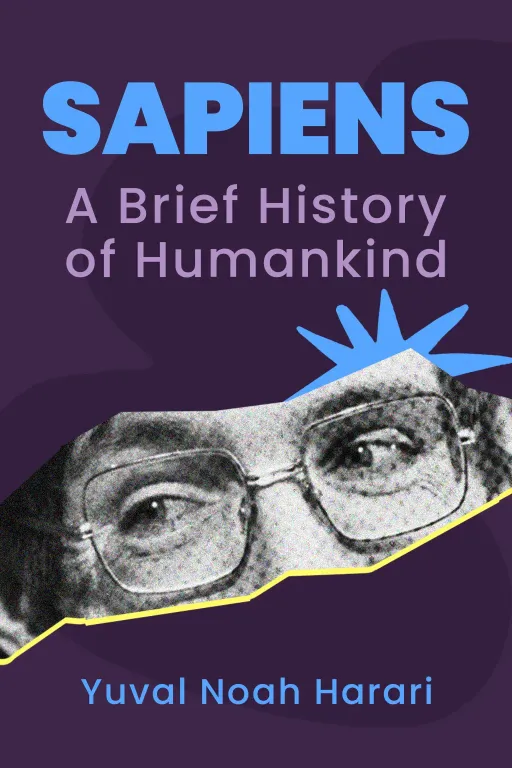
Nova: Far from incomplete, it's just scratching the surface. Today, we're going to dive into two groundbreaking books that fundamentally shifted how we think about history, moving us from mere chronology to profound patterns. First up, the global phenomenon that is by Yuval Noah Harari. What's fascinating about Harari is that he started as a medieval historian, but then dared to write a history of humankind, from our earliest ancestors to our potential future. That kind of audacious scope just isn't something you see every day.
Atlas: Oh, I love that – a historian with a truly expansive view. It sounds like he wasn't afraid to connect some very disparate dots.
Nova: Absolutely. And then we'll turn to by Jared Diamond. Diamond is actually a physiologist by training, which gives him this incredible, interdisciplinary lens to examine why societies developed so differently across continents. His approach was truly groundbreaking, offering a powerful, non-racial explanation for the vast disparities we see in the world.
Atlas: A physiologist tackling history? That’s interesting. So, it sounds like both of these authors are asking the uncomfortable "why" questions, digging beneath the surface events.
Nova: Precisely. They're revealing that history isn't just a collection of isolated incidents; it's a complex, interwoven tapestry shaped by forces we often don't even perceive. And understanding those forces is like having a superpower.
The Invisible Threads: How Shared Fictions Shape Our Reality
SECTION
Nova: So, let's start with Harari and his big idea from: the power of shared fictions. He argues that what truly allowed to dominate the planet, to build cities, nations, and global economies, wasn't our individual strength or intelligence. It was our unique ability to believe in and cooperate around things that don't physically exist.
Atlas: Okay, but what do you mean by "shared fictions"? Like, Santa Claus? Or the Tooth Fairy?
Nova: Well, yes, those are fictions, but Harari is talking about much bigger, more pervasive ones that fundamentally structure our entire reality: money, nations, religions, laws, human rights. These aren't tangible things you can pick up and examine under a microscope. They are collective stories we agree to believe.
Atlas: Hold on. Money isn't real? My landlord would beg to differ! I mean, I work for it, I spend it, it clearly has value.
Nova: And that's exactly the point! It has value. Think about it: a dollar bill is just a piece of paper with some ink. Its inherent value is almost zero. But because billions of people across the globe believe in its worth, it allows you, a stranger, to exchange goods and services with another stranger you've never met, on the other side of the world. That's an incredible feat of cooperation, all built on a shared story, a shared fiction.
Atlas: Wow. That gives me chills. So, the entire global economy is essentially one massive, collective act of make-believe that we all participate in.
Nova: Exactly! And it's not just money. Nations are shared fictions. There's no inherent, biological difference between someone born on one side of a border versus another, but we believe in the nation, its flag, its laws, and that belief allows millions to cooperate, sometimes even to fight for it. Human rights, for example, are a beautiful and powerful fiction. They're not a physical law of nature, but a story we decided to tell ourselves about the inherent dignity of every individual, and that story has reshaped the world.
Atlas: That makes me wonder about that deep question you mentioned earlier. What widely accepted "truth" in my life might actually be a powerful, shared fiction? I'm thinking about things like career paths, or even the concept of "success." We buy into these narratives, and they guide our whole lives.
Nova: And that's the profound insight. Recognizing these fictions doesn't diminish their power; it illuminates it. It shows us how malleable our reality can be, how much of our world is constructed by human minds, not by immutable laws of nature. It empowers us to question, to challenge, and perhaps even to rewrite some of these stories.
Geography's Silent Architects: Unpacking Environmental Determinism
SECTION
Nova: Now, while Harari helps us understand the power of human-created narratives, what about the forces that shaped these narratives could even take root and flourish? That brings us to Jared Diamond and.
Atlas: So, if Harari is about the invisible stories we tell, Diamond is about the invisible forces of the planet itself?
Nova: Precisely. Diamond set out to answer one of history's biggest questions: why did wealth and power become distributed as they are, with some societies developing agriculture, writing, and complex political systems far earlier than others? He looked at the vast disparities that emerged, for example, between Eurasia and the Americas.
Atlas: Yeah, I've heard the common, often problematic, explanations for that, usually involving some supposed inherent superiority.
Nova: And Diamond systematically dismantles those. He argues it wasn't about race or innate intelligence. It was about geography and environment. Think about the availability of domesticable plants and animals. Eurasia had a massive head start. They had wheat, barley, rice, cattle, pigs, sheep, goats – plants and animals that were easy to domesticate and incredibly productive.
Atlas: Like how much power could a good grain or a few livestock really have?
Nova: An immense amount! Imagine a society that can grow high-yield crops and raise easily domesticable animals. That means they can produce food surpluses. Surpluses mean not everyone has to be a farmer; some people can specialize. They can become artisans, soldiers, priests, scribes, engineers. That fuels the development of towns, writing, technology, and complex political structures.
Atlas: That’s a great way to put it. So, a few good seeds and some docile animals kickstarted entire civilizations.
Nova: Exactly. And then there's the continental axis. Eurasia is primarily oriented east-west. This meant that domesticated plants and animals, and the technologies that came with them, could spread relatively easily across vast distances because they stayed within similar latitudes and climates. A crop suited for Italy could also thrive in China.
Atlas: But wait, how does that compare to, say, the Americas?
Nova: The Americas, Africa, and Australia are primarily oriented north-south. This meant that moving crops, animals, or technologies across latitudes was much harder. A crop that thrived in Mexico might not survive the different climate zones further north or south. So, innovations were often confined to smaller geographical areas, slowing down the overall pace of development.
Atlas: I can definitely relate to that. It’s like trying to grow a tropical plant in a temperate climate – it just doesn't work. So, these seemingly small geographical advantages compounded over millennia, leading to huge disparities in development without any inherent difference in the people themselves. That’s actually really inspiring, because it re-frames so much of what we think we know.
Synthesis & Takeaways
SECTION
Nova: So, when you put Harari's shared fictions alongside Diamond's geographical determinism, you get this incredibly powerful dual lens for understanding history. It's not just a string of random events; it's the interplay of the stories we tell ourselves and the environment we find ourselves in.
Atlas: That makes me wonder, what does this mean for understanding our present and future? If so much of our reality is built on these fictions and historical environmental advantages, what can we do with that knowledge?
Nova: It means we can question everything. We can look at existing power structures, economic systems, and even our own personal beliefs, and ask: "Is this a natural law, or is this a powerful, shared fiction we've all bought into?" And if it's a fiction, we have the power, collectively, to rethink it, to rewrite it.
Atlas: So this isn't just about understanding the past; it's about empowering us to shape the future by understanding the patterns that govern us. It’s about being more intentional about the stories we believe and the systems we perpetuate.
Nova: Absolutely. It’s about moving beyond the superficial "what happened" to the profound "why it happened," and recognizing that we are both products of these patterns and potential architects of new ones. What "truth" are you going to examine through this lens today?
Atlas: That’s a great way to put it. I'm definitely going to be looking at a few things differently after this. Thanks, Nova!
Nova: Always a pleasure, Atlas.
Atlas: This is Aibrary. Congratulations on your growth!