The Geography of Impact: Critical Thinking in Environmental Systems
Golden Hook & Introduction
SECTION
Nova: Alright, Atlas, quick game. Rapid-fire word association. I say a word, you hit me with the first geographical or environmental concept that pops into your head. Ready?
Atlas: Oh, I like this. Hit me. My brain's warmed up and ready for some intellectual gymnastics.
Nova: "Impact."
Atlas: Oh, "Erosion." Definitely erosion. The slow, relentless reshaping of a landscape.
Nova: Perfect. "Future."
Atlas: "Sea-level rise." Immediate, visceral. The map literally changing.
Nova: Excellent. "Solutions."
Atlas: "Watershed management." Localized, interconnected, crucial. Everything flows downstream, right?
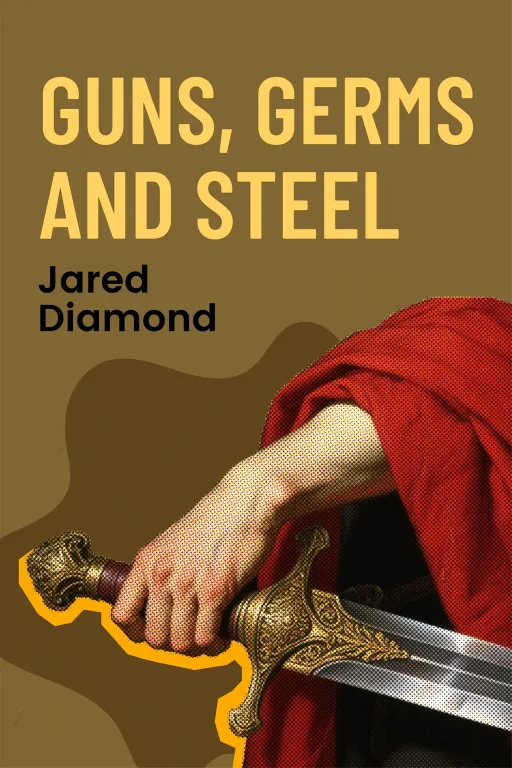
Nova: Exactly! And that, my friend, is a perfect, albeit quick, microcosm of what we're diving into today: "The Geography of Impact"—how critical thinking about physical space and environment is absolutely foundational to understanding our world. We're drawing heavily from two monumental works: Jared Diamond’s Pulitzer Prize-winning "Guns, Germs, and Steel," and David Wallace-Wells’ stark, unflinching look at our future, "The Uninhabitable Earth."
Atlas: Oh, I know that feeling. Diamond’s book is a masterclass in connecting dots, even if some of its 'geographical determinism' can be a bit... spicy. And Wallace-Wells? That one still haunts me. It’s a necessary, if terrifying, read.
Nova: It is. Diamond’s work, in particular, sparked huge academic debates, with critics often pushing back against the idea that geography dictates destiny too rigidly. But regardless of where you land on that, what’s undeniable is how powerfully it forces you to think about the physical stage on which human history plays out. And Wallace-Wells, in his own way, brings that same geographical lens to our immediate future, showing us how climate change isn't a uniform threat, but a collection of deeply localized, geographically specific nightmares.
Atlas: So, basically, we’re talking about how literally you are on the planet has shaped everything from the rise of civilizations to the existential threats we face today, and how understanding that is key to solving anything.
Nova: Precisely. It’s about understanding the spatial implications of everything—from ancient agricultural revolutions to modern climate crises.
The Foundational Role of Geography in Human-Environment Interactions
SECTION
Nova: Let's start with Diamond. His central thesis in "Guns, Germs, and Steel" is that geographical and environmental factors, not inherent racial or cultural superiority, explain why some civilizations developed faster and dominated others. It’s a powerful, sweeping argument.
Atlas: That makes sense, but how does he connect that to, say, the development of agriculture or technology? It feels like a massive leap.
Nova: It’s all about the axis of the continents. Think about Eurasia versus the Americas or Africa. Eurasia is oriented east-west, while the Americas and Africa are primarily north-south. This seems like a trivial detail, but it had profound consequences.
Atlas: Wait, hold on. You’re saying the direction a continent points fundamentally altered human history? That sounds a bit out there.
Nova: It's incredible, but yes. Imagine trying to spread a crop like wheat, or an innovation like the wheel. If you're moving east or west across Eurasia, you generally stay within similar latitudes. That means similar climates, similar day lengths, similar growing seasons. So, a crop like wheat, once domesticated in the Fertile Crescent, could spread relatively easily across thousands of miles to Europe and Asia.
Atlas: Right, like, the environmental conditions are fairly consistent. So, you don't have to re-engineer your entire agricultural system just because you moved a thousand miles.
Nova: Exactly. Now, compare that to the Americas. If you move from, say, modern-day Mexico north to Canada, or south to Chile, you cross vastly different latitudes, climates, and ecological zones. A crop like maize, domesticated in Mesoamerica, faced massive environmental barriers trying to spread north or south. It had to adapt to completely new conditions, which took centuries, if not millennia. The same applied to domesticated animals and technologies.
Atlas: I see. So, the east-west axis of Eurasia acted like a superhighway for the spread of agriculture, animals, and innovation, giving those societies a huge head start in terms of population density, technological development, and immunity to diseases. Whereas the north-south axes were more like rugged mountain passes.
Nova: That’s a great analogy. This geographical advantage meant Eurasian societies could develop complex social structures, writing, metallurgy, and resistance to diseases at a much faster pace, simply because their innovations could spread more easily. This wasn't about superior intelligence, but superior geography.
Atlas: That's actually really inspiring, in a way. It shifts the blame from people to planetary mechanics. But it also makes me wonder: if geography was such a dominant force historically, how does that translate to today's environmental challenges? Are we still just pawns in a geographical game?
The Urgent Spatial Implications of Climate Change and Solution Design
SECTION
Nova: That’s the perfect bridge to David Wallace-Wells’ "The Uninhabitable Earth." While Diamond looks at history, Wallace-Wells looks at our projected future, but through a strikingly similar geographical lens. He argues that climate change isn't just a global average temperature rise; it’s a terrifying mosaic of localized impacts, dictated by, you guessed it, geography.
Atlas: So you’re saying that the idea of a uniform "global warming" is misleading? That it’s not really going to hit everyone the same way?
Nova: Absolutely. The book paints a stark picture of how different geographical regions will experience climate change in wildly different, often catastrophic, ways. Consider coastal cities, for instance. Places like Miami, Jakarta, or Venice face existential threats from rising sea levels and storm surges, literally disappearing under water. Their geographical location, at sea level, makes them uniquely vulnerable.
Atlas: Wow, that’s kind of heartbreaking. But it’s also something I imagine a lot of our listeners in urban planning or environmental policy are grappling with—how do you plan for that when the threat isn't evenly distributed?
Nova: Exactly! Then you have arid regions, like parts of the Middle East, North Africa, or the American Southwest, which will face unprecedented droughts, leading to water scarcity, agricultural collapse, and mass displacement. Their geography makes them prone to desertification. Or imagine the impact of melting permafrost in the Arctic, releasing ancient carbon and methane, creating feedback loops that accelerate global warming.
Atlas: So basically, you’re saying that the solutions can't be one-size-fits-all either. A seawall in Miami isn't going to help a farmer in the Sahel.
Nova: Precisely. This is where critical thinking in geography becomes paramount for designing persuasive, localized sustainable solutions. If you're trying to address food security in a region, you have to understand its climate patterns, water sources, soil composition, and even its historical land use. Ignoring these spatial factors leads to ineffective, often counterproductive, interventions.
Atlas: That makes me wonder, how do we, as analytical architects or ethical explorers, use this geographical understanding to build more persuasive arguments? Because it’s one thing to understand the problem, but another entirely to convince people to act on deeply localized, complex solutions.
Nova: It’s about moving beyond abstract "global warming" to vivid, geographically specific narratives. When you can say, "This particular watershed is facing a 30% reduction in rainfall by 2050, directly impacting the livelihoods of these 50,000 farmers," you make the problem tangible. You map the arguments directly onto the land and the lives of the people there. It makes the stakes incredibly clear and personal. It's about demonstrating how local actions have local consequences, and how local solutions bring local benefits.
Synthesis & Takeaways
SECTION
Nova: So, what we’ve seen today, from ancient axes of continents to the future-facing map of climate vulnerability, is that geography isn't just about where things are; it’s about they are, and. Critical thinking in environmental systems absolutely demands this spatial literacy. Ignoring the geographical context, both historical and contemporary, means we’re essentially trying to solve a puzzle without looking at the full picture. It’s like trying to navigate without a map, and the consequences are far too severe.
Atlas: So, the takeaway here is that whether we're looking at historical development or future environmental resilience, the landscape itself is a key player, often the silent, most powerful one. And understanding that map, truly understanding it, is our best bet for crafting real, impactful solutions.
Nova: Exactly. And for our listeners, especially those driven by a desire for mastery and making an impact, here’s a tiny step you can take: select a current global environmental issue that resonates with you, and then actively research its geographical distribution. Don't just think global; think granular. Where are the impacts felt most acutely? What are the specific geographical features contributing to its complexity?
Atlas: That’s a fantastic, actionable challenge. And to build on that, how does understanding that geographical context fundamentally change your perspective on environmental responsibility and the potential for real, localized impact? It's a deeper question than just knowing the facts.
Nova: It really is. It shifts from a vague sense of global duty to a precise understanding of interconnectedness and targeted action.
Atlas: This is Aibrary. Congratulations on your growth!