The Echo Trap: Why Ignoring History Leads to Repeating Mistakes.
Golden Hook & Introduction
SECTION
Nova: Most people think they're learning from history just by knowing names and dates. But what if that 'knowledge' is actually our biggest blind spot, keeping us trapped in an echo chamber of the past?
Atlas: Wait, so knowing history isn't enough? That feels... counterintuitive. I mean, isn't the whole point of studying history to learn from it?
Nova: It is, Atlas, but not in the way many of us imagine. We often see history as a collection of isolated events, missing the grand narratives that connect them. This limited view prevents us from recognizing recurring patterns and understanding the foundational forces that shape our world today. It's time to see the forest, not just the trees.
Atlas: So we're talking about going beyond the 'what happened' to the 'why it happened' on a much deeper level. That sounds like a powerful shift in perspective. What are we diving into today to help us make that shift?
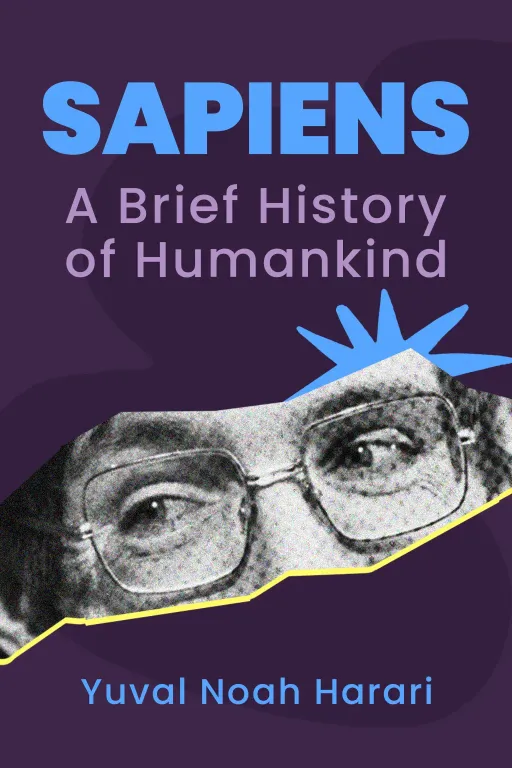
Nova: Today, we're exploring the core ideas from two groundbreaking books that fundamentally changed how we understand human history. First up, Yuval Noah Harari's, a global phenomenon that reframed our entire understanding of what it means to be human and why we dominate the planet. It's a book that truly captivated a massive audience and critics alike for its bold, interdisciplinary approach.
Atlas: Oh,! That book got everyone talking about everything from money to religion in a whole new light. And the other?
Nova: The other is Jared Diamond's Pulitzer Prize-winning masterpiece,. It's a book that sparked immense discussion, even controversy, for its powerful argument that environmental and geographical factors, not racial superiority, were the primary drivers of societal development and global power dynamics.
Atlas: So we're talking about two massive re-evaluations of human history, one about our internal world of belief, the other about our external world of geography? That’s a fascinating pairing.
Nova: Exactly. They offer complementary lenses to understand the 'Echo Trap' – that cycle of repeating mistakes because we haven't grasped the underlying mechanisms. Let's start with those invisible architects of our world – the shared fictions Harari talks about in.
Deep Dive into Core Topic 1: The Power of Shared Fictions
SECTION
Nova: Harari argues that our unique ability to create and believe in shared fictions allowed us to cooperate on a massive scale, leading to our dominance as a species. Think about it: money, nations, religions – these aren't physical things you can touch or find in nature. They exist purely in our collective imagination.
Atlas: So you're saying money isn't 'real'? That sounds a bit... anarchic. What does that actually mean for our everyday lives? My bank account seems pretty real to me!
Nova: It’s not anarchic at all, it’s actually incredibly orderly! It means money, like a nation or a corporation, is a social construct. It has no inherent value, but we all agree it does. Because we collectively believe in it, we can trade, invest, and build economies with complete strangers. Take a company like Google. It’s a legal fiction. It has no physical body, no emotions, yet it employs hundreds of thousands, owns vast assets, and shapes global communication. It only works because millions of people believe in its existence and follow its rules.
Atlas: That's a powerful idea. It makes me think about how quickly new 'fictions' can emerge and reshape society, like cryptocurrencies or even social media trends. It's almost like a superpower we don't fully grasp. But isn't that just a fancy way of saying 'culture'? What makes 'shared fiction' a more powerful lens?
Nova: It goes deeper than culture. Culture is often about shared behaviors, traditions, and values. Shared fictions are about shared but have immense organizing power. Consider religion: it can unite millions of people from different geographical regions, speaking different languages, under a common set of beliefs and goals. That level of flexible cooperation among strangers is unprecedented in the animal kingdom.
Atlas: So, the ability to build these shared illusions is why we're at the top of the food chain? That's a wild thought. No other animal can cooperate on that scale.
Nova: Precisely. A chimpanzee troop can only cooperate effectively with about 50 individuals. Humans can build cities of millions, entire nations of billions, all because we can tell and believe stories about things that aren't physically present. That cognitive leap allowed us to leapfrog every other species and completely reshape the planet.
Atlas: It makes you wonder what fictions we're still operating under today that shape our reality without us even realizing it. What's the downside? Are we always just building more elaborate fictions that might eventually crumble or mislead us?
Nova: That’s the critical part of understanding the Echo Trap. These fictions, while incredibly powerful for cooperation, can also create blind spots, prejudices, and even lead to conflict when different fictions clash. And sometimes, we get so caught up in the stories we tell ourselves, we forget the physical realities that also govern our existence.
Deep Dive into Core Topic 2: Geography's Iron Hand
SECTION
Nova: And while our minds were busy creating these intricate fictions, the very ground beneath our feet was silently dictating our destiny. This is where Jared Diamond's 'Guns, Germs, and Steel' comes in, offering a stark, material counterpoint to Harari's cognitive revolution.
Atlas: Ah, the Pulitzer-winning book. I remember some of the buzz around that. He argued against racial superiority, right? That there wasn't anything inherently 'better' about certain groups of people?
Nova: Exactly. Diamond's central thesis is that the environment, not inherent biological differences, provided different starting materials and opportunities for various societies. He meticulously demonstrated how geographical and environmental factors determined which societies developed agriculture, advanced technology, and immunity to diseases, profoundly impacting global power dynamics.
Atlas: So, it wasn't about smarter people, but better luck with geography? That's a huge claim. Can you give an example of how that played out? Like, how does a mountain range affect whether a society gets steel?
Nova: Consider Eurasia versus the Americas. Eurasia has a largely east-west axis, with similar latitudes stretching across vast distances. This meant that domesticated plants and animals – like wheat, barley, sheep, and goats – could spread relatively easily across thousands of miles, adapting to similar climates.
Atlas: So, if you found a good crop in one place, you could plant it in many other places without much trouble?
Nova: Precisely. In contrast, the Americas have a predominantly north-south axis. Moving a crop like corn from Mexico to what's now the US required it to adapt to vastly different climates, altitudes, and day lengths, making its spread much slower and more challenging. This geographical luck meant Eurasia had a huge head start in agriculture.
Atlas: That's fascinating. So, the mere direction of a continent could determine whether you develop writing or advanced weaponry? It sounds almost too deterministic.
Nova: It’s about cascading effects. Food surpluses from efficient agriculture led to denser populations. Denser populations allowed for specialized labor – not everyone needed to farm. This meant people could become scribes, engineers, soldiers, or inventors. This specialization, combined with the availability of suitable raw materials like iron ore, drove technological innovation – leading to things like steel, and yes, guns.
Atlas: And the 'germs' part? That was a massive, often overlooked, factor in colonization, wasn't it? The Europeans brought more than just guns.
Nova: Absolutely. Living in close proximity to a wide variety of domesticated animals for millennia meant Eurasian populations were exposed to and developed immunities to a host of diseases – smallpox, measles, influenza. When Europeans arrived in the Americas, these diseases, entirely new to indigenous populations, caused catastrophic epidemics, decimating their numbers and weakening their resistance.
Atlas: Wow. So, the environment wasn't just a backdrop; it was the primary architect of power dynamics. It makes you wonder how much of what we attribute to human ingenuity or even 'destiny' was just... geographical advantage.
Nova: It's a powerful counter-narrative to traditional, often ethnocentric, historical explanations. It forces us to re-evaluate our assumptions about progress, inequality, and even the very idea of 'civilization.' It’s an ecological lens on human destiny.
Synthesis & Takeaways
SECTION
Nova: So we have Harari showing us the power of our minds to create shared fictions that enable cooperation, and Diamond showing us the power of our environment to shape the very foundations of our societies. Together, they paint a picture of history not as random, but as profoundly influenced by these two fundamental forces.
Atlas: And the 'Echo Trap' of ignoring this? It feels like if we don't understand these deep currents, we'll keep making policy decisions or societal judgments based on superficial explanations, blaming individuals or cultures when the real drivers are much deeper.
Nova: Precisely. If we don’t recognize these foundational elements, we’re doomed to misinterpret the past and stumble into future pitfalls. The deep question then becomes: what current societal 'fictions' or geographical advantages might be shaping our collective future in ways we haven't yet considered? Are we clinging to outdated beliefs, or overlooking critical environmental realities?
Atlas: That's a question worth pondering. It challenges us to look beyond the immediate headlines and ask what foundational stories we're telling ourselves, and what environmental realities we're ignoring. It's about seeing the forest, not just the trees, in our own time.
Nova: Exactly. It's about developing a richer, more nuanced understanding of the world around us, and within us. It’s about recognizing that history isn't just something that happened; it's a dynamic, ongoing process shaped by forces we often overlook.
Atlas: Absolutely. This has been a truly eye-opening discussion. It really makes you rethink everything you thought you knew about why the world is the way it is. Thank you for making these complex ideas so accessible and engaging.
Nova: Thank you for joining us on this journey through history's grand narratives. We hope this episode sparks your own curiosity and encourages you to look for the deeper patterns shaping our world.
Atlas: And we'd love to hear your thoughts on those current 'fictions' or 'geographical advantages' you've identified. Share your insights with us on social media and let's continue the conversation.
Nova: This is Aibrary. Congratulations on your growth!