The 'Culture' Trap: Why You Need a Deeper Lens on History.
Golden Hook & Introduction
SECTION
Nova: What if the most powerful forces shaping human history weren't our DNA, our intelligence, or even our tools, but rather... stories we made up?
Atlas: Oh, I like that! You're saying our entire civilization is built on a foundation of… fiction? That sounds a bit out there, but I'm intrigued.
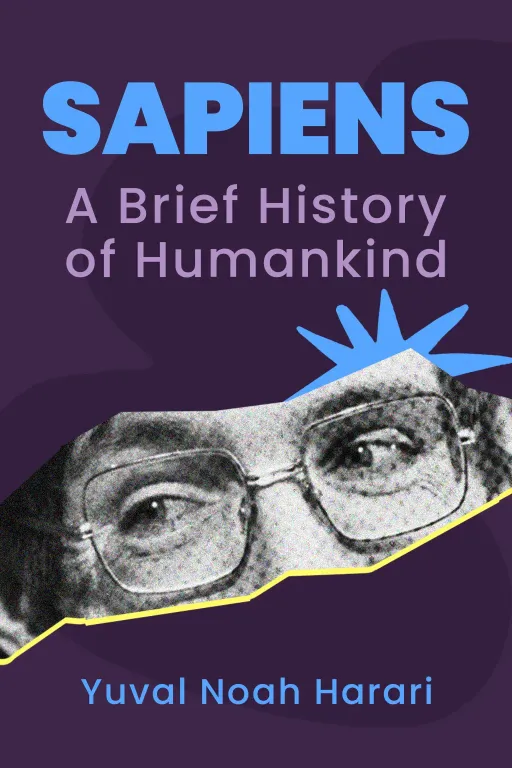
Nova: Exactly! And we're going to zoom out today, exploring how two groundbreaking books challenge our 'culture trap'—that narrow view of what makes us human. First, we dive into by Yuval Noah Harari. Harari, a professor of history at the Hebrew University of Jerusalem, initially developed these ideas from his popular lecture courses. This book became a global phenomenon precisely because it dared to connect biology, anthropology, and history in such a radical way.
Atlas: And then we'll shift gears to by Jared Diamond. I’ve always been fascinated by Diamond's background as a physiologist and evolutionary biologist, bringing that scientific rigor to history. That's a unique lens right there.
Nova: Absolutely. Both brilliant minds, both forcing us to question everything we thought we knew about humanity's journey.
The Power of Shared Myths: How Fictions Shaped Humanity
SECTION
Nova: Let's start with Harari and his idea that our ability to believe in "shared myths" or "inter-subjective realities" is what truly set Homo sapiens apart. Imagine a chimpanzee trying to organize a protest against the alpha male in another troop. Impossible, right?
Atlas: Right, like how would they even communicate that complex idea across groups? Their social structures are so limited to direct, intimate connections.
Nova: Precisely. But humans, we can create stories like 'nations,' 'human rights,' or 'money.' Take money, for example. A dollar bill is just paper, or even just numbers on a screen, but because billions of us collectively it has value, it allows us to cooperate on a massive scale. You can trade your labor for pieces of paper, then use those pieces of paper to buy food from someone you've never met, on another continent. No other animal can do that. That scale of trust and cooperation is unique to us.
Atlas: So you're saying that the entire global economy is essentially one massive, collective hallucination we've all agreed to participate in? That sounds wild, but it makes a strange kind of sense when you put it like that. What's even more interesting is how something so abstract can have such concrete, tangible effects in our daily lives.
Nova: It's exactly that. Harari argues these shared fictions are not lies, but rather powerful social constructs. They allow millions to work together towards common goals, whether it's building pyramids, fighting wars, or creating complex legal systems. Without these myths, our societies wouldn't exist as they do. They provide the operating system for our collective existence.
Atlas: That gives me chills, thinking about how deeply ingrained these stories are, and how rarely we question their foundational nature. For our listeners who are navigating complex organizational structures or even trying to build startups, understanding this could be a game-changer. It's like, if you want to create something big, you don't just need a product; you need to tell a compelling enough story that everyone buys into and believes in together.
Nova: Exactly. It's about engineering collective belief. And that ability, for Harari, is humanity's superpower. It allowed us to conquer the planet, for better or worse.
Geography as Destiny: Unpacking the Environmental Roots of Inequality
SECTION
Nova: And that naturally leads us to the second key idea we need to talk about, which often acts as a powerful, material counterpoint to what we just discussed: Jared Diamond's groundbreaking work in. If Harari shows us the power of mind-made constructs, Diamond reveals the relentless force of the physical world.
Atlas: Okay, so if Harari explains we cooperate, Diamond explains some groups ended up with the 'upper hand' historically? I’m curious, because this is where a lot of potentially uncomfortable questions about perceived superiority or inferiority come in.
Nova: Exactly. Diamond famously argues that it wasn't any inherent racial or intellectual superiority that gave Eurasians a head start. It was geography. Think about the Eurasian landmass – it's huge, stretching east-west, sharing similar latitudes. This allowed for the rapid spread of domesticated plants and animals. Crops from the Fertile Crescent, like wheat and barley, could easily move across similar climates and daylight cycles.
Atlas: Right, like how corn from Central America couldn't just easily jump to the northern plains or across an ocean. Different climates, different growing seasons, different geographical barriers.
Nova: Absolutely. And that rapid diffusion meant more food, which meant denser populations, which led to more complex societies, specialized labor, and crucially, more exposure to animals. More animals meant more animal-borne diseases—the 'germs' in his title. Eurasians developed immunities over millennia. When they encountered populations in the Americas, who had far fewer domesticated animals and thus fewer diseases, the impact was devastating.
Atlas: So, when Europeans arrived in the Americas, they didn't just bring guns and steel; they unknowingly brought invisible biological weapons that decimated the indigenous populations, not because of any inherent flaw in those populations, but because of a historical difference in their exposure to pathogens. That’s such a powerful, almost tragic, illustration of environmental determinism. It really challenges the idea of 'progress' as a purely human-driven, merit-based achievement. It's like, you can have the best stories, but if your environment isn't conducive to certain foundational developments, you're at a profound disadvantage.
Nova: And it’s not just disease. The availability of domesticable animals in Eurasia provided beasts of burden for agriculture and transportation, further accelerating societal development and military might. The lack of such animals in many other parts of the world was a massive impediment.
Synthesis & Takeaways
SECTION
Nova: What both Harari and Diamond illuminate is this profound truth: our present reality, our 'culture,' is not some inevitable outcome. It's a complex tapestry woven from our collective imaginations and the brute facts of geography and biology. It’s a dynamic interplay between the stories we tell ourselves and the physical world we inhabit.
Atlas: That’s actually really inspiring. It makes you realize how many of the 'truths' we hold dear are simply products of our specific cultural moment, not universal constants. So many of us are constantly trying to optimize our lives and careers based on norms that might just be… made up, or at least heavily influenced by circumstances we rarely consider.
Nova: Exactly. The deep question we posed earlier was: What current belief do you hold about human nature that might be a product of your specific cultural moment, not universal truth? Is it the idea that certain types of work are inherently more valuable? That individualism is always superior to collectivism? Or even our contemporary relationship with technology and progress? These books force us to confront those assumptions.
Atlas: For someone who loves exploring new knowledge areas, this is a goldmine. It's about peeling back those layers of assumed reality, understanding the deep currents of history. For our curious listeners, I'd encourage you to pick up these books— by Yuval Noah Harari and by Jared Diamond—and really let their insights challenge your worldview. See what beliefs might be a 'culture trap' for you.
Nova: And then, share your reflections with us! What 'culture traps' did you identify in your own thinking after listening today? We’d love to hear your insights on social media.
Atlas: It’s a powerful reminder that understanding history isn't just about the past; it's about gaining a deeper lens to build a more resilient future.
Nova: This is Aibrary. Congratulations on your growth!