Stop Guessing, Start Understanding: The Guide to Historical Patterns.
Golden Hook & Introduction
SECTION
Nova: Atlas, if I told you we're diving into a book called "Stop Guessing, Start Understanding: The Guide to Historical Patterns," what's your instant, unfiltered thought?
Atlas: My instant thought? Probably that I'm already guessing, and I'm pretty sure I don't understand half the historical patterns in my own coffee cup. Sounds like I need this book... or a new coffee cup.
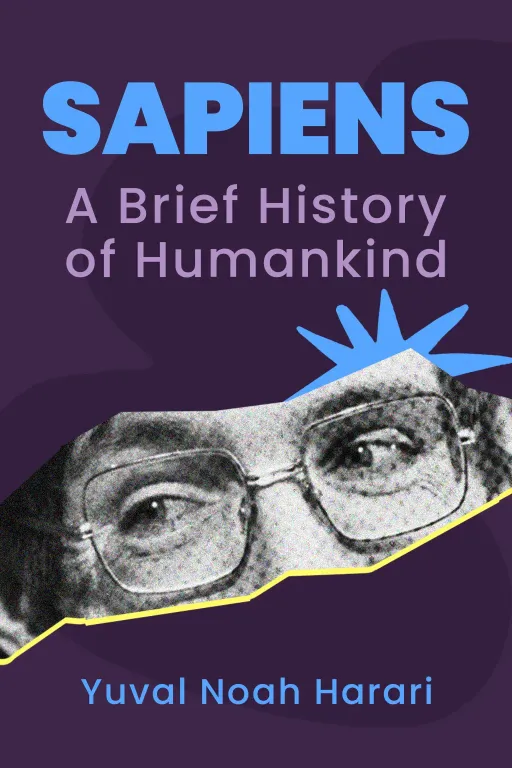
Nova: Well, you're in luck, because today we're dissecting the core insights from a book that brilliantly synthesizes the kind of panoramic views you find in a global phenomenon like Yuval Noah Harari's "Sapiens," which, by the way, became a massive international bestseller and ignited conversations everywhere, and also the rigorous, interdisciplinary approach of a Pulitzer-winning work like Jared Diamond's "Guns, Germs, and Steel." This book is essentially a guide to seeing the invisible forces that have shaped us.
Atlas: A guide to invisible forces? That sounds less like history and more like... a magician's handbook for understanding reality. I'm intrigued.
Nova: Exactly! And it all starts with what the book calls "The Blind Spot"—our tendency to miss the deep currents of history, leading us to, well, guess a lot about the present.
Atlas: Oh, the blind spot! I know that feeling. It's like trying to navigate a city with only a map of yesterday's traffic. So, how does this book help us see beyond that?
The Power of Shared Fictions
SECTION
Nova: It introduces us to a radical idea, profoundly explored by Harari: that much of human history, and our ability to cooperate on a massive scale, comes down to "shared fictions." Think about it: money, nations, laws, even corporations—these aren't tangible things, right? They're stories we all agree to believe.
Atlas: Shared fictions? So, you're saying my bank account balance is just a really popular bedtime story?
Nova: In a way, yes! It's a collective hallucination, but a fantastically useful one. Harari argues that our unique capacity to invent and believe in these myths is what allowed us to form societies larger than a small tribe. A chimpanzee can't convince another chimp to trade a banana for a piece of paper that represents future bananas. But humans can, and do, on a global scale.
Atlas: That's wild. It's like the biggest improv show ever, and we're all just playing along. But if they're fictions, does that make them... less real? Less powerful?
Nova: Quite the opposite. Their power comes precisely from our collective belief. Consider the Roman Empire. It wasn't just legions and emperors; it was a shared belief in Roman law, in citizenship, in the idea of Rome itself. That narrative allowed millions of people, often with disparate interests, to cooperate, build roads, conquer lands, and create a civilization that lasted for centuries. The fiction became a deeply embedded reality.
Atlas: So, the story of Rome was so compelling that people literally built an empire out of it. That's a serious narrative arc. But what happens when the fiction starts to fray? Like, if enough people stop believing in the value of money, does it just... poof?
Nova: Exactly. That's the delicate balance. These fictions are incredibly robust because they're constantly reinforced by our daily actions and institutions. But history is full of examples where shared fictions collapsed—kingdoms falling, currencies becoming worthless—because the collective belief eroded. It shows us that our current "truths" are often just the most successful stories we've told ourselves.
Geography's Invisible Hand in History
SECTION
Nova: And that brings us to our second profound insight, which often acts as a powerful, sometimes sobering, counterpoint to the idea of human-made fictions: the role of geography. Jared Diamond, in his seminal work, "Guns, Germs, and Steel," radically shifted our understanding of why certain civilizations developed faster or gained dominance. He argued it wasn't about inherent superiority, but about environmental luck.
Atlas: Environmental luck? So, it's not about being "smarter" or "harder working," but about having better dirt?
Nova: In essence, yes! Diamond meticulously showed how factors like the availability of domesticable plants and animals, the orientation of continents, and even disease resistance, gave some regions a massive head start. For example, Eurasia had a vast east-west axis, meaning similar climates spanned huge distances. This allowed crops, animals, and innovations to spread rapidly.
Atlas: Wait, so the shape of the land literally dictated the pace of progress? That's a massive claim. I always thought it was about brilliant inventors or cunning leaders.
Nova: Those certainly played a role, but Diamond argues they were often downstream effects. Imagine being in the Fertile Crescent, with access to wild wheat and barley that were easy to domesticate, plus animals like sheep, goats, and cows. That allowed for settled agriculture, food surpluses, which then supported specialists—priests, scribes, soldiers—and eventually complex societies. Contrast that with, say, New Guinea, where staple crops were less caloric and harder to cultivate, and large domesticable animals were scarce. The people there were incredibly ingenious, but their geography presented immense hurdles.
Atlas: So, it's like some regions were born with a silver spoon, or maybe a silver seed, in their mouth. That really makes you rethink the whole narrative of "discovery" and "conquest," doesn't it?
Nova: Absolutely. It challenges the very notion of "historical dominance" being a testament to inherent cultural or racial superiority, an idea that has caused immense suffering throughout history. Diamond showed that the advantages were often accidental, geographical endowments that provided the raw materials for societal development. The "discovery" of the Americas, for instance, wasn't just about European daring; it was also about Europeans having developed steel, gunpowder, and immunities to diseases like smallpox, all products of their long geographical head start.
Synthesis & Takeaways
SECTION
Nova: So, when we put these two ideas together—the power of shared fictions and the invisible hand of geography—we get a much richer, more nuanced understanding of our world. Many "truths" we accept today, from economic systems to national borders, might be brilliant, enduring shared fictions, while the underlying currents of why some societies developed certain ways are rooted in deep geographical luck.
Atlas: That's a pretty profound reframe. It makes me wonder about all the things I just accept as "the way things are." What widely accepted "truth" in my life or work might actually be a historical construct, something we just collectively decided was real, rather than a universal constant?
Nova: Exactly the question this book wants us to ask. It's an invitation to look beneath the surface, to question the origins of our most fundamental beliefs and structures. Understanding these historical patterns isn't just academic; it's about gaining a clearer lens on the present, and perhaps, even shaping a more conscious future.
Atlas: It's a powerful reminder that history isn't just dates and names, but a living, breathing force that shapes everything from our wallets to our worldviews. And that understanding gives us a chance to, well, stop guessing and start understanding.
Nova: Beautifully put, Atlas. And that's a journey worth taking. We encourage all of you to ponder that question: what "truth" in your life is a historical construct? Share your insights with us on social media—we'd love to hear your thoughts.
Atlas: Absolutely. Because challenging those ingrained ideas is where real growth begins.
Nova: This is Aibrary. Congratulations on your growth!