Beyond the Echo Chamber: Embracing Diverse Historical Narratives
Golden Hook & Introduction
SECTION
Nova: What if everything you thought you knew about why the world is the way it is... was totally wrong? Not just a little bit off, but fundamentally, foundationally, upside down?
Atlas: Whoa, that's a pretty bold claim, Nova. Are we talking about a conspiracy theory, or something a bit more... intellectual?
Nova: Definitely intellectual, Atlas. We're talking about the very fabric of history, the stories we tell ourselves, and the 'truths' we hold dear. Our understanding of history often feels fixed, a linear progression of facts. But that linear view creates massive blind spots, limiting our ability to grasp complex cultural shifts and even future trends. We miss the messy, human story.
Atlas: Right, like history is just a list of dates and famous names, not a living, breathing narrative. So, what are we peeling back today?
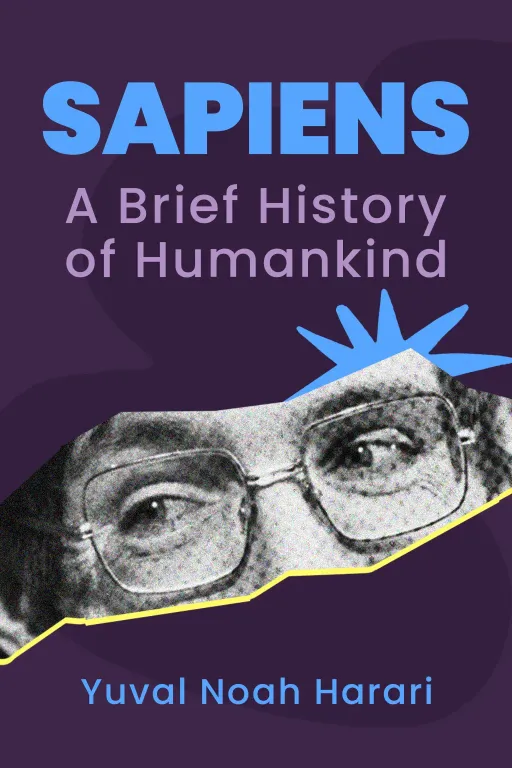
Nova: Today, we're diving into how two groundbreaking books challenge these fixed notions. We’re looking at "Sapiens: A Brief History of Humankind" by Yuval Noah Harari, a historian and philosopher who makes incredibly complex ideas accessible to millions, and "Guns, Germs, and Steel" by Jared Diamond, a physiologist and evolutionary biologist whose unique scientific lens on history earned him a Pulitzer Prize. They both offer powerful counter-narratives to what we typically assume.
Atlas: That's a fascinating pairing. I'm curious how these different perspectives – one from a historian, one from a scientist – converge on such a profound idea.
The Power of Shared Fictions: Harari's Sapiens
SECTION
Nova: Well, let's start with Harari. What do you think truly binds millions of strangers together, allowing them to cooperate on a massive scale, far beyond what any other animal can do?
Atlas: Well, common goals, maybe shared values? A good leader?
Nova: All true, but Harari goes deeper. He argues it's our unique human ability to create and believe in what he calls 'shared fictions' or 'inter-subjective realities.' These aren't lies in the negative sense, but powerful collective myths that exist only in our shared imagination.
Atlas: Okay, but 'fictions' sounds a bit like 'make-believe.' How can something made up be so powerful? Can you give an example?
Nova: Absolutely. Think about money. It's just paper, or numbers on a screen. It has no intrinsic value. But because billions of people across the globe collectively it has value, it functions as an incredibly powerful tool for cooperation. Or consider a corporation. It's not a physical entity, it's a legal fiction, a story we've all agreed to.
Atlas: That's incredible. So, the concept of a country, or even human rights, they're also these shared fictions? They only exist because we all collectively agree they do?
Nova: Exactly. Harari traces this back to what he calls the Cognitive Revolution, about 70,000 years ago. That's when Homo sapiens developed the capacity for language rich enough to create stories, myths, and legends. This ability allowed us to imagine things that don't physically exist, like gods, spirits, or abstract concepts, and crucially, to get large groups of people to believe in the imagined things.
Atlas: So, the cause was a cognitive leap, the process was storytelling and collective belief, and the outcome was global trade, complex societies, and literally everything we understand as civilization. That's astonishing. It challenges the very foundations of how I see society. It's like realizing the loyalty people have to a sports team is based on a story they all believe in, not just the players on the field.
Nova: That's a perfect analogy, Atlas! It's not that these fictions are 'false.' They are incredibly real in their consequences and utility. They allowed our ancestors to cooperate in numbers far exceeding the typical social groups of other primates, which are limited by personal knowledge and direct relationships. This ability enabled us to build cities, empires, and global networks. It’s how cultures shift and evolve, by changing the stories we tell ourselves.
Geography as Destiny: Diamond's Guns, Germs, and Steel
SECTION
Nova: Now, while Harari looks at the internal human mind and its capacity for shared beliefs, Jared Diamond in "Guns, Germs, and Steel" looks at something entirely different: the external world. He argues that environmental and geographical factors, not inherent racial or cultural superiority, were the primary drivers of historical trajectories and power dynamics.
Atlas: That sounds like a big claim. Does it mean human agency doesn't matter, or that our choices are just predetermined by where we live?
Nova: Not at all. It's about understanding the deep, often unacknowledged, roots of historical inequality. Diamond doesn't deny human choices, but he asks: what were the factors that gave some societies a head start? He focuses on the "proximate factors" like guns, germs, and steel, but then dives into the "ultimate factors": geography, climate, and the availability of domesticable plants and animals.
Atlas: Okay, so give me an example of how a mountain range or a specific crop could change history on a global scale.
Nova: Let's consider the classic example: the divergent development of Eurasia versus the Americas. Eurasia stretches primarily along an East-West axis. This allowed for the relatively easy spread of domesticable plants and animals, like wheat, barley, cows, and horses, across similar latitudes and climates. Innovations in agriculture or technology in one region could spread relatively quickly across the entire continent.
Atlas: So, the cause was the East-West axis, the process was the rapid diffusion of resources and knowledge, and the outcome was faster agricultural development, denser populations, and more robust technologies.
Nova: Precisely. Now, compare that to the Americas, which primarily lie on a North-South axis. Spreading crops from, say, modern-day Mexico to the Andes, meant traversing vastly different climates and ecological zones. A crop adapted to a temperate zone might not survive in a tropical one. This significantly slowed the diffusion of agriculture, animals, and technology. Furthermore, Eurasia had a much larger pool of domesticable large mammals, vital for labor, transport, and protein, which were largely absent in the Americas.
Atlas: Whoa. So, the simple fact of continental orientation and the presence of certain animals dictated which societies developed farming, writing, and metalworking faster? That's astonishing. It completely reframes why certain civilizations appeared to be 'more advanced' at the time of European contact. It’s not about their people, it’s about their planet.
Nova: Exactly. Diamond's work isn't about excusing historical actions, but about understanding the profound, often invisible, environmental advantages that some societies had. It's a powerful counter-narrative to traditional explanations that often leaned on racial or cultural superiority. It forces us to reconsider the 'inevitability' of certain historical outcomes.
Synthesis & Takeaways
SECTION
Nova: So, when we put Harari and Diamond together, we see two different but complementary lenses for deconstructing 'fixed' historical views. Harari shows us the power of the stories we tell and believe, while Diamond reveals the profound influence of the ground we stand on. Both dismantle the idea of history as an inevitable march, showing it as a series of contingent events shaped by constructed narratives and environmental luck.
Atlas: It brings us right back to that deep question from the book content: "What widely accepted 'truth' about our culture might actually be a powerful, yet constructed, historical narrative?" I imagine a lot of our listeners are now looking at their daily lives, their countries, their economies, and wondering which parts are 'real' and which are just very, very powerful stories. How can we apply this deconstructive lens ourselves?
Nova: The key is active, curious learning. It's about developing a critical skepticism towards any 'truth' that feels too simple or too absolute. When you encounter a widely accepted idea—whether it's about the 'spirit of capitalism,' the 'destiny of a nation,' or even the 'natural order of things'—ask yourself: Is this a story we've agreed to believe? Who benefits from this story? Or, from Diamond's perspective, what environmental or geographical factors might have subtly shaped this reality over millennia?
Atlas: So, it's about always being willing to question the foundations, to dig deeper than the surface narrative. It’s about understanding the 'why' behind the 'what.'
Nova: Precisely. It allows us to interpret current cultural phenomena with far greater nuance and frees us from the blind spots of linear thinking. It truly makes you a more insightful observer of the human story.
Nova: What 'inevitable' aspect of our world might just be a story we've collectively decided to believe, or a path carved by ancient geography?
Atlas: That's a question I'll be pondering all week.
Nova: This is Aibrary. Congratulations on your growth!