The Strategist's Guide: Crafting Unbeatable Plans with Foresight
9 minGolden Hook & Introduction
SECTION
Nova: Atlas, quick — what's the first thing that comes to your mind when I say 'strategy'?
Atlas: Oh, Nova, easy! It's that fancy word people use in meetings to sound smart right before they announce another 'synergy' initiative. It’s usually followed by a lot of head-nodding and then… not much actual change.
Nova: You're not wrong! It's often tossed around like a magical incantation, isn't it? But today, we're cutting through the buzzwords to explore what a strategy really is, and how to craft one that actually wins. We’re drawing from seminal works that have shaped how leading thinkers approach complex problems, synthesized here in what we call.
Atlas: I love that. So, we're not just talking about big business, right? For our listeners who are building the future, who see the potential, but sometimes get bogged down in the 'how,' this is about making that vision tangible.
Nova: Exactly. It's for the innovators, the nurturers, the strategists among us who aren't content with just dreaming. It’s about transforming those dreams into a coherent action plan.
The Anatomy of True Strategy: Beyond Buzzwords
SECTION
Nova: So, let's dive into the core problem: most 'strategies' out there are actually just goals, or, as you perfectly put it, buzzwords. They're wishful thinking dressed up in corporate jargon.
Atlas: Oh, I know that feeling. "Our strategy is to be number one!" Or "Our strategy is innovation!" It sounds great on a slide, but then you're left wondering, 'Okay, but how do we that?'
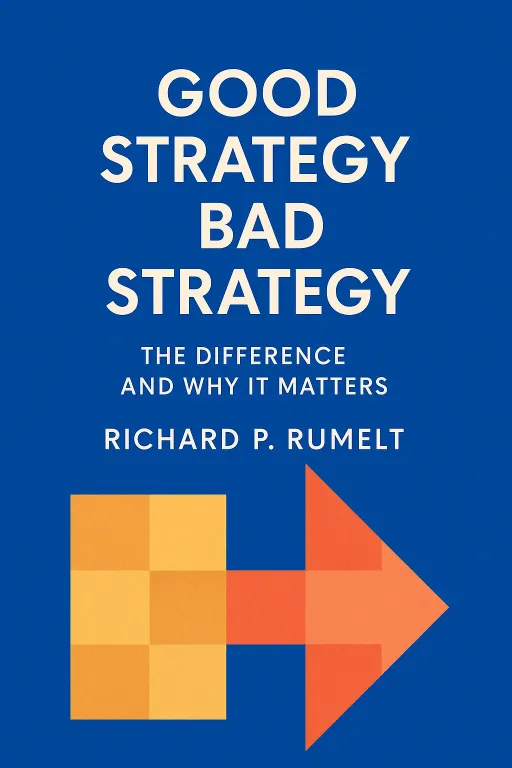
Nova: Precisely. Richard Rumelt, in his highly acclaimed book, cuts through this beautifully. He defines good strategy not as a declaration of ambition, but as a coherent action plan with three crucial components: a clear diagnosis, a guiding policy, and coherent actions.
Atlas: That makes sense. So, it’s not just about the destination, but understanding the terrain and having a map.
Nova: It’s even more fundamental than that. Think of it like a doctor. A bad 'strategy' would be a patient saying, "My strategy is to be healthy!" A good doctor starts with a: "You have a bacterial infection causing this specific inflammation." That’s the first step – identifying the critical challenge. What's the problem you're trying to solve?
Atlas: That’s a great analogy. For someone in a high-stakes tech environment, it might be diagnosing a product isn't gaining traction, not just saying, "Our goal is more users."
Nova: Exactly. Once you have that diagnosis, you move to a. This isn't a list of things to do; it's a high-level approach for dealing with the diagnosed challenge. For our doctor, it might be: "We will target the bacterial infection with broad-spectrum antibiotics while supporting the immune system." It's an overarching approach.
Atlas: That’s a subtle but critical distinction. It’s like, "We’re going to focus on customer retention through hyper-personalization," rather than just "We're going to keep customers." It’s the on a conceptual level.
Nova: And finally, the. These are the coordinated steps that implement the guiding policy. For the doctor, it's the specific prescription, the follow-up appointments, dietary advice. Each action makes sense in light of the policy and the diagnosis.
Atlas: So, it’s all connected. Diagnosis, then a high-level decision on how to tackle it, then the actual, specific steps. It’s like a chain reaction where each link is essential. I imagine a lot of our listeners, the integrated thinkers, are nodding right now, because they’ve probably seen strategies that skip a few of those links.
Nova: Absolutely. Let's take a hypothetical company, Zenith Corp., a once-dominant player now seeing its market share decline because its core product line is technologically outdated. A bad 'strategy' meeting might yield: "Our strategy is to regain market leadership by innovating!"
Atlas: And everyone claps, right?
Nova: Exactly. But a strategy, following Rumelt, would first diagnose: "Our core challenge is that competitor X has leapfrogged us with a new, more efficient microchip architecture, making our current offerings less competitive and costly to produce."
Atlas: Ouch. That's a cold, hard fact.
Nova: Then the guiding policy might be: "We will leverage our existing brand loyalty and supply chain advantages to rapidly develop and integrate a superior microchip technology, focusing on energy efficiency and modularity." It’s specific, it’s an approach.
Atlas: And the coherent actions would be… hiring top-tier engineers, investing heavily in R&D, perhaps even acquiring a smaller tech firm with that expertise, retooling manufacturing lines… all aligned.
Nova: Precisely. Each action feeds directly into that guiding policy, which addresses the initial diagnosis. That’s a strategy that solves a problem, not just states a desire.
Crafting Unbeatable Plans: Playing to Win and Nova's Take
SECTION
Nova: Now that we understand the anatomy of a true strategy, the next critical step is how to make it. How do you move from understanding what strategy is, to actually crafting one that leads to success? This is where A. G. Lafley and Roger L. Martin’s insights from become incredibly powerful.
Atlas: I’ve been thinking about this. For someone who sees the future and is building it, the "where to play" and "how to win" framework sounds like a blueprint for their vision.
Nova: It absolutely is. Lafley and Martin simplify strategic choice into two fundamental questions: "Where will you play?" and "How will you win?" These aren't just questions; they force clarity and focus, which are the hallmarks of a great strategy.
Atlas: So "where to play" isn't just about geography, is it? It's about markets, customer segments, product categories...
Nova: Exactly. It's about defining the arena where you to compete. For a startup like EcoInnovate, aiming to disrupt the sustainable packaging market, "where to play" could be: "We will focus on biodegradable packaging solutions for the luxury cosmetics industry, specifically targeting mid-sized brands committed to eco-friendly practices." It's tight, it's defined.
Atlas: That makes sense. It’s not trying to be everything to everyone. It’s about being deliberate. But then, "how to win" feels like the real puzzle. How do you stand out in that specific arena?
Nova: This is where you identify your unique advantage. For EcoInnovate, "how to win" might be: "We will win by offering superior material science that provides genuinely compostable packaging without compromising on aesthetics or durability, backed by a premium, personalized design service."
Atlas: That’s a clear differentiator. It tells you exactly what they’re going to be at. So, it's not just about being the game, but having a clear plan to your chosen segment.
Nova: That's it. It creates a clear path to success because you've deliberately chosen your battleground and your weapon. And this connects perfectly with what we call Nova's Take on strategy: a strong strategy isn't just about what you want to achieve, but how you will specifically get there, tackling real obstacles. It’s about designing the bridge, not just drawing the destination.
Atlas: That gives me chills. That's actually really inspiring for anyone who feels like they have a clear vision but are struggling with the execution. It’s about being a strategic architect. But what about when your diagnosis is wrong, or the market shifts? How do you keep a guiding policy from becoming rigid?
Nova: Great question. That's where the "foresight" in comes in. It’s not about being static, but about building in adaptive capacity, which is a topic for another day. However, the initial clarity provided by these frameworks gives you a solid foundation to adapt, rather than flailing in uncertainty.
Synthesis & Takeaways
SECTION
Nova: So, to bring it all together, what we've explored today is that true strategy is a coherent action plan. It's not a fuzzy goal or a trendy buzzword. It's about a clear diagnosis of the challenge, a guiding policy for how you'll approach it, and coherent actions that are all aligned.
Atlas: Right, like Rumelt says, it’s problem-solving, not wishful thinking. And then, as Lafley and Martin show us, it's about making those deliberate choices: where you'll play, and how you'll win, to carve out an unbeatable position.
Nova: Exactly. The real impact for our listeners—the innovators, the nurturers, the strategists—comes from recognizing that you don't just see the future; you architect the bridges to it by understanding the obstacles and designing a coherent path. It’s about designing a real path, not just drawing a destination.
Atlas: That’s such a hopeful way to look at it. It empowers you to act. So, for our listeners, here’s your tiny step: take one of your current goals. Can you clearly articulate the main challenge to achieving it, and then define a specific, coherent action to address that challenge?
Nova: And think about it: is that action truly coherent with a guiding policy, or is it just another item on a to-do list? It’s about turning intention into impact.
Atlas: That’s a fantastic challenge. It really forces you to apply these ideas.
Nova: This is Aibrary. Congratulations on your growth!