

The Strategic Blind Spot: Why Planning Alone Isn't Enough
9 minGolden Hook & Introduction
SECTION
Nova: The pressure to plan, plan, plan is immense in every industry. We're told meticulous strategy is the key to success. But what if all that brilliant, painstaking planning is actually setting you up for failure? What if your most carefully constructed strategy is, in fact, your biggest strategic blind spot?
Atlas: Wait, hold on. You're telling me the very thing we're taught to do, the foundation of every successful business, could be our undoing? That's a pretty bold claim, Nova. I imagine a lot of our listeners, especially those who pride themselves on their analytical acumen, are feeling a jolt right now.
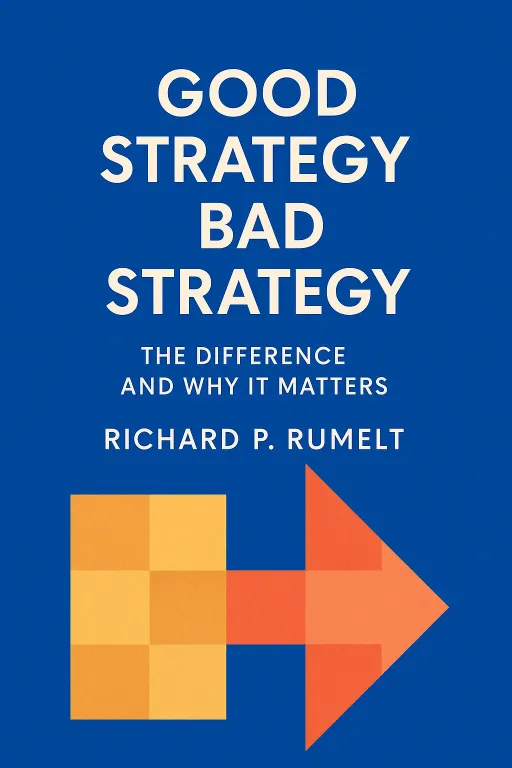
Nova: Absolutely, Atlas. And it's a jolt we need. Today, we're dissecting that very idea by looking at the profound insights from Richard Rumelt's seminal work,. Rumelt, a celebrated professor of business and society at UCLA, is known for his sharp, no-nonsense approach to strategic thinking. He's not afraid to call out the emperor's new clothes in the world of corporate strategy, which is exactly why this book has resonated so deeply with leaders and thinkers across industries. It’s been widely acclaimed for cutting through the fluff.
Atlas: Okay, so this isn't just another management book with feel-good platitudes. Rumelt is delivering a reality check.
Nova: Precisely. And the cold, hard fact he lays out is this: even the most brilliant strategy can spectacularly fail if it doesn't account for the unpredictable nature of competition and change. Relying solely on static plans leaves you incredibly vulnerable when reality inevitably shifts.
The Illusion of Static Planning
SECTION
Atlas: That makes me wonder, can you give an example? I mean, for our listeners who are confident builders, who put immense effort into their blueprints, how does a 'brilliant' plan go so wrong?
Nova: Let's consider the classic case of Blockbuster. In the early 2000s, Blockbuster had a dominant market position, a massive infrastructure of stores, and a seemingly brilliant plan to expand and maintain its physical footprint. They were masters of logistics, real estate, and merchandising. Their plan was to keep optimizing the physical rental experience.
Atlas: Right, I remember those Friday night trips. Seemed like an unbeatable model at the time.
Nova: Exactly. Their plan was brilliant for the world they were in. But their strategic blind spot was the unpredictable nature of technological change and competition. Netflix emerged, not as a direct competitor initially, but as a DVD-by-mail service. Blockbuster saw it, even had a chance to acquire them, but their static, store-centric plan prevented them from truly grasping the paradigm shift that was coming. They were so focused on optimizing their existing model, they couldn't pivot.
Atlas: So basically, their detailed plan became a cage. They built this incredible machine, but the world moved on, and the machine couldn't adapt. That’s probably going to resonate with anyone who's seen their industry disrupted.
Nova: Think about it like a highly detailed battle plan drawn up days before a conflict. It might be brilliant on paper, accounting for every known variable. But the moment the first shot is fired, and the enemy makes an unexpected move, that static plan can become a liability. A good general doesn't just execute the plan; they adapt, diagnose, and respond in real-time. Blockbuster's plan was like that general who just kept reading the original blueprint while the battle raged around them.
Atlas: That's a perfect analogy. It’s not that planning is inherently bad, but it sounds like the of the plan, the inability to see beyond its boundaries, is the real danger. So, for someone who's spent months, maybe even years, crafting a strategic roadmap, how do they know if it's becoming a blind spot?
Nova: That's the million-dollar question, isn't it? It's when you start prioritizing the plan itself over the reality it's supposed to address. When you ignore market signals, dismiss competitor innovations, or rationalize away internal challenges just to stick to the script. That’s when your strategy stops being a guide and starts being a delusion. It’s the difference between a map and the actual terrain. You can have the most beautiful map, but if the river has changed course, following the old map will get you nowhere.
Good Strategy vs. Bad Strategy: Identifying the Crux
SECTION
Atlas: That makes sense, but how do you break free from that rigidity? This leads us perfectly to Rumelt's brilliant distinction between good and bad strategy. What does he mean by a 'good strategy' identifying the 'crux' challenge?
Nova: Oh, the 'crux' is where the magic happens. Rumelt argues that a good strategy doesn't just list goals; it identifies the – the 'crux' – and then applies a coherent set of actions to overcome that specific obstacle. It's about diagnosis, not just aspiration. It's the bottleneck, the Gordian knot, the one thing that, if solved, unlocks everything else.
Atlas: So it's not just any problem; it's problem. Can you give an example of a company that nailed this 'crux' identification?
Nova: Absolutely. Think about Apple when Steve Jobs returned in the late 90s. The company was bleeding money, had too many products, and no clear direction. The previous strategy was essentially 'compete everywhere, make everything.' That was a bad strategy – a wishy-washy list of aspirational goals without a clear diagnosis.
Atlas: Right, like trying to be all things to all people. That sounds like a recipe for mediocrity.
Nova: Exactly. Jobs's diagnosis, his 'crux,' was that Apple had lost its focus and its soul. It was suffering from 'product bloat' and a diluted brand identity. His strategy wasn't to 'become number one in PCs' or 'increase market share.' His strategy was to. To kill off 70% of the product line, focus on four core products – two desktops, two portables – and to pour resources into design and user experience. That was the coherent set of actions to overcome the 'crux' of lost focus.
Atlas: Wow, that’s a perfect example. Identifying that core problem, the 'crux,' then everything else flows from there. So, if that's good strategy, what does 'bad strategy' look like in practice? Give me an example of the 'fluff and wishful thinking' Rumelt talks about.
Nova: Bad strategy, in Rumelt's view, often masquerades as strategy. It's full of high-sounding goals like 'maximize shareholder value' or 'achieve world-class excellence' without explaining to get there or is preventing it. It's often just a list of things management would happen.
Atlas: So, if I'm hearing you right, it's like a company saying, "Our strategy is to grow revenue by 20% next year," but without identifying they haven't grown by 20% before, or they'll take to overcome the current growth inhibitors.
Nova: Exactly! It's an objective, not a strategy. A bad strategy avoids making tough choices, or it sets goals that are inherently contradictory. It's a strategy that doesn't acknowledge the 'crux' – the difficult, often uncomfortable truth about what's really holding you back. It's the difference between saying "I want to be fit" and saying "I will eliminate sugar from my diet and run 5k three times a week to address my high cholesterol".
Atlas: That's a great way to put it. For our listeners, especially those analytical strategists who are always trying to ground their approach, Rumelt's book really helps you dissect your own strategic approaches. It ensures your plans are not just well-intentioned, but also robust and actionable in the face of uncertainty. The tiny step he recommends, I think, is incredibly powerful: Review your current strategic plan. Can you clearly identify the 'crux' challenge it aims to overcome?
Synthesis & Takeaways
SECTION
Nova: That question, Atlas, is the ultimate diagnostic tool. Because ultimately, a good strategy isn't about having the longest list of initiatives or the most ambitious vision. It's about having the sharpest diagnosis of the challenge, and then designing a focused, coherent attack to overcome it. It's about facing reality, not wishing it away.
Atlas: It’s a profound shift from thinking about strategy as a destination to strategy as a continuous process of diagnosis and adaptation. For anyone driven by tangible growth, this book isn't just theory; it's a practical guide to making sure your efforts actually lead somewhere meaningful, rather than just spinning your wheels against an invisible obstacle.
Nova: Precisely. The core insight here is that planning alone isn't enough. It's the of your strategic thinking – your ability to identify the real challenge and then craft a response that is both coherent and adaptable – that truly matters. It’s about building resilience and clarity, not just a static blueprint.
Atlas: So, for our listeners, the question isn't just 'Do I have a plan?' but 'Is my plan addressing the right problem, and is it flexible enough to handle the inevitable curveballs?' It's about being a strategic thinker, not just a strategic planner.
Nova: Absolutely. And that leads us to a crucial reflective question for all of you out there: What is the true 'crux' challenge you're currently facing, that your current plans might be overlooking or not adequately addressing? Think about it.
Nova: This is Aibrary. Congratulations on your growth!









