The Growth Trap: Why You Need to Rethink Your Business Strategy.
8 minGolden Hook & Introduction
SECTION
Nova: If your business strategy is just 'grow bigger, grow faster,' you're probably driving blind. That's not strategy; it's a wish list, and frankly, it's dangerous.
Atlas: Whoa, Nova, dangerous? That's a strong word for what many people consider the ultimate business goal! I imagine a lot of our listeners have been told exactly that: "Grow, grow, grow!"
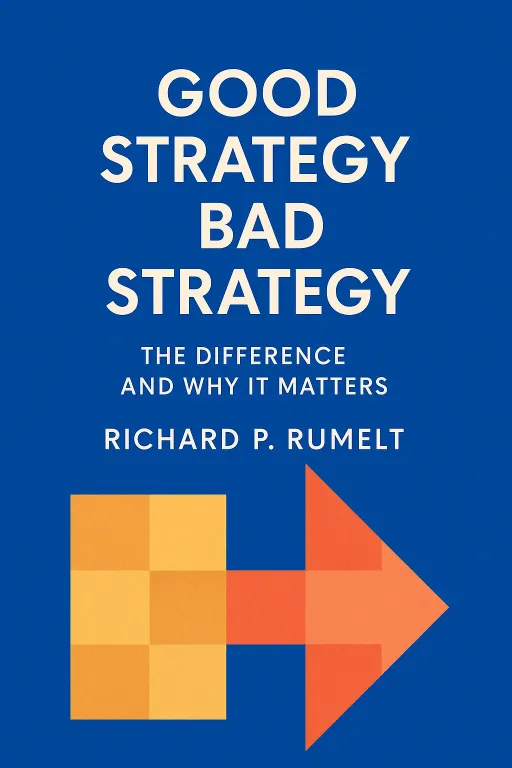
Nova: Exactly, Atlas. And that's precisely the growth trap we're talking about today. It's the blind spot that many businesses fall into, mistaking ambitious goals for a coherent, actionable strategy. We're diving into this crucial distinction, drawing on the wisdom of two strategic titans: Richard Rumelt's "Good Strategy Bad Strategy" and A. G. Lafley and Roger L. Martin's "Playing to Win." Rumelt, often called the "strategist's strategist," spent decades advising top corporations and then wrote this incredibly blunt, no-nonsense critique of what he calls 'bad strategy.'
Atlas: Okay, so he's not pulling any punches. That makes me wonder, what does this "blind spot" actually look like in the wild? Can you give us an example of a company that's just chasing growth, but missing the strategy?
The Blind Spot: Why Goals Aren't Strategy
SECTION
Nova: Absolutely. Let's imagine a hypothetical tech startup, let's call them "Skyrocket Solutions." Their CEO is charismatic, and their big goal is "10x user growth in 18 months!" Sounds exciting, right?
Atlas: Sounds like every startup pitch I've ever heard! High energy, big numbers. What's wrong with that?
Nova: What's wrong is that it’s just a goal. There's no underlying diagnosis of they're not growing, or they need to overcome to achieve that growth. They just throw money at marketing, build features randomly, and hope for the best. Resources are wasted, teams are burnt out, and they eventually hit a wall because they never truly understood the terrain.
Atlas: That sounds like a lot of frustration, and honestly, a lot of wasted effort. So, Rumelt would call that a classic case of bad strategy?
Nova: Precisely. Rumelt argues that a strategy has three essential components. First, a clear of the challenge. Not just 'we need more users,' but 'our onboarding process is too complex, leading to a 70% drop-off from sign-up to first active use.' Second, a for dealing with that challenge. This isn't a vague aspiration; it's a focused approach, like 'simplify the user journey to five clicks or less, prioritizing immediate value over feature breadth.'
Atlas: Hold on, Nova. Diagnosis, guiding policy, coherent actions... that sounds a bit academic. How is that genuinely different from just having a really good plan? Isn't it just fancy words for common sense, for a lot of our listeners who are just trying to get things done?
Nova: That’s a great question, Atlas, and it gets to the heart of it. The difference lies in the. A good diagnosis identifies the fundamental obstacle that, if overcome, unlocks significant progress. It’s like a doctor diagnosing a rare disease versus just treating a fever. And the guiding policy isn't just any plan; it's a focused approach that on that specific diagnosis. It explicitly says "we will do and, by implication,."
Atlas: Oh, I see. So it's not just listing things to do; it's about pinpointing the to fix, and then having a laser focus on that. That’s a huge insight. So the third part, "coherent actions," flows directly from that.
Nova: Exactly. Coherent actions are the coordinated steps designed to carry out that guiding policy. For Skyrocket Solutions, instead of random feature development, it would be a series of focused sprints to redesign the onboarding, A/B test new flows, and measure drop-off rates, all aligned with the guiding policy of simplification. It's about a chain of activities that mutually reinforce each other.
Playing to Win: Making Integrated Strategic Choices
SECTION
Nova: Speaking of making tough, focused choices, that leads us perfectly to our second big idea from A. G. Lafley and Roger L. Martin's "Playing to Win." While Rumelt gives us the structure for strategically, Lafley and Martin show us how to strategically through what they call "integrated choices."
Atlas: Integrated choices. That sounds powerful. What does that mean in practice?
Nova: It means strategy isn't just about setting goals or even just diagnosing problems; it’s about making five interconnected, deliberate choices. They call them the "cascade of choices": What is our winning aspiration? Where will we play? How will we win? What capabilities must be in place? And what management systems do we need? The magic is in the.
Atlas: So it's about connecting all the dots, not just having a good idea for one part of the business. Can you give an example of a company that really nailed this "where to play and how to win" aspect?
Nova: Imagine a struggling consumer goods company with a detergent brand, let's call it "CleanSweep." They're losing market share, trying to compete on price, and failing. Their "winning aspiration" was vague: "be a leading detergent brand." Lafley and Martin would say that's not enough.
Atlas: Right, like our "10x user growth." So how do they get out of that rut?
Nova: They apply the framework. They realize they can't win everywhere. So, they make a deliberate "where to play" choice: "We will focus on the eco-conscious, premium segment for laundry detergents, targeting urban families with higher disposable income." That's a huge "no" to the mass market.
Atlas: Oh, I see. That’s a tough decision, because it means giving up a lot of potential customers.
Nova: It is, but it's strategic. And then comes the "how to win" choice: "We will win by offering superior cleaning performance with plant-based, sustainably sourced ingredients, delivered in innovative, recyclable packaging, and building a community around eco-friendly living."
Atlas: That’s a complete shift! So it's not just market segmentation, it's about building a unique, defensible position. But isn't "how to win" just competitive advantage? What's the revolutionary insight here for a curious learner who's already read a few business books?
Nova: The truly profound insight, Atlas, is the and the. It’s not just about having a sustainable product; it’s about how that choice with your packaging, your distribution channels, your marketing message, and even your internal R&D capabilities. Every part of the business reinforces that "where to play" and "how to win." It’s a complete, mutually reinforcing system. True strategy isn't about doing; it's about making difficult trade-offs and building a coherent, winning system.
Atlas: That’s a great way to put it. It’s like a sports team: their strategy isn't just picking good players—where to play—but how they to exploit weaknesses and achieve victory. If one part of the system is out of sync, the whole thing falls apart.
Nova: Exactly! And this framework helps you build that coherence. Think of the companies that fail because they try to "play everywhere" and "win every way." They end up with diluted products, confused customers, and exhausted employees. They haven't made those integrated, tough choices.
Synthesis & Takeaways
SECTION
Nova: So, Atlas, what we're really talking about here is moving beyond fuzzy aspirations to sharp, deliberate choices. Rumelt gives us the structure for strategically, helping us diagnose the real challenge, and Lafley and Martin show us how to strategically by making integrated choices about where and how to win.
Atlas: For our listeners who are constantly trying to navigate complex challenges in their own work or even personal projects, this isn't just academic. It's about taking control of your destiny, instead of just hoping for the best. But what's the single most important thing they can do to apply this, starting today?
Nova: I love that question. Here's a concrete step: Look at your current business plan, or even your personal goals. Can you clearly articulate the it's solving? Not just the goal itself, but the critical challenge that, if you conquer it, will truly unlock progress? If you can't articulate that specific problem, you're likely in the blind spot, and it's time to start with that diagnosis.
Atlas: That's actually really inspiring. It's about clarity over ambition, and deliberate action over wishful thinking. A powerful call to truly rethink your strategy.
Nova: Absolutely. It's how you build something truly resilient and successful.
Atlas: This is Aibrary. Congratulations on your growth!