Stop Guessing Your Next Move: The Guide to Strategic Certainty
8 minGolden Hook & Introduction
SECTION
Nova: Most strategic plans, Atlas, they gather dust, not dividends. And the problem usually isn't a lack of ambition; it's a fundamental misunderstanding of what strategy.
Atlas: Oh, I love that. Because honestly, I imagine a lot of our listeners, myself included sometimes, have been in meetings where we craft these beautiful, soaring mission statements and then… nothing really changes. It feels like we're just guessing our next move.
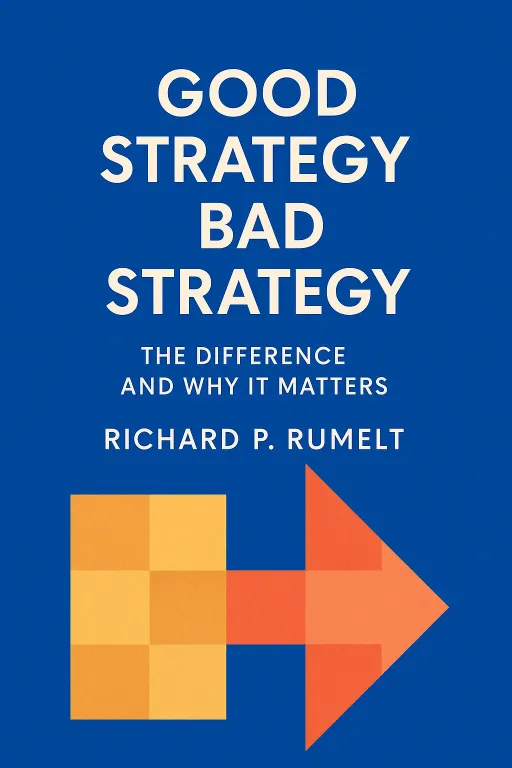
Nova: Exactly! And that's precisely what we're tackling today, moving from that guessing game to strategic certainty. We're diving into the core ideas behind "Stop Guessing Your Next Move," which draws heavily on giants like Richard Rumelt's "Good Strategy Bad Strategy" and Clayton M. Christensen's "The Innovator's Dilemma."
Atlas: Those are heavy hitters. I mean, Christensen's work, especially, has reshaped how we think about entire industries.
Nova: Absolutely. And Rumelt, in particular, developed his insights not from an ivory tower, but from decades of advising companies literally battling strategic failures. His work is incredibly grounded, battle-tested, and frankly, a breath of fresh air when you're drowning in corporate jargon.
Atlas: That makes sense. Because for anyone out there trying to gain a competitive advantage, trying to master their field, it's not enough to just a plan. It has to be a plan that. So, where do we even begin with understanding what a strategy looks like, if so many go wrong?
Nova: Well, let's start by flipping that on its head. To truly understand good strategy, we first need to expose the silent killers – what Rumelt calls "bad strategy."
The Silent Killers of Strategy
SECTION
Nova: So, bad strategy, at its core, isn't just about making a mistake. It's often about avoiding choice, setting vague goals, or, and this is a big one, mistaking fluff for substance. Think of it like a diet plan. A bad diet plan isn't one that just fails; it's one that says, "Eat healthy and exercise more."
Atlas: Oh, I know that feeling. That’s like ninety percent of New Year's resolutions right there. It sounds good. It feels right. But then you’re staring at a fridge full of… options.
Nova: Precisely! There's no specific action, no critical challenge identified, no focused power. Rumelt argues that a good strategy identifies a and then focuses power on them. Bad strategy, on the other hand, often avoids those tough choices. It'll throw out buzzwords like "synergy" or "innovation" without actually defining what those mean or how they'll be achieved.
Atlas: That makes me wonder, how do you tell the difference when everyone's talking about 'digital transformation' or 'leveraging AI'? It all sounds important. How do you separate the fluff from the actual substance?
Nova: It's a fantastic question, and it comes down to what Rumelt calls the "kernel" of strategy. A good strategy has a kernel: a diagnosis of the challenge, a guiding policy for dealing with it, and coherent actions. A bad strategy often lacks this kernel. Let me give you an example. Imagine a large tech company, let's call them 'GlobalTech,' facing declining market share. Their CEO announces a new "vision to be the leading innovator in the global digital ecosystem."
Atlas: Sounds impressive on paper. Very aspirational.
Nova: Right? But then, when you dig deeper, the "strategy" is just a list of initiatives: "invest more in R&D," "enhance customer experience," "expand into new markets." There's no clear diagnosis of market share is declining. Is it competition? Outdated products? A shift in customer needs? Without that clear diagnosis, the guiding policy is vague, and the actions are just a scattershot of good intentions. The result? Wasted resources, internal confusion, and ultimately, continued decline.
Atlas: So, if I'm looking at my own team's quarterly plan, or even my personal career growth plan, what's a red flag that it might be 'bad strategy'? Is it just a list of things to do without a clear 'why'?
Nova: Exactly. If you can't clearly state the core challenge you're trying to overcome, and the single most important action you're going to take to overcome, you might be dealing with bad strategy. It's about honesty, not just ambition. It's about focusing your power, not spreading it thin across a dozen vague goals.
Atlas: I can see how that would be a game-changer for anyone trying to carve out a niche or accelerate their growth. You need that focus.
The Innovator's Trap
SECTION
Nova: And that naturally leads us to the second key idea we need to talk about, which often acts as a counterpoint to what we just discussed: even if you have a "good strategy," success itself can be a trap. This is where Clayton Christensen’s "The Innovator's Dilemma" comes in, showing how even hugely successful companies can fail by sticking to old strategies and missing disruptive innovations.
Atlas: That sounds counterintuitive. Why would success make you blind? Wouldn't you be aware of what's happening in the market if you're at the top? It feels like those companies should be the ones leading the charge.
Nova: You'd think so, wouldn't you? But Christensen’s research reveals a profound truth: successful companies, driven by their existing customers and profit models, often dismiss new, "disruptive" technologies or business models because they initially offer lower margins or don't appeal to their best customers. They listen to their current market, which tells them to keep doing what they're doing.
Atlas: So, they're too good at what they do, almost?
Nova: Precisely. Let's use the classic example: Blockbuster versus Netflix. In Blockbuster's heyday, they were the undisputed king of video rentals. Their strategy was clear: convenient physical stores, new releases, late fees – a highly profitable model. When Netflix started with mail-order DVDs, Blockbuster executives looked at it and thought, "Who wants to wait for a DVD in the mail? And the margins are terrible!"
Atlas: I remember that! It seemed so clunky compared to just walking into a store.
Nova: Right. Then, when streaming emerged, they again dismissed it as a niche for tech enthusiasts with slow internet. Their best customers weren't asking for it, and it didn't fit their existing, highly profitable business model. They were strategically blind to the future because they were so good at optimizing their present. They kept investing in their successful physical stores, while Netflix was busy building the infrastructure for the future.
Atlas: Wow. That's a bit like what happens in careers too. You get really good at one thing, become a specialist, and then a new tool or technology emerges that completely changes the game. For those of us trying to become recognized specialists, how do we spot the 'disruptive innovations' in our own careers or departments before they eat our metaphorical lunch?
Nova: It comes down to a willingness to honestly assess, even when things are going well. It’s about not letting your current success blind you to potential future threats or opportunities. It means actively seeking out what looks "unprofitable" or "niche" today, because that's often where tomorrow's disruption lies. It requires a certain amount of intellectual humility and a willingness to sometimes cannibalize your own success before someone else does.
Atlas: That’s a tough ask, especially when you're focused on measurable outcomes and immediate ROI. It's about looking beyond the immediate, isn't it?
Synthesis & Takeaways
SECTION
Nova: Absolutely. So, bringing these two powerful ideas together, strategic certainty isn't about having a crystal ball. It's about two things: first, having a that honestly diagnoses a core challenge and focuses your power to overcome it, avoiding the fluff and vague aspirations. And second, it's about avoiding the by constantly reassessing, even when you're successful, and being open to disruption, even if it means changing what currently works.
Atlas: So, it’s not just about having a plan, it's about having a plan that tackles a problem, and then being brave enough to change it even when things are going well. That's going to resonate with anyone who's trying to get ahead and achieve tangible improvement.
Nova: Exactly. And that brings us to our tiny step for today. I want every listener to identify one current project they're working on. Can you clearly state its core challenge? And then, can you identify the single most important action to overcome?
Atlas: That's incredibly practical. It forces you to cut through the noise and get to the essence. For anyone cultivating growth and seeking to master their craft, that kind of clarity is your competitive advantage. Don't just guess your next move. Make it with certainty.
Nova: A perfect distillation, Atlas. It's about turning insights into real progress, not just good intentions.
Atlas: Fantastic stuff, Nova. This is Aibrary. Congratulations on your growth!