The Invisible Threads: Mastering Stakeholder Relationships for Influence
Golden Hook & Introduction
SECTION
Nova: Most people think negotiation is about winning. You go in, you fight, you conquer. But what if that 'win' is actually the biggest loss you could possibly suffer, especially when it comes to long-term relationships?
Atlas: Oh, I love that. The 'victory' that costs you everything. That's going to resonate with anyone who's ever felt the sting of a hollow win. So, how do we avoid that kind of Pyrrhic victory?
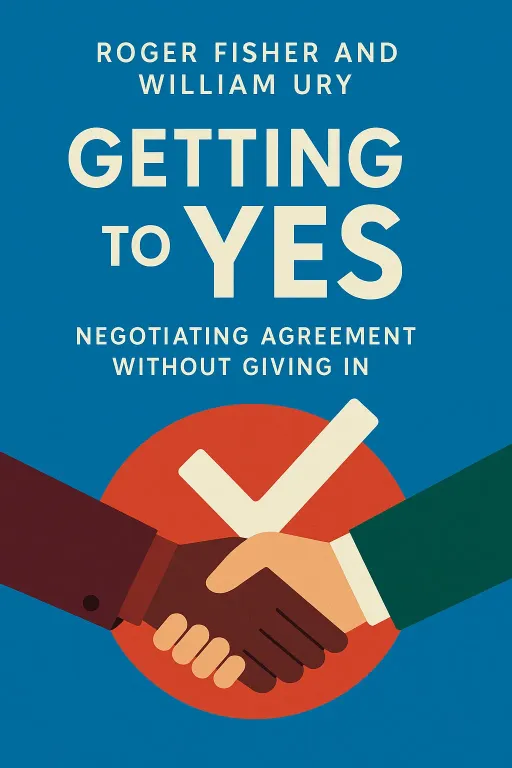
Nova: Precisely. And that's where two absolutely foundational works come in: by Roger Fisher and William Ury, and by Robert Cialdini. These aren't just books; they're blueprints for transforming how we interact, how we gain allies, and how we build power through collaboration, not conflict. They've fundamentally shifted our understanding of human interaction in both professional and personal contexts, becoming cornerstones in the fields of negotiation and persuasion.
Atlas: They're like the secret decoder rings for human interaction, aren't they? Offering insights into why people do what they do, and how we can navigate those dynamics more effectively.
Nova: Exactly. And today, we're pulling back the curtain on the invisible threads that truly master stakeholder relationships. We'll dive deep into this from two perspectives. First, we'll explore how to transform negotiations by focusing on shared interests, then we'll discuss the subtle, ethical principles of influence that can build stronger, more productive relationships.
From Positional Battles to Shared Interests: The 'Getting to Yes' Revolution
SECTION
Nova: So, let's start with. The core idea is simple, yet revolutionary: don't bargain over positions.
Atlas: What do you mean, 'don't bargain over positions'? Isn't that what negotiation? I want X, you want Y, we meet in the middle?
Nova: That’s the classic, often destructive, approach. Fisher and Ury argue that when you cling to positions – "I demand this price," "I will only accept these terms" – you create an adversarial dynamic. It becomes a test of wills, often leading to stalemates or suboptimal outcomes. The problem is, you're locked into a rigid stance, and there’s very little room to maneuver without losing face.
Atlas: That sounds rough, but how do you bargain over positions? What's the alternative? Because for our listeners who are constantly in high-stakes discussions, simply abandoning their stance feels counter-intuitive.
Nova: The alternative is to focus on. Behind every position, there are deeper needs, desires, and concerns – those are the interests. Think about the classic story of two chefs arguing over having the last orange. One says, "I need the orange!" The other says, "No, need the orange!" That's positional bargaining. It's a zero-sum game.
Atlas: Okay, so how do you get past the orange? Do you just cut it in half?
Nova: You ask. You uncover their interests. One chef might need the peel for zest in a cake, the other might need the juice for a sauce. Their were identical – "I want the orange" – but their were completely different, and non-conflicting. Once those interests are known, you can easily find a win-win: one gets the peel, the other gets the juice. Both walk away satisfied, with their underlying needs met, and crucially, their relationship intact.
Atlas: That's a great way to put it. So, basically, you're saying, dig deeper to find the 'why' behind the 'what.' For our listeners who are often mediating complex team projects or strategic partnerships, this must be gold. It’s not about who gets the budget, but what the budget for each department.
Nova: Precisely! It's about separating the people from the problem. Attack the issue, not the person. And then, invent options for mutual gain. Don't assume there's a fixed pie. Often, once you understand interests, you can expand the pie, finding creative solutions that weren't apparent when everyone was just shouting their demands.
Atlas: But wait, looking at this from a high-stakes business perspective, isn't that a bit naive? What if the other side really want the whole orange, peel and all? What if their interest to dominate, or to extract maximum value at your expense?
Nova: Excellent question, Atlas. That's where also emphasizes knowing your BATNA – your Best Alternative To a Negotiated Agreement. It’s your walk-away point. If their interests are truly adversarial and you can't find mutual gain, you need to know your own power and alternatives. It’s not about being a pushover; it’s about being effective and self-aware enough to know when to walk away or when to push for your own legitimate interests. It’s about being principled, not soft.
Atlas: I see how that would be valuable. It gives you a strong foundation, so you're not negotiating from a place of desperation. It grounds your flexibility.
The Subtle Art of Ethical Influence: Cialdini's Principles in Action
SECTION
Nova: And that naturally leads us to the second key idea we need to talk about, which often acts as a powerful complement to interest-based negotiation: the subtle art of influence, as laid out by Robert Cialdini in his seminal work,. Cialdini, a renowned social psychologist, spent years studying what makes people say 'yes,' often without even realizing why.
Atlas: Ah, Cialdini. This is where we learn how to get people to say 'yes' without realizing they're being influenced, right? Sounds a bit… manipulative?
Nova: That's the common misconception, and Cialdini himself is very clear: these principles can be used unethically, but they are most powerful and sustainable when used ethically, to genuinely guide people towards mutually beneficial outcomes. He identifies six universal principles of persuasion. Let's touch on Reciprocity first.
Atlas: Reciprocity. So, if I scratch your back, you scratch mine?
Nova: Exactly. It's the ingrained human tendency to repay in kind what we have received. Think about how charities often send a small, unsolicited gift with a donation request. Even if it's just a personalized address label or a small notepad, that tiny gift significantly increases donation rates because people feel a subtle obligation to reciprocate. It’s a powerful, almost subconscious push.
Atlas: Wow, that’s so simple, yet powerful. I imagine a lot of our listeners in leadership roles might overlook the power of a genuine, small favor or an act of generosity to build goodwill before a difficult conversation. It’s like pre-loading the 'yes' button, building a foundation of trust and obligation.
Nova: Precisely. It’s about building social capital. It’s not about grand gestures, but consistent, thoughtful acts that create a sense of indebtedness. Another one is Social Proof.
Atlas: Oh, I know that feeling. Like when you see a restaurant packed, you automatically assume it's good, even if you've never tried it before.
Nova: Or when you're unsure about a decision, you look to what others are doing. Cialdini illustrates this brilliantly with the concept of canned laughter on sitcoms. Even though we, as viewers, intellectually know it's fake, it subtly signals to us that "this is funny," making us more likely to laugh along. In a business context, testimonials, case studies, or mentioning how many other successful companies use a service are all forms of social proof.
Atlas: That’s a bit like… if everyone else is doing it, it must be right. For people who are trying to introduce new ideas or practices into their organizations, highlighting where it’s already worked successfully elsewhere isn’t just selling; it’s leveraging a fundamental human tendency to follow the crowd, especially when there's uncertainty.
Nova: Absolutely. It reduces perceived risk and provides validation. It's not about fabricating success, but intelligently showcasing existing success stories. It provides comfort and a sense of belonging to a larger, successful group.
Atlas: So, it's about presenting your case not just on its merits, but also by showing that others, similar to your audience, have already embraced it. That can be incredibly persuasive, especially in environments where people are risk-averse.
Nova: Exactly. It taps into our inherent need for validation and belonging. And when you combine that with understanding interests from, you start to see how these invisible threads really weave together to create powerful, ethical influence.
Synthesis & Takeaways
SECTION
Nova: So, what we're really talking about here, blending Fisher and Ury with Cialdini, is moving beyond transactional interactions to truly relational ones. It’s about understanding the underlying human motivations—those deep interests—and then ethically leveraging the subtle principles of influence to build bridges, not walls. It’s about playing a longer game, creating lasting value and collaboration.
Atlas: That’s such a hopeful way to look at it. It’s not about outsmarting people; it’s about understanding them better to create environments where everyone can thrive. For those of us who strive for harmonious and productive teams, or who want to lead initiatives effectively, this isn't just theory; it's a playbook for genuine impact.
Nova: Indeed. It’s about recognizing those invisible threads and learning to weave them intentionally, creating stronger, more resilient collaborations that go beyond a single negotiation or a single ask. It fundamentally shifts your perspective from seeing others as obstacles to seeing them as partners in possibility.
Atlas: So, for our listeners, think about a recent interaction where you felt stuck. How might you have reframed the discussion, not around fixed positions, but around shared underlying interests? And what small, ethical act of reciprocity or social proof could you introduce to build a stronger foundation for next time?
Nova: Mastering these threads isn't just about getting what you want; it's about building a better ecosystem for everyone involved, cultivating influence that lasts.
Atlas: This is Aibrary. Congratulations on your growth!