Mastering Negotiation: Strategies for Mutual Success
Golden Hook & Introduction
SECTION
Nova: What if everything you thought about winning an argument was actually holding you back from truly getting what you want?
Atlas: That's a bold statement, Nova! I feel like my entire life has been about winning arguments, or at least trying to. What are we talking about today that’s going to flip my world upside down?
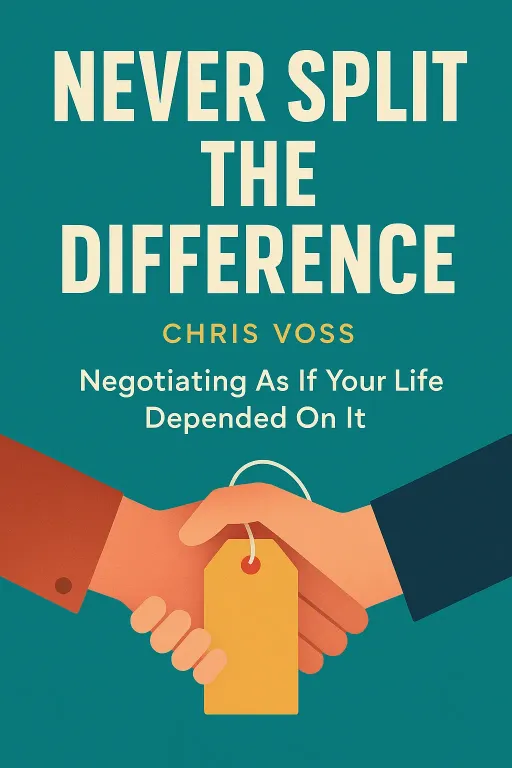
Nova: Today, Atlas, we’re diving into the absolute art and precise science of negotiation, specifically through the powerful lenses of two foundational texts. We’re talking about "Never Split the Difference" by the legendary Chris Voss, and the classic, world-changing "Getting to Yes" by Roger Fisher.
Atlas: Oh, interesting. Voss, the former FBI hostage negotiator, who spent years in intense, life-or-death scenarios. And Fisher, the renowned Harvard professor and co-founder of the Harvard Negotiation Project. That sounds like we're covering the entire spectrum, from high-stakes showdowns to principled boardroom collaboration.
Nova: Exactly! And what's truly fascinating is how these two giants, one from the intense world of life-or-death negotiations and the other from the hallowed academic halls of Harvard, offer paths that, at first glance, seem utterly opposed. Yet, when you dig deeper, they are incredibly complementary for anyone looking to truly upskill their influence and competitive edge, especially in a dynamic field like marketing.
Atlas: So, how do we even begin to unpack such different approaches? Are we talking about two separate toolkits, a kind of 'choose your fighter' situation, or is there a unified theory of getting what you want, no matter the context?
Nova: That's the million-dollar question, isn't it? We’re going to argue that true mastery lies in understanding both, and knowing precisely when and how to deploy each.
Tactical Empathy & High-Stakes Negotiation
SECTION
Nova: Let's start with Chris Voss and "Never Split the Difference." Voss’s background is singular. He spent years as the FBI's lead international hostage negotiator, which means he was in situations where the stakes literally couldn't be higher. His book, which has been widely acclaimed for its practical, no-nonsense approach, essentially distills those life-and-death tactics into principles for everyday negotiation.
Atlas: So, he’s taking strategies from talking down armed criminals and saying, "Hey, apply this to your next client meeting"? That sounds… intense. And maybe a little manipulative?
Nova: That’s a common first reaction, Atlas! But Voss argues it’s not about manipulation, it’s about tactical empathy. It's about profoundly understanding the other side's perspective, their fears, their desires, not just their stated positions. He pushes us to use tools like mirroring, labeling emotions, and asking calibrated "how" or "what" questions.
Atlas: "Tactical empathy." That’s a powerful phrase. So, can you give me an example of how this plays out in a real-world scenario, maybe something more relatable than a bank robbery?
Nova: Absolutely. Imagine a marketing graduate, a recent hire, trying to negotiate a larger budget for a crucial digital campaign. Their boss is resistant, citing company-wide cutbacks. Now, a traditional negotiator might argue with data, showing ROI projections. But Voss would say, "Stop. What is your boss feeling?"
Atlas: Okay, so the boss is probably feeling stressed, under pressure from upper management, worried about their own job if they overspend.
Nova: Exactly! So, instead of immediately pushing for more money, the junior marketer might start by mirroring their boss's concerns. "It sounds like you're under a lot of pressure with these budget constraints, and you're worried about the optics of approving a large new spend right now."
Atlas: Whoa. That's a different opener. It immediately acknowledges the boss's reality.
Nova: Precisely. And then, they might use labeling: "It seems like there's a strong sense of caution, even apprehension, about committing to new projects." This validates the boss's emotions, disarming them slightly. It’s not about agreeing with the boss's position, but deeply understanding their emotional landscape. Voss found that when people feel understood, truly heard, they become more open to finding solutions.
Atlas: So, the goal isn't just to get to 'yes' on the budget, but to get the boss to feel, "This person gets me, they're not just pushing their own agenda."
Nova: Exactly. And Voss takes it a step further with the "No" game. He teaches us to actually a "No." Getting someone to say "No" makes them feel safe, in control. It gives them autonomy. "Is it a ridiculous idea for me to even propose this campaign right now?" or "Have you completely ruled out any flexibility in the Q3 budget?"
Atlas: That’s counter-intuitive. My instinct is always to push for a "yes." But I can see how a forced "yes" can feel like a trap, and then they resent you later. A "no" feels like you're empowering them to have a say.
Nova: It’s a profound psychological shift. Voss's book is highly rated because it provides a framework for navigating these emotionally charged conversations, even when you’re facing a brick wall. It’s about turning confrontation into a collaborative problem-solving exercise, but one where you’re acutely aware of the psychological levers at play. It’s a powerful tool for a marketer who needs to influence stakeholders, clients, or even internal teams, especially when there’s resistance or a competitive element.
Principled Negotiation & Mutual Gain
SECTION
Nova: Now, let's pivot to a different but equally crucial approach: Roger Fisher's "Getting to Yes." This book, a product of the Harvard Negotiation Project, has been a cornerstone of negotiation theory since its publication and is widely used in diplomacy, law, and business education globally. While Voss focuses on the psychology of high-stakes, often competitive, interactions, Fisher zeroes in on how to achieve mutual gain, especially when preserving relationships is paramount.
Atlas: So, if Voss is teaching me how to win a difficult battle, is Fisher teaching me how to avoid the battle altogether and just... make friends?
Nova: Not exactly 'make friends,' but how to build sustainable, mutually beneficial outcomes. Fisher and his colleagues argue for what they call "principled negotiation," which has four main tenets. The first is to "separate the people from the problem."
Atlas: That sounds like basic emotional intelligence, but I imagine it's harder than it sounds when you're in the thick of it.
Nova: It is. It means addressing the substantive issues without letting interpersonal dynamics, emotions, or egos derail the process. The second tenet is to "focus on interests, not positions." This is key. A position is what someone says they want – "I want a 10% discount." An interest is they want it – "I need to hit my quarterly savings target" or "I want to feel like I got a good deal."
Atlas: That makes so much sense! So often, we just bang heads over the "what" without ever understanding the "why."
Nova: Exactly. And when you understand the "why," the interests, you can then move to the third principle: "invent options for mutual gain." This is where creativity comes in. Instead of a fixed pie, you look for ways to expand the pie for everyone involved.
Atlas: Like, maybe the client can't give a 10% discount, but they can offer an extended payment term, or an exclusive feature, or faster delivery? Things that might satisfy the underlying interest even if the initial position isn't met.
Nova: Precisely! And the fourth principle is to "insist on using objective criteria." This means agreeing on fair standards or benchmarks rather than relying on arbitrary will. Market value, expert opinions, legal precedents, industry standards—these provide legitimacy and make the solution more palatable for everyone.
Atlas: So, if Voss is about understanding the other side's emotional state to get them to lean your way, Fisher is more about creating a framework where the logical, fair solution naturally emerges.
Nova: That’s a fantastic way to put it. Fisher's approach is designed for situations where you need to collaborate, build long-term relationships, or solve complex problems where both sides have legitimate needs. Think about a marketing team trying to align with the sales team on lead qualification criteria. If sales wants more leads and marketing wants higher quality, simply arguing positions won't work. Focusing on the shared interest—closing more deals efficiently—allows them to invent options like shared CRM access or a joint scoring system, using objective criteria like conversion rates to measure success.
Synthesis & Takeaways
SECTION
Nova: So, we have Voss, the master of tactical empathy in high-stakes, often adversarial situations, and Fisher, the architect of principled negotiation for collaborative, mutual gain. How does a modern marketer, looking to stay competitive, use both?
Atlas: That’s the real trick, isn't it? It sounds like you need to be a chameleon. One moment you're mirroring and labeling like Voss, understanding the emotional undercurrents, and the next you're at the white board with Fisher's four principles, brainstorming win-win solutions.
Nova: Absolutely. It's not about choosing one over the other; it's about having a full, incredibly versatile toolkit. When you're negotiating a significant partnership deal, for instance, you might start with Fisher's principles to establish shared interests and invent options for mutual gain, building trust and a positive working relationship.
Atlas: But then, if a competitor tries to undercut you, or a vendor is being unreasonable on pricing, you might need to tap into Voss's playbook. You might use mirroring to understand their hidden motivations, or ask calibrated questions to expose their assumptions, without necessarily burning the bridge.
Nova: Exactly. A marketer's world is full of both "us vs. them" moments – like securing a prime ad placement or negotiating agency fees – and "how can we both win?" opportunities, such as aligning internal teams on a new campaign strategy or collaborating with a content creator. True mastery comes from knowing which strategy, or blend of strategies, to deploy at any given moment.
Atlas: That’s actually really inspiring. It means negotiation isn't just about being aggressive or being a pushover. It's about being incredibly intelligent and adaptable. It sounds like the "Tiny Step" from our show notes—reflecting on a past situation and seeing how these principles could have changed the outcome.
Nova: Absolutely. We encourage all our listeners to think about a recent interaction where influence was key. Perhaps negotiating a project deadline, or even just discussing plans with a friend. How would tactical empathy, truly understanding the other person's emotions and fears, have shifted things? Or, how would focusing on underlying interests, instead of just positions, have opened up new possibilities for mutual gain? Share your thoughts with us on social media; we'd love to hear your insights.
Atlas: Knowing these frameworks gives you so much more agency. It makes me want to re-evaluate every 'lost' negotiation I've ever had!
Nova: It’s a journey of continuous learning, and mastering these strategies is a huge leap forward in anyone's professional and personal life.
Nova: This is Aibrary. Congratulations on your growth!