Beyond Consensus: Designing for Collaborative Governance in a Divided World
Golden Hook & Introduction
SECTION
Nova: Everyone says 'compromise is key,' but what if I told you compromise is actually the enemy of true progress, especially when the stakes are global?
Atlas: Whoa, hold on a second, Nova. That's a pretty provocative statement. We're taught from childhood that compromise is how you get along, how you find middle ground. Are you really saying we should throw that out the window?
Nova: I am, Atlas, at least when we're talking about progress and solutions for complex challenges. Today, we're diving into a fascinating concept, inspired by the ideas in a book called "Beyond Consensus: Designing for Collaborative Governance in a Divided World." It’s a powerful exploration of why our traditional approaches to problem-solving often fall short, especially when our world feels increasingly fragmented and complex.
Atlas: That resonates deeply, especially for anyone trying to build robust systems or anticipate future challenges. It feels like we're constantly hitting walls in collective decision-making. So, the book argues that mere compromise isn't enough to build collective well-being?
Nova: Exactly. It's about transcending mere agreement to design systems for genuine collaborative governance. And to understand how, we first need to confront why our current methods are, in fact, limiting us.
The Inadequacy of Compromise: Beyond Win-Lose Narratives
SECTION
Nova: The cold, hard fact the book lays out is that achieving collective solutions in a diverse world is incredibly difficult. Traditional negotiation often leads to compromise, not true collaboration.
Atlas: Okay, so what’s the difference? Because to many, compromise like a good thing. It sounds fair.
Nova: It sounds fair, but let's think about it this way: Imagine two children fighting over an orange. A classic compromise is cutting the orange in half, giving each child 50%. Sounds fair, right? But what if one child wanted the peel to bake a cake, and the other wanted the juice for a drink?
Atlas: Oh, I see where this is going. With compromise, both got half an orange, but neither got what they truly needed. If they had collaborated, one would get all the peel, the other all the juice, and both would be 100% satisfied.
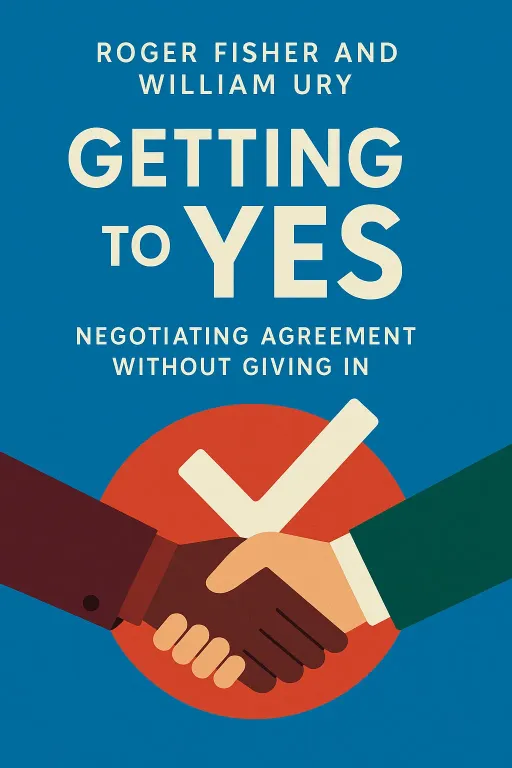
Nova: Precisely! That's the essence of the insight from "Getting to Yes" by Roger Fisher and William Ury. This seminal work really taught us to focus on, not. A position is "I want half the orange." An interest is "I need the orange peel for my cake."
Atlas: But wait, looking at this from a high-stakes strategic perspective, isn't that incredibly idealistic? People come to the table with fixed positions, often because their constituents demand it. How do you even begin to shift that mindset when the incentive structure is often about winning?
Nova: That's the challenge. Fisher and Ury emphasize separating the people from the problem. It’s about being hard on the problem, soft on the people. Instead of attacking the other party's position, you work them to understand the underlying interests driving that position. Then, you invent options for mutual gain.
Atlas: So, it’s like reframing the entire conversation from a zero-sum game to a value-creation exercise. But that requires a level of trust and openness that often feels missing in divided environments. How do you foster that?
Nova: It ties into inventing options. Let's take your example of a community divided over a new development project. One faction might have the fixed position of "no development," while another insists on "build everything." A compromise might be building half. But if you dig deeper, the "no development" group might be interested in preserving green space and community character. The "build everything" group might be interested in economic growth and affordable housing.
Atlas: And suddenly, you're not arguing over square footage; you're exploring solutions that could involve mixed-use development, green infrastructure, and creative financing for affordable units. That's a completely different conversation. That makes me wonder how you even anticipate and uncover those deeper interests proactively, not just reactively.
Principles of True Collaboration: Shared Interests and Collective Intelligence
SECTION
Nova: And that brings us to the next layer of designing for collaboration, which is about cultivating an environment where these shared interests can truly flourish. It's about moving from just 'getting to yes' to building a 'we' that thinks collectively.
Atlas: Okay, so how do we move from understanding interests to actually building something new together? Because that's where the rubber meets the road, especially for those seeking resilient solutions.
Nova: This is where Peter Senge's "The Fifth Discipline" becomes so relevant. Senge emphasizes the importance of shared vision and team learning in organizations. These principles extend directly to governance, where collective intelligence is paramount for tackling complex issues.
Atlas: So, collective intelligence isn't just a buzzword? How can diverse groups, often with conflicting pasts and deeply held beliefs, actually build a 'shared vision' without watering down their unique perspectives until it's meaningless?
Nova: That's the art of it. Think of an orchestra. Each musician is incredibly talented, a master of their instrument. But the magic, the true collective intelligence, happens when they play with a shared vision for the piece, listening and adapting to each other, not just playing their own notes. It's about synergy, where the whole is greater than the sum of its parts.
Atlas: That’s a great analogy. It suggests that individuality isn't suppressed, but rather channeled towards a common goal. But unlike an orchestra with a conductor and a score, in collaborative governance, who sets that shared vision?
Nova: That's where Nova's Take comes in, which is really the synthesis of these ideas: effective collaboration requires shifting from adversarial stances to a shared commitment to finding solutions that benefit parties. It's not about one person setting the vision, but about cultivating a process where the vision emerges collaboratively.
Atlas: That’s actually really inspiring. Can you give an example of that in practice? Because it sounds incredibly difficult to achieve.
Nova: Absolutely. Consider a multi-national environmental treaty negotiation. Initially, each country comes with rigid positions based on their national economic interests. But by fostering a shared vision for a sustainable global future – a future where everyone has clean air and water, stable climate – and then engaging in team learning, openly sharing scientific data, and understanding different cultural perspectives, they can invent novel solutions. These solutions might involve technology transfer, shared resource management, or innovative carbon credit systems that benefit all parties, rather than just a lowest common denominator compromise that leaves everyone feeling short-changed. It's about designing a process for collective innovation.
Atlas: Wow, that’s such a hopeful way to look at it. It moves beyond just managing conflict to actually creating something new and better. It sounds like a blueprint for how an optimistic architect would approach global challenges.
Synthesis & Takeaways
SECTION
Nova: So, to synthesize, designing for collaborative governance in a divided world isn't about avoiding conflict. It's about fundamentally changing we engage with conflict. It's about understanding that compromise often leaves value on the table, and true progress comes from digging deeper into shared interests and then cultivating a shared vision and collective intelligence to invent entirely new solutions.
Atlas: That's a profound shift. It means we have to re-evaluate our default setting for problem-solving. It’s not about finding the middle, but finding the way forward, together. And for our listeners, that "Tiny Step" from the book is so critical: identify one area where you are currently negotiating, and reframe the discussion around shared interests, not fixed positions.
Nova: Exactly. This isn't just theory; it's a call to action to build resilience into our social and political systems. It’s about cultivating a mindset of trust in the collective capacity for innovation.
Atlas: It’s about embracing the unfolding, trusting the process, and understanding that collective well-being isn't a given; it's something we actively design for.
Nova: For anyone who craves unique insights and enjoys challenging conventional thinking, this approach offers a powerful pathway to a more stable future.
Atlas: I imagine a lot of our listeners will be reflecting deeply on this one.
Nova: This is Aibrary. Congratulations on your growth!