Beyond the To-Do List: Unlocking True Personal Productivity
Golden Hook & Introduction
SECTION
Nova: What if I told you that being busy, constantly running from one task to the next, is actually a massive roadblock to being truly productive?
Atlas: Wait, isn't busyness the whole point? That sounds a bit out there, Nova.
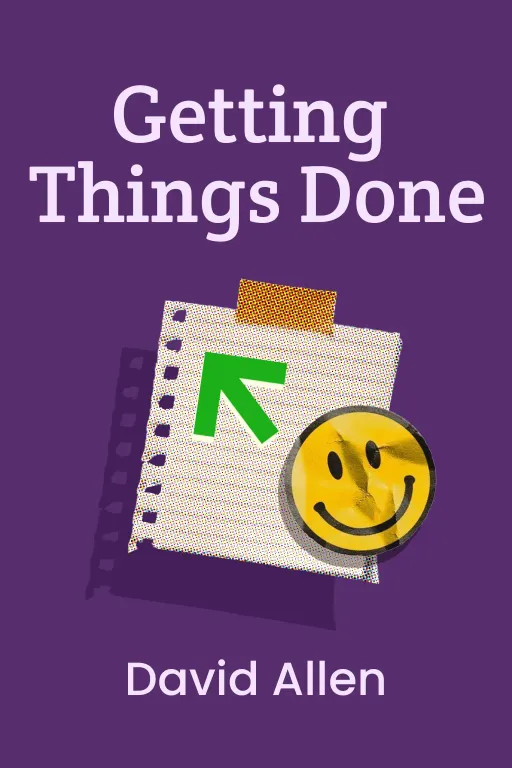
Nova: Today, we're dissecting that very idea through the lens of a seminal work: "Getting Things Done," by David Allen. A system that paradoxically makes you less "busy" but far more effective.
Atlas: Yeah, a book that’s practically legendary in the productivity space for a reason. It's not just theory; it's practically a global standard for how to manage your work.
Nova: Exactly. And the core problem Allen identifies is something many high-achievers face: the overwhelm. This constant mental load of things to do, remember, follow up on, it's a silent killer of focus.
The Illusion of Busyness vs. The Power of a Trusted System
SECTION
Nova: We often mistake motion for progress. We're busy because our brains are constantly trying to keep track of every open loop, every commitment, every idea. It's like trying to juggle a dozen flaming torches while also solving a complex algebraic equation. Your brain is trying to be both the processor and the storage unit, and it's terrible at the latter.
Atlas: Oh, I know that feeling. It's like my brain is a web browser with 50 tabs open, all playing music simultaneously. For our listeners who are constantly optimizing systems, this mental overhead is a huge drain on actual strategic thinking. You can't analyze numbers effectively when you're also trying to remember if you fed the dog.
Nova: Precisely. And Allen's genius was in creating what he calls a "trusted system." The fundamental idea is to get out of your head and into an external, organized, reliable place. Your brain is for, not for. This isn't just about a to-do list; it's about offloading mental clutter so your analytical mind can focus on problem-solving.
Atlas: Okay, so you're saying my brain isn't a hard drive? But what's the big deal? I have notebooks, digital tools, a whiteboard. What makes system different from just a fancy to-do list? Isn't it just another thing to manage?
Nova: The difference is completeness and next actions. It starts with "capture" – getting every single "open loop" out. Not just tasks, but ideas, worries, things you "might" want to do, that random thought about getting a new coffee maker. The moment it's out of your head and in a reliable inbox, your brain registers it as "handled," even if you haven't done it yet. It frees up that analytical mind you value so much.
Atlas: So, the "Tiny Step" from the book, "spend 30 minutes capturing all open loops," that's the starting gun? Like, literally everything? The dry cleaning, the Q3 report, that weird dream I had last night, the idea for a new product feature?
Nova: Exactly! And then comes "clarify." For each captured item, you ask: "What is it?" and "What's the required to move this forward?" If it takes less than two minutes, do it immediately. If not, delegate, defer, or discard. It’s about breaking down overwhelming projects into concrete, manageable steps.
Atlas: That's brilliant. It forces linearity on chaos. For someone who optimizes processes, defining that "next action" is key. No more staring at "Project X" and wondering where to start, just "Email Sarah about budget projection." That's actionable efficiency, and it immediately reduces that mental friction.
Nova: And then you "organize" those next actions by context – things you can do at your computer, at home, on the phone. This means when you at your computer, you only see computer-related tasks. No more scrolling through your whole list feeling guilty about tasks you can't do right now. And crucially, you "review" your system regularly. This builds trust. Your brain learns it doesn't need to remind you because the system will.
Atlas: Hold on, though. For a visionary driven by impact, the "review" part might feel like overhead. Or the initial capture, overwhelming. How do you prevent this system from becoming thing to manage, another source of busyness? Isn't that just adding more items to the plate?
Nova: That's a valid concern. It requires discipline initially, absolutely, like building any new habit. But the payoff is immense. Imagine the mental bandwidth you free up when you're not constantly running mental background checks on your commitments. That's bandwidth for strategic thinking, for problem-solving, for innovation. It's an investment that pays dividends in clarity and focus, allowing you to be the strategist and builder you want to be, rather than just reacting to incoming fires.
Synthesis & Takeaways
SECTION
Nova: Ultimately, "Getting Things Done" isn't just about managing tasks; it's about managing your attention. It's about consciously deciding what to focus on and knowing that everything else is safely held in a system you trust. It's about regaining control over your mental landscape.
Atlas: Wow. That’s actually really inspiring. So it's less about ticking boxes and more about freeing up the mental space to actually impact, to be a true strategist rather than just a busy operator. It's about control, not just activity. It's about optimizing your most valuable resource: your mental clarity.
Nova: Exactly. So, for anyone feeling that mental overwhelm, that constant hum of unaddressed commitments, start with that tiny step. Take 30 minutes, dump every single open loop from your brain onto paper or a digital tool. Just get it out. You’ll feel a shift immediately.
Atlas: And assign a next action to at least five of them. It's not about being "busy," it's about being "clear." That's a powerful distinction for anyone driven by results.
Nova: Absolutely. It’s about unlocking true personal productivity.
Nova: This is Aibrary. Congratulations on your growth!