Beyond the To-Do List: Mastering the Art of Getting Things Done
Golden Hook & Introduction
SECTION
Nova: Atlas, quick game. Give me a five-word review of your current state of productivity. Don't overthink it, just five words.
Atlas: Oh, I know that feeling. Let's see… "Too many tabs, too little brain."
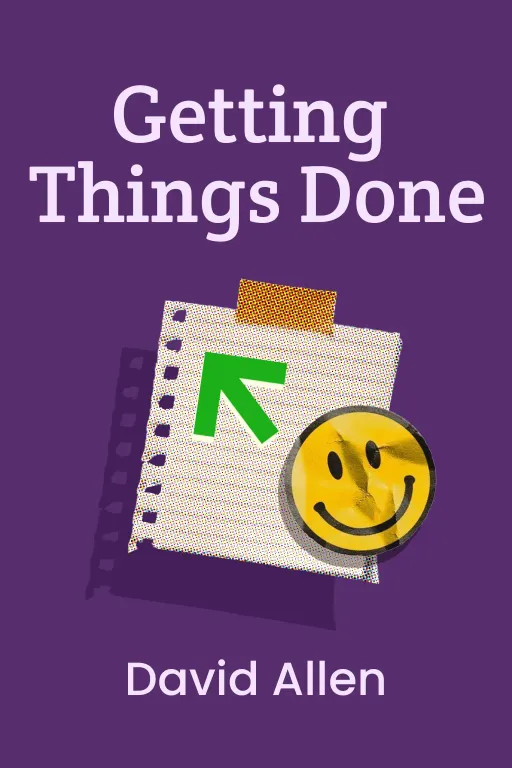
Nova: Wow. That's actually pretty profound and incredibly relatable, Atlas. And it perfectly sets the stage for what we're diving into today: a book that promises to tame that exact mental chaos. We're talking about David Allen's groundbreaking work, "Getting Things Done."
Atlas: Oh, I've heard whispers about GTD. Isn't that the system that's supposed to revolutionize how you work?
Nova: Absolutely. And what's fascinating is that Allen didn't just theorize this in an ivory tower. He developed this entire methodology over decades as a management consultant, working directly with high-level executives to help them regain control. It's built from the trenches of real-world overwhelm.
Atlas: Well, if anyone needs to get things done, it's those folks. But honestly, "too many tabs, too little brain"—that's my default state. I imagine a lot of our listeners feel like their minds are just a constant stream of notifications and half-finished thoughts.
The Mind-Clutter Problem: Why We Feel Overwhelmed
SECTION
Nova: Exactly. And that brings us to the core problem Allen identifies, which I think is a profound insight. He says the feeling of being overwhelmed often stems not from having too much to do, but from a lack of clarity and control over our commitments.
Atlas: Wait, are you saying it's not the sheer volume of tasks? Because my to-do list would beg to differ. It's a mile long!
Nova: That's a great point, and it's a common misconception. Think of your mind like a computer's RAM. Every unaddressed email, every vague idea for a project, every half-remembered promise—Allen calls these "open loops." Each open loop takes up a little bit of your mental processing power, even if you're not actively working on it.
Atlas: So, it's like having a hundred browser tabs open, even if you're only looking at one?
Nova: Precisely! And each of those tabs is constantly refreshing in the background, draining your mental energy. Let me give you a vivid example. Imagine you had a conversation with a colleague last week, and they said, "Hey, could you look into that new software for us?" You nodded, you agreed, but you never wrote it down.
Atlas: Oh, I've been there. You just sort of... carry it.
Nova: Exactly! And for the next few days, that vague "look into new software" thought just pops into your head at random moments. While you're in a meeting, while you're trying to focus on a report, even when you're making dinner. It's not a concrete task you can act on, it's just a persistent, low-level hum of unfinished business.
Atlas: That's going to resonate with anyone who struggles with mental fog. It's that feeling of always being "on," even when you're trying to relax. It saps creativity, doesn't it?
Nova: It absolutely does. Your brain is constantly trying to remind you of these open loops, because it doesn't trust that you've captured them somewhere reliable. This constant background processing makes it incredibly difficult to engage in deep work, strategic thinking, or even just genuine presence. It's a fundamental drain on our most precious resource: our attention.
The GTD Methodology: Achieving 'Mind Like Water'
SECTION
Nova: So, if the problem is mental clutter from open loops, what's the solution? This is where Allen's methodology really shines, promising to help us achieve what he calls a "mind like water."
Atlas: A mind like water? That sounds incredibly serene, but I'm skeptical. How do you go from a chaotic mental swamp to a calm, clear lake? What are the actual steps?
Nova: It's all about building a trusted system outside your head. The GTD framework has five core steps: Capture, Clarify, Organize, Reflect, and Engage. And the very first, most crucial step, is Capture.
Atlas: Capture. So, just write things down? Like a to-do list?
Nova: More than that. It means getting out of your head – every idea, every commitment, every vague thought, big or small, personal or professional – and putting it into an "inbox." This could be a physical inbox, a digital note-taking app, a voice recorder, anything. The key is to get it out of your brain's RAM and into a temporary holding place.
Atlas: Okay, I can see the immediate relief in that. Just getting it out. But then what? My inbox would be overflowing with random thoughts. That sounds like a different kind of overwhelm.
Nova: That's why the next step, Clarify, is so vital. This is where you process each item in your inbox. You ask: "What is this?" "Is it actionable?" "If so, what's the very next physical action I need to take?" And if it's not actionable, you decide if you need to trash it, put it on a someday/maybe list, or file it as reference material.
Atlas: What do you mean by clarifying? Isn't "Plan vacation" clear enough? For someone in a high-pressure environment, every minute counts, and breaking things down seems like extra work.
Nova: That's the trap! "Plan vacation" is vague. Your brain still has to figure out to plan it. A clarified 'next action' for "Plan vacation" might be "Research flights to Bali" or "Call travel agent for package deals" or "Email spouse to discuss dates." The difference is, the clarified action is a single, physical, visible activity.
Atlas: Ah, I see. When you have "Research flights to Bali," your brain just goes, "Okay, I know what to do." It removes that internal debate. That's actually really powerful for busy professionals who need to move from thought to action seamlessly.
Nova: Exactly! It reduces decision fatigue because you've already decided the 'next action.' Then, you Organize these clarified actions into appropriate lists – by context, by project, by due date. This creates a trusted system where your brain knows everything is handled, so it can finally relax and achieve that 'mind like water.'
Synthesis & Takeaways
SECTION
Nova: So, what David Allen is really showing us is that the goal isn't just to get more done faster. It's about creating a system that frees up your mental energy, allowing you to be present, to think strategically, and to genuinely engage with your work and life without that constant hum of unfinished business. It's a profound shift from merely managing tasks to mastering your commitments and achieving mental peace.
Atlas: That’s actually really inspiring. It’s not just about productivity; it’s about regaining control over your mental landscape. So, for our listeners who are feeling that "too many tabs, too little brain" overwhelm right now, what's the single most impactful tiny step they can take today to start this journey towards a 'mind like water'?
Nova: The tiny step, the foundational one, is simply to do what Allen calls "the mind sweep." Get a piece of paper, or open a digital document, and just write down every single open loop in your mind. Personal, professional, small, large, silly, serious. Just capture it all. Don't organize, don't judge, just get it out of your head.
Atlas: Okay, that sounds incredibly achievable. Just a brain dump. I can definitely do that. And I imagine the immediate relief from just seeing it all externalized would be immense.
Nova: It is. It's the first step to telling your brain, "I've got this. You don't have to carry it anymore."
Atlas: That’s a fantastic way to put it. It’s about building a partnership with your own mind.
Nova: Absolutely. It's about bringing clarity and control back into your life, one tiny, captured thought at a time.
Atlas: We’d love to hear if you try this mind sweep! Share your experiences with us on social media.
Nova: This is Aibrary. Congratulations on your growth!