Beyond Busy: The Art of Focused Work in a Distracted World
Golden Hook & Introduction
SECTION
Nova: Atlas, what's the one thing you think founders are at, even when they're working 80 hours a week and practically living on coffee?
Atlas: Oh, I love that question. That's easy. Actually doing the thing that. They're often masters of the busy-work ballet, tap-dancing through a million trivial tasks, but struggling to hit those truly impactful strategic breakthroughs.
Nova: You've nailed it. It's that feeling of being perpetually busy, yet strangely... unproductive. And that's exactly what we're diving into today, inspired by the powerful ideas behind focused work, drawing heavily from the insights of academics like Cal Newport and productivity gurus like David Allen.
Atlas: Wow, that's kind of heartbreaking, actually. I imagine a lot of our listeners, especially the early-stage founders, feel that deeply. They're passionate, they're working non-stop, but then they look back at the end of the week and wonder where the real progress went.
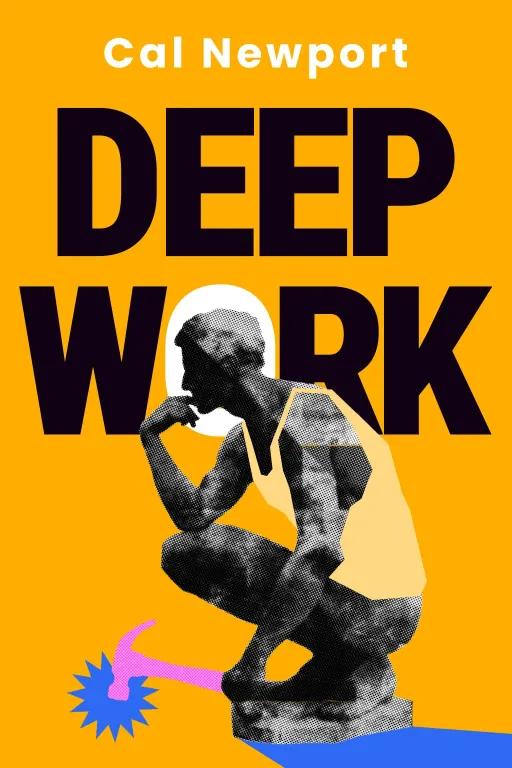
Nova: Exactly. It’s not just about a lack of time; it’s about a lack of time. And the book we're discussing today, "Beyond Busy: The Art of Focused Work in a Distracted World," really synthesizes how to reclaim that. Cal Newport, a computer science professor, brought "Deep Work" to the forefront, arguing that intense focus is a superpower. And David Allen, a seasoned management consultant, gave us "Getting Things Done," a widely acclaimed system that's almost legendary for freeing up mental space. Both approaches have garnered immense praise for their practical, transformative power.
Atlas: Right? I've heard those names thrown around a lot. So, you're saying this isn't just about time management, but something fundamentally deeper about how we approach our work?
The Silent Saboteur: How Distraction Kills Founder Impact
SECTION
Nova: Absolutely. Think of it this way: in today's always-on world, constant distractions aren't just annoying interruptions; they're erosion. They erode our ability to do truly meaningful work. For founders, who need to be innovative, strategic, and decisive, this scattered approach becomes a silent saboteur. It hinders innovation, it stifles strategic thinking, and it leaves them feeling depleted, despite all the effort.
Atlas: Hold on, isn't that just the reality of being a founder today? You're expected to be everywhere at once – responding to investors, supporting your team, putting out fires, engaging with customers. It feels like the system is to keep you scattered.
Nova: It certainly that way, doesn't it? But the truth is, while the demands are real, our to them often compounds the problem. We've become conditioned to constant context-switching. Every notification, every email ping, every Slack message pulls our attention away, even if just for a second. And that second isn't free. There's a cognitive cost to re-engaging with your original task. It's like trying to fill a bucket with a hole in the bottom – you're pouring in effort, but a lot of it is just leaking away.
Atlas: That makes sense, but how do you even to fight that tide when everyone expects instant replies? It feels almost rude not to respond immediately.
Nova: That's the societal pressure we're up against, and it's a huge part of the problem. Your brain isn't designed for that level of constant interruption. Let me tell you about Sarah, a brilliant founder I know. She was trying to build a new AI-powered analytics platform for small businesses. She'd start her day with grand plans – architecting a new feature, strategizing market entry. But by 9:15 AM, her inbox would be overflowing. A quick check of Slack would turn into 20 minutes of troubleshooting a minor team issue. A "quick call" from an investor would stretch to an hour.
Atlas: Oh, I know that feeling. It's like your day gets hijacked before it even properly starts.
Nova: Exactly. Sarah would end her day feeling utterly exhausted, having "worked" for 12 hours straight, but her core strategic task – the AI platform's new feature – would have barely moved. It was always pushed to "tomorrow," which then became "next week." The cause was clear: constant, reactive engagement. The process was a frantic, fragmented dance between urgent but often unimportant tasks. And the outcome? Her product growth stalled. Her team, seeing her perpetually stressed and reactive, became less proactive themselves. Innovation, the lifeblood of an early-stage startup, was slowly suffocating under the weight of a thousand tiny distractions.
Atlas: That sounds rough, but it's a reality for so many. It's not just about getting less done; it's about the of what you're doing. If you're constantly jumping between things, you can't possibly bring your best, most innovative thinking to any single task.
The Dual Power-Up: Deep Work & Structured Systems for Real Results
SECTION
Nova: Precisely. So, if that's the problem, what's the antidote? It turns out, it's not about working, but working and. And this is where the dual power-up comes in: Cal Newport's "Deep Work" combined with David Allen's "Getting Things Done."
Atlas: Deep Work. I'm curious, what exactly do you mean by "deep work"? It sounds a bit like meditation for your to-do list.
Nova: That's a great way to put it! It's actually the ability to focus without distraction on a cognitively demanding task. It’s about engaging your brain at its highest level, pushing your intellectual capabilities to create new value, improve a skill, or solve a complex problem. Newport argues it's the skill that allows you to quickly master complicated information and produce better results in less time. Think of it as intellectual heavy lifting.
Atlas: So you're saying it's not just about hunkering down, but about training your brain to ignore everything else and really?
Nova: That's right. And it's a skill that requires cultivation, like any other. But here’s the thing: you can't just to do deep work if your mind is cluttered with a hundred other unresolved commitments. That's where David Allen's "Getting Things Done," or GTD, becomes indispensable. GTD provides a system for capturing, clarifying, organizing, reflecting on, and engaging with your commitments. Every idea, every task, every random thought that pops into your head – you capture it.
Atlas: Okay, so GTD is like the ultimate mental decluttering system, clearing the runway for the deep work jet to take off.
Nova: Exactly! It frees up mental space, allowing for more deep work sessions and less cognitive load. You're not spending mental energy trying to remember what you need to do next; the system remembers it for you. It's a foundational shift in how you interact with your commitments.
Atlas: That’s a perfect example. I imagine a lot of founders are walking around with a thousand open tabs in their brain. So how do these two ideas, deep work and GTD, actually work together in practice? What's the 'tiny step' for someone who feels they can't even block out 30 minutes?
Nova: Let me tell you about Mark, another founder. He started his company with a brilliant idea for a sustainable logistics solution, but like Sarah, he was constantly firefighting. He read Newport and Allen and decided to make a radical change. First, he blocked out two hours for what he called "sacred deep work time." During these hours, he would turn off all notifications – phone, email, Slack – and focus solely on the most complex, value-generating tasks: optimizing his routing algorithms, sketching out investment pitch decks, or refining his growth strategy.
Atlas: That sounds like a dream. But what about all the stuff he to do—the emails, the team check-ins? Did it all just pile up?
Nova: That's the GTD part! Mark implemented a rigorous system. Every email, every idea, every task that came in during his deep work block was immediately captured into a trusted system – a simple digital tool or even just a notebook. After his deep work session, he dedicated specific, shorter blocks of time to process those captures: clarify what they meant, organize them into actionable steps, and decide when he would engage with them. He wasn't ignoring them; he was simply them to a dedicated time.
Atlas: In other words, he wasn't letting the urgent dictate the important. He was proactively deciding what deserved his attention and when.
Nova: Precisely. The cause was a proactive decision to define and protect focused blocks. The process involved disciplined capture and systematic processing of all other inputs. And the outcome? Mark started making exponential progress on his core product. His team saw him calmer, more strategic, and more effective. His ability to innovate skyrocketed, leading to breakthroughs in his logistics algorithms that attracted significant investor interest. He wasn't just busy; he was.
Atlas: That gives me chills, honestly. It's not just about self-improvement; it's about the survival and growth of their vision. For early-stage founders, this isn't a luxury; it's a strategic imperative. It's about protecting the very core of what they're trying to build.
Synthesis & Takeaways
SECTION
Nova: Absolutely. What emerges from combining these powerful ideas is that intentional focus and a structured approach to work aren't just nice-to-haves; they are essential for turning ideas into reality and achieving significant progress. It’s the difference between merely working hard and actually building something remarkable. For founders, in particular, the ability to carve out and protect deep work, supported by a system that clears mental clutter, is the foundational skill for innovation and strategic thinking. It allows them to move beyond the reactive chaos and truly lead their companies forward.
Atlas: That’s actually really inspiring. It feels like a way to reclaim control in a world that constantly tries to pull you in a million directions. So, what's one tiny, actionable step our listeners can take to start implementing this, especially if they're feeling overwhelmed?
Nova: Here’s the tiniest step, direct from the insights we've discussed: Block out just one hour in your calendar tomorrow for uninterrupted, focused work on your single most important task. Turn off notifications – email, phone, Slack, everything. Just one hour. Experience what true focus feels like.
Atlas: I love that. One hour. That feels achievable. And for anyone out there who takes that challenge, we’d love to hear about it! Share your experience, your struggles, or your breakthroughs with the Aibrary community. Let us know how that one hour impacted your day.
Nova: This is Aibrary. Congratulations on your growth!