The Investor's Dilemma: Decoding the Games Founders Play
Golden Hook & Introduction
SECTION
Atlas: You're in a pitch meeting. The founder is charismatic, the deck is flawless, the Total Addressable Market is enormous. Every metric screams 'yes.' But you have this nagging feeling in your gut that something is off. You can't put your finger on it, but the story doesn't quite add up.
Badz: That's a scenario every investor knows well, Atlas. It's the moment where the spreadsheet says one thing, but your intuition says another.
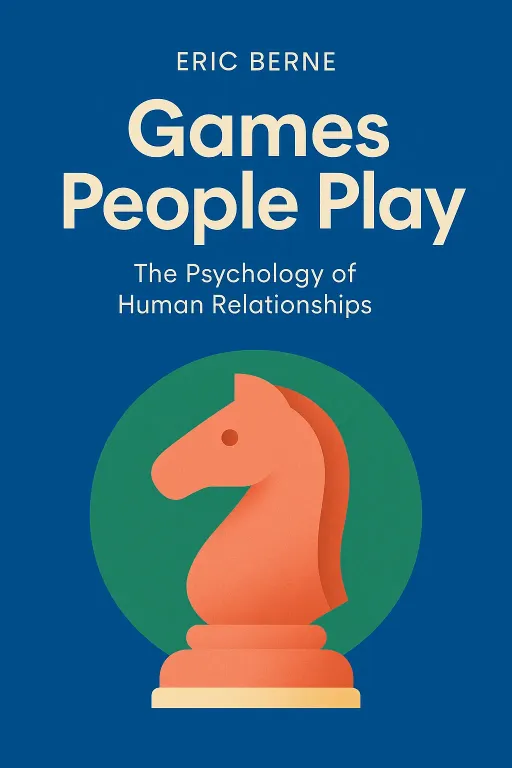
Atlas: Exactly. And what if there was a language for that feeling? A system for decoding the hidden script running beneath the surface of every human interaction? That's exactly what we're exploring today through Eric Berne's classic, 'Games People Play.' We're not treating this as a therapy book, but as a strategic manual for high-stakes environments.
Badz: I love that framing. That 'gut feeling' is often what separates good investors from great ones. Moving from a vague intuition to a structured framework for understanding human dynamics... that's the holy grail.
Atlas: Well, let's chase it down. Today we'll dive deep into this from two perspectives. First, we'll explore the fundamental 'operating system' of human interaction: the Parent, Adult, and Child ego states. Then, we'll use that lens to identify and analyze the specific 'red flag games' that can sabotage a startup from the inside out.
Deep Dive into Core Topic 1: The Three Faces of a Founder
SECTION
Atlas: So let's build that framework. Berne argues we all operate from three distinct 'ego states.' Think of it like a computer having three different processors that can be active at any time. There's the Parent, the Adult, and the Child.
Badz: An operating system for personality. As a tech investor, that analogy immediately clicks. So what's the function of each processor?
Atlas: Great question. First, you have the 'Parent' ego state. Berne says, "Everyone carries his parents around inside of him." This is the ingrained, pre-recorded library of rules, commands, and 'shoulds' we absorbed from authority figures. It's the voice that says, "That's the way it's done," or "You must always..." It can be nurturing, but it can also be critical and dogmatic.
Badz: So, it's the legacy code. The unquestioned assumptions that run in the background.
Atlas: Perfectly put. Then there's the 'Child' ego state. This is where our feelings live. It's the part of us that is curious, spontaneous, and creative, but also the part that can be fearful, rebellious, or needy. Berne's quote is, "Everyone carries a little boy or girl around inside of him." It's our archaic, emotional self.
Badz: The source of both brilliant, out-of-the-box ideas and, I'd imagine, emotional overreactions in the boardroom.
Atlas: Precisely. And finally, the most important one for our discussion: the 'Adult' ego state. This is our rational processor. It's not about age; it's about function. The Adult is objective. It gathers data from the outside world, processes it, and makes logical assessments. When a therapist in Berne's world says, "That is your Adult," it's a compliment. It means you're appraising reality in the here and now.
Badz: So, Parent is taught concepts, Child is felt concepts, and Adult is thought concepts.
Atlas: You've got it. Now, a healthy interaction, especially in business, is Adult-to-Adult. The stimulus and response are both rational. I ask for your quarterly numbers; you provide them with context. Simple, clean, productive. Berne calls this a 'complementary transaction.' Communication flows.
Badz: But that's the ideal, not always the reality.
Atlas: Far from it. The trouble starts with what Berne calls a 'crossed transaction.' This is where the communication lines get tangled. For instance, an investor asks an Adult-to-Adult question: "Can you walk me through your high customer acquisition cost?" The expected response is an Adult one, with data and a plan. But what if the founder responds from their Child state?
Badz: We see this constantly. Instead of an Adult answer, you get a Child response. It could be defensiveness: "Why are you attacking us? We're working sixty-hour weeks here!" Or it's an appeal for sympathy: "It's been so tough, the market is brutal." The transaction is crossed. The Adult asked a question, and the Child answered. And for an investor, that's an immediate signal of a problem.
Atlas: It's a huge breakdown in communication. Or, what if they respond from their Parent state?
Badz: That's maybe even more concerning. The investor asks about the high CAC, and the founder replies with a dogmatic, Parent statement like, "This is the standard CAC for a disruptive SaaS platform. You have to spend money to make money." It's a platitude, not an analysis. It's not data-driven; it's a rule they've internalized.
Atlas: And what does that tell you, as an investor?
Badz: It tells me they might not be adaptable. They're running on a pre-programmed script, not responding to the reality of their own business metrics. The best founders we see operate primarily from their Adult—they live in the data. But they can harness the creativity of their Child to innovate and draw on the core values of their Parent, without being by either. A founder trapped in their Child or Parent state is a massive liability.
Deep Dive into Core Topic 2: Red Flag Games in Startups
SECTION
Atlas: Okay, so let's take this a step further. When these crossed transactions stop being random errors and become a recurring pattern—a pattern with a hidden motive and a predictable, negative outcome—Berne says we're no longer just talking. We're playing a 'game.'
Badz: So a game is a series of these ulterior transactions. It looks like one thing on the surface—an Adult conversation—but there's a psychological script running underneath.
Atlas: Exactly. And some of these games are absolute poison for a startup. Let's analyze a classic from the book that I'm sure you've seen: 'Why Don't You—Yes But'.
Badz: Oh, I know this one without even hearing the description. The 'un-coachable founder.'
Atlas: That's it. Berne describes it perfectly. The player, let's say a founder, presents a problem. The other players, maybe their investors or advisors, are invited to offer solutions. The founder's Adult seems to be asking for help. But the game is that they reject every single suggestion with a 'Yes, but...'
Badz: "We need to improve our sales pipeline." "Why don't you hire more sales reps?" "Yes, but we don't have the budget." "Why don't you focus on a cheaper inbound marketing strategy?" "Yes, but our product is too complex for that." "Why don't you, the founder, do the sales yourself?" "Yes, but I need to focus on product."
Atlas: You've played this game before. The surface conversation is about problem-solving. But Berne says the real aim, the psychological payoff, is entirely different. The founder isn't trying to solve the problem. They are trying to prove that the problem is unsolvable. The payoff is the quiet, smug satisfaction when all the advisors give up. The founder's Child state is reassured that its position—"My problems are uniquely difficult, and I'm justified in not being able to fix them"—is correct.
Badz: It's a massive diligence red flag. The game is a defense mechanism to avoid the vulnerability of actually trying something new and potentially failing. By rejecting all advice, they maintain control and can blame the intractability of the problem, not their own inaction. The psychological payoff, that feeling of being 'right' in their failure, comes at the direct expense of the company's progress. It creates enormous organizational drag.
Atlas: Let's look at another one that's just as destructive in a startup: 'If It Weren't For You'. Berne's classic example is a woman, Mrs. White, who constantly complains that her domineering husband prevents her from doing things, like taking dance lessons. It's his fault she's unfulfilled.
Badz: A game of blame.
Atlas: Exactly. But then, through therapy, the husband stops being so restrictive. He tells her, "Go ahead, sign up for dance lessons." And what happens? She's suddenly terrified. She discovers she has a morbid fear of dance floors and can't go through with it. The shocking revelation is that her husband's restrictions were actually a to her. They protected her from confronting her own phobia. The game allowed her to blame him instead of facing her own fear.
Badz: I've seen the startup version of this a dozen times. It's the CEO who says in a board meeting, "We would have hit our product roadmap that key engineer who left." Or, "We'd be profitable by now the board being so risk-averse and not approving that extra funding."
Atlas: The 'You' becomes the scapegoat.
Badz: Precisely. It allows the leader to avoid confronting their own failure of strategy, execution, or leadership. Did the engineer leave because the culture is toxic? Is the board risk-averse because the CEO hasn't presented a compelling, data-driven case? The game of 'If It Weren't For You' is a complete abdication of responsibility.
Atlas: And the psychological payoff is justification. It preserves the founder's self-image as a competent leader who was simply thwarted by external forces. They get to feel like a victim of circumstance, not the architect of their own problems. And that's a game that can bankrupt a company.
Synthesis & Takeaways
SECTION
Atlas: So, when you put it all together, it's a powerful lens. We have these ego states—Parent, Adult, Child—which are the fundamental building blocks of our interactions.
Badz: They're the 'what.' What state is this person communicating from?
Atlas: And when those states are used in these dishonest, recurring patterns to get a hidden psychological payoff, we get these destructive games, like 'Yes, But' or 'If It Weren't For You'.
Badz: And that's the 'how.' How are they using their communication? Is it to solve a problem or to win a psychological game? Recognizing this is a superpower for an investor. It's all about pattern recognition. Is this a one-off bad conversation, or is this a recurring game that defines the company's culture?
Atlas: What's the ultimate risk of a game-playing culture?
Badz: A game-playing founding team will burn through cash and opportunities because they're more invested in their internal psychological drama than in building a business. They're optimizing for their own emotional payoffs, not for market success. And you can't build a billion-dollar company on a foundation of psychological debt.
Atlas: Berne's ultimate goal for a person is to achieve 'autonomy'—which he defines as the recovery of awareness, spontaneity, and intimacy. It's about being aware of reality, being free to choose your response, and being capable of genuine, game-free connection. For anyone in a high-stakes role, the takeaway is clear.
Badz: It is. Next time you're in a meeting—whether it's a pitch, a board meeting, or a one-on-one—listen for the game. Don't just hear the words. Ask yourself: Is this communication coming from the Parent, the Adult, or the Child? Is this a straightforward 'procedure' to solve a problem, or is it a 'game' with a hidden agenda? Answering that question can be the difference between a 10x return and a total write-off.