The 'Rational Actor' Myth: Why You Need Evolutionary Game Theory.
Golden Hook & Introduction
SECTION
Nova: What if I told you the person you think you are—this rational, self-interested individual making logical choices—is actually a myth? A beautiful, convincing, but ultimately flawed story we tell ourselves.
Atlas: Whoa, Nova. Are we really going to dismantle our entire sense of self before coffee? That's a bold claim. It sounds like you're saying our internal logic is somehow… broken.
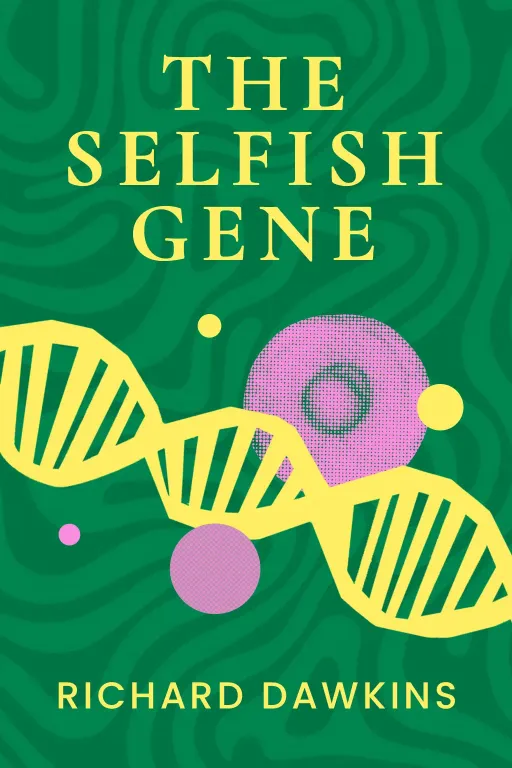
Nova: Broken is too strong a word, Atlas. It's more like… incomplete. We operate with a blind spot, a huge one, when we ignore the deeper, often unconscious evolutionary and psychological forces that truly drive us. And that's exactly what we're diving into today, thanks to two absolutely foundational works: Richard Dawkins’ "The Selfish Gene" and Eric Berne’s "Games People Play."
Atlas: Ah, Dawkins and Berne. Two titans who really shook things up in their respective fields. I remember "The Selfish Gene" when it first hit the scene. It completely revolutionized how we understood evolution, shifting the focus from the organism to the gene itself. It sparked intense debate and completely reframed our understanding of something as fundamental as altruism.
Nova: Exactly! And Berne, with "Games People Play," gave us a whole new language to understand the often-unspoken psychological scripts we follow in everyday interactions. It became a cultural phenomenon, helping millions decode their own relationships and social dynamics. Together, these books offer a profoundly deeper, more effective lens for understanding and designing human systems.
Atlas: So, we're talking about peeling back the layers on human motivation, right? Not just what we think we're doing, but what’s actually pulling the strings.
Nova: Precisely. And to truly understand those strings, we have to start at the very beginning.
Unmasking the 'Rational Actor' Myth: The Selfish Gene's Deep Logic
SECTION
Nova: The conventional view, the one that underpins so much of our economics and social policy, is that humans are rational actors. We weigh costs and benefits, we make logical decisions in our self-interest. But Dawkins flips that script entirely. He argues that the primary unit of natural selection isn't the individual, or even the group, but the gene.
Atlas: Okay, so, are you saying we're just puppets of our genes? That feels a bit… deterministic, especially for someone trying to design ethical systems or build equitable communities. Where does free will or moral choice fit into that?
Nova: It's not about denying free will entirely, Atlas. It's about understanding the causation behind our predispositions. Dawkins describes organisms, including us, as "survival machines" for our genes. Our bodies, our behaviors, even our instincts for cooperation or competition, are all strategies genes employ to ensure their own replication.
Atlas: So, when a bird gives an alarm call, potentially putting itself at risk to warn the flock, that's not pure selflessness? It's the gene for "alarm-calling-in-a-flock-with-related-birds" ensuring its survival in the gene pool?
Nova: You got it. From a gene's-eye view, that altruistic act is a highly effective strategy for propagation. The bird's genes are present in its relatives, so by helping them survive, it's helping copies of itself survive. It's a deep, cold logic, but it explains so much of what seems "irrational" from an individual perspective. It's not about the bird consciously calculating genetic advantage; it's about an instinct hardwired over millennia.
Atlas: That makes me wonder about actual human empathy or genuine selfless acts. Is it all just a genetic trick? Because that feels like it strips away a lot of what we consider meaningful about human connection.
Nova: That's a crucial point, and it's where the nuance comes in. While the evolutionary explanation might be gene-centric, our experience is still one of love, empathy, and genuine connection. Understanding the genetic underpinnings doesn't diminish the beauty of altruism; it just provides a deeper explanation for its existence and prevalence. For someone building systems, this insight is powerful because it means you can't just appeal to "rational self-interest." You have to account for these deeper, often invisible, drives for group cohesion, kin selection, and reciprocal altruism that are hardwired into us.
Atlas: So, instead of assuming people will always act in their own immediate, rational benefit, we should be designing systems that acknowledge these ingrained patterns of cooperation and competition, even if they seem counterintuitive at first glance. That's a much more robust starting point.
Nova: Exactly. It's about designing human nature, not against some idealized, purely rational version of it. And if our genes are pulling some strings, what about the conscious, or semi-conscious, patterns we fall into every day?
The Games We Play: Transactional Analysis and System Design
SECTION
Nova: That brings us beautifully to Eric Berne and "Games People Play." Berne took a psychological approach, arguing that many of our social interactions aren't straightforward exchanges of information. Instead, they're "games"—predictable sequences of transactions with a hidden motive or "payoff."
Atlas: That's fascinating. So, these "games" aren't always malicious, but they can definitely derail a project or a community if you don't see them coming. It sounds like they're fulfilling some kind of psychological need rather than an explicit, rational goal.
Nova: Precisely. Berne introduced transactional analysis, which posits that we operate from different "ego states": Parent, Adult, and Child. A "game" happens when people interact from these ego states in a way that seems one thing on the surface, but has a different, often unconscious, motivation underneath. The payoff is usually an emotional one.
Atlas: Can you give an example? Like, what does a "game" actually look like in real life?
Nova: Absolutely. Consider the classic game "Why Don't You—Yes But." Someone presents a problem, say, "I'm so overwhelmed with work." The other person, often from an Adult-to-Adult state initially, offers solutions: "Why don't you delegate more?" or "Have you tried time-blocking?" But the first person responds to every suggestion with "Yes, but..." and then a reason why it won't work.
Atlas: Oh, I've definitely seen that game played, probably even played it myself! The person isn't actually looking for a solution, are they? They're looking for something else.
Nova: Exactly. The "payoff" for the first person might be to prove that no one can help them, reinforcing a belief that they're a victim. For the "Why Don't You" player, the payoff might be a sense of superiority, or frustration at the other's perceived helplessness. It's not a rational problem-solving exchange; it's a subconscious dance to fulfill an emotional need.
Atlas: That's incredibly insightful. For someone looking at large-scale governance or community management, how do you even begin to identify these games, let alone design systems that can guide them proactively? It sounds like you'd need to be a psychologist for every interaction.
Nova: You don't need to be a psychologist, but you do need to be "game-aware." Berne's work helps us recognize patterns. When you see a predictable, often frustrating, interaction repeat, and it doesn't seem to lead to a rational outcome, it's often a game. For system designers, this means asking: what subconscious payoffs might people be seeking within this system? Can we design mechanisms that offer healthier, more constructive payoffs, or at least make the "games" less destructive?
Atlas: So, if we know people might be prone to games like "Why Don't You—Yes But," maybe a system could offer built-in peer feedback loops or structured problem-solving sessions that make it harder to just shoot down ideas without genuine engagement. It's about channeling those deeper drives.
Nova: Exactly! It's about designing for the complete human, not just the logical one. By understanding both our evolutionary predispositions and the psychological games we play, we can build systems that are more resilient, more equitable, and genuinely more effective because they align with, rather than fight against, our deeper nature.
Synthesis & Takeaways
SECTION
Nova: So, bringing it all together, the 'rational actor' myth is a powerful illusion. It blinds us to the profound evolutionary logic that shapes our deepest behaviors, and the intricate psychological games that define our daily interactions. Ignoring these forces leads to systems that are fragile, prone to unexpected failures, and often unintentionally perpetuate inequality.
Atlas: It’s a powerful lesson in humility, isn't it? That our best intentions in designing systems—whether for economics, governance, or community—can be undermined if we don't account for these invisible currents. It's not about being cynical, but about being profoundly realistic.
Nova: Absolutely. The insights from Dawkins and Berne aren't about reducing humanity to mere biological machines or manipulative game-players. They're about providing a more complete, more honest picture of who we are. And with that deeper understanding comes the power to design systems that truly work human nature, rather than against an idealized, incomplete version of it. It moves us from simply reacting to problems to proactively shaping environments where cooperation can thrive and destructive games are disincentivized.
Atlas: So, how might our listeners use this to proactively account for and guide the 'games' or genetic predispositions that influence behavior within diverse communities? Because that's the ultimate goal for many of us: to build systems with nature's wisdom, to implement change at scale, and to ground theory in human practice.
Nova: Indeed. It's about designing with human nature, not against it. Because the better we understand the invisible forces at play, the more truly rational, and ultimately, more just, our systems can become.