The Psychology of Professional Dynamics
Golden Hook & Introduction
SECTION
Nova: If your office feels like a high-stakes psychological thriller, you might actually be a character in a game you did not realize you were playing.
Atlas: Oh, I know that feeling. It is like showing up to a chess match and realizing everyone else is playing poker, and somehow, you are the only one losing money.
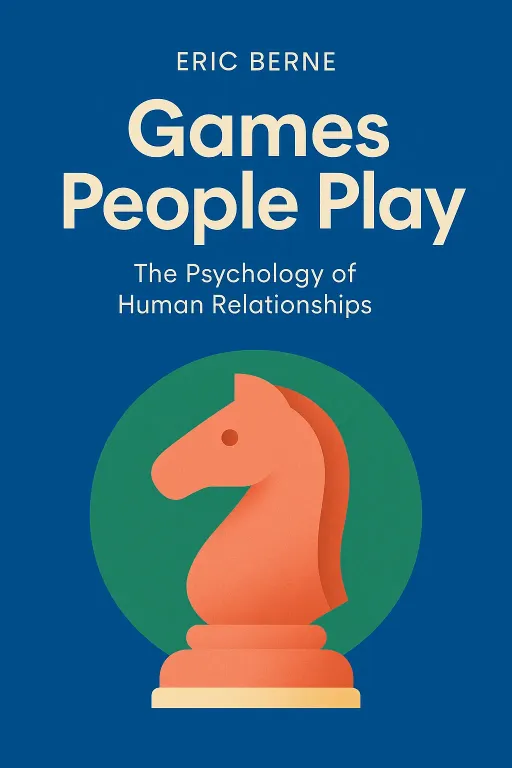
Nova: Exactly. Today we are diving into two legendary frameworks that decode this exact madness: Eric Bernes classic Games People Play, and Slavoj Zizeks mind-bending masterpiece, The Sublime Object of Ideology.
Atlas: Wow, that is a heavy-duty pairing. We are going from mid-century psychology to contemporary continental philosophy. Why this specific duo?
Nova: Because together, they give us the ultimate toolkit. Berne helps us survive the daily micro-politics of the conference room, while Zizek reveals the invisible macro-forces shaping our entire organizational culture.
Atlas: That makes perfect sense. It is like getting a microscope for the individual personalities and a telescope for the corporate beast itself. Let us start with the microscope. Who is Eric Berne, and why should we care about his games?
Nova: Eric Berne was a Canadian-born psychiatrist who challenged traditional psychoanalysis in the mid-twentieth century. He wanted a language that regular people could actually use to understand their relationships, which is why he wrote Games People Play. It became an unexpected cultural phenomenon, staying on bestseller lists for years despite being written as an academic text.
Atlas: That is fascinating. Usually, academic texts are where good ideas go to die in jargon. How did Berne make it accessible?
Nova: He introduced Transactional Analysis. The core idea is that every time we interact with someone, we are operating from one of three ego states: Parent, Adult, or Child.
Atlas: I guess that explains why some managers sound like they are reprimanding a teenager when you are just five minutes late with a report.
Nova: You hit the nail on the head. That is a Parent-to-Child transaction. When both people are in the Adult state, communication is straightforward, objective, and productive. The trouble starts when the transactions cross, or worse, when we start playing psychological games.
Micro-Dynamics and the Games of Office Politics
SECTION
Atlas: Okay, so what exactly constitutes a game in Bernes world? Is it just regular office gossip, or is it something more structured?
Nova: It is highly structured. In Transactional Analysis, a game is a recurring set of transactions with a hidden agenda and a predictable, negative emotional payoff. The players are not acting consciously; they are following a subconscious script.
Atlas: That sounds incredibly exhausting. Can you give us a concrete example of how this plays out in a normal meeting?
Nova: Let us look at a game Berne calls Why Dont You... Yes, But. Imagine a project manager named Sarah and a software engineer named Dave. Sarah is struggling with a tight deadline and brings it up in a team meeting. She says, I am completely overwhelmed with this launch schedule.
Atlas: And Dave, being a helpful colleague, steps in with advice.
Nova: Naturally. Dave says, Why dont you delegate the documentation to the junior developers? Now, in a healthy Adult-to-Adult conversation, Sarah might say, Good idea, I will do that. But in this game, Sarah responds, Yes, but they are already swamped with debugging.
Atlas: Right, so Dave tries again. He says, Why dont you ask the product team for a two-week extension?
Nova: And Sarah fires back, Yes, but the product team is under pressure from the board, so they will never agree. This loop continues five or six times. Dave offers brilliant solutions, and Sarah systematically shoots every single one of them down.
Atlas: I have been in that meeting. It feels like hitting a tennis ball against a brick wall. What is actually happening beneath the surface there?
Nova: Under the surface, they are not solving a problem. Sarah is operating as a helpless Child, and Dave has stepped into the role of the wise, nurturing Parent. But the hidden agenda is different. Sarah wants to prove that her problem is completely unsolvable and that no one can understand her unique suffering. The game ends when Dave runs out of ideas and falls silent.
Atlas: And what is the psychological payoff? Who wins?
Nova: Both get their subconscious rewards. Sarah gets to feel validated in her martyrdom, thinking, See, I told you so, nobody can help me. Dave gets a different payoff, which is the quiet satisfaction of having tried his best as the benevolent helper, even if he feels slightly frustrated. The primary focus shifts from the actual work to the preservation of these subconscious roles.
Atlas: That sounds like a massive waste of organizational energy. If this is happening in every department, it is a miracle any work gets done at all. How do you break a cycle like that?
Nova: You refuse to play your assigned role. You break the game by responding from a pure Adult state. When Sarah says, I am completely overwhelmed, instead of offering advice in a Parent role, Dave could say, That sounds incredibly stressful, how do you plan to handle it?
Atlas: Oh, I see. You throw the ball back into their court. You force them to step into their own Adult state.
Nova: Exactly. You disrupt the script. Another incredibly common office game is what Berne calls Now I Have Got You, You Son of a Bitch.
Atlas: That is an intense title. How does that one work?
Nova: This is the game of the hyper-vigilant manager. Imagine a leader who gives vague instructions for a project, waits for the employee to make a minor, inevitable mistake, and then pounces with immense fury. The mistake is minor, but the reaction is catastrophic.
Atlas: That sounds like someone who was just waiting for an excuse to get angry.
Nova: That is precisely what it is. The manager has accumulated a reservoir of unexpressed frustration and resentment. They do not address the real systemic issues. Instead, they use the employees minor slip-up as a socially acceptable justification to release all that pent-up anger. The payoff for the manager is the feeling of righteous indignation.
Atlas: It sounds like these games are basically survival mechanisms for people who do not know how to communicate honestly. But when you scale this up to an entire department, or an entire company, it must create a deeply toxic ecosystem.
Nova: It does. And when these individual games start to merge with the overall corporate culture, we leave the realm of simple psychology and enter the realm of ideology. This is where Slavoj Zizek's work becomes incredibly powerful.
The Sublime Object of Corporate Ideology
SECTION
Atlas: This is a perfect transition. We are moving from the individual players to the rules of the stadium itself. Zizek is famous for being incredibly dense, so break this down for us. What is his central argument in The Sublime Object of Ideology?
Nova: Zizek looks at how we maintain our belief systems, especially when we think we are too smart to believe them. Classic theory suggested that ideology is a form of illusion, like a veil pulled over our eyes. The old formula was: they do not know it, but they are doing it.
Atlas: Like being brainwashed. You do not realize you are serving a master, so you just do it.
Nova: Yes. But Zizek says that is not how modern organizations work. Today, we have what he calls cynical distance. The modern formula is: we know very well what we are doing, yet we are doing it anyway.
Atlas: That sounds incredibly familiar. We all joke about the corporate buzzwords, the synergy, the paradigm shifts, and the endless compliance training. We know it is mostly empty performance, but we still show up and do it.
Nova: Exactly. You do not have to believe in the corporate mission statement to make it work. Your cynicism actually helps you survive the daily grind, but your physical actions still support the system. You write the self-evaluation, you use the buzzwords in your emails, and you attend the mandatory fun events. The system does not care if you believe in your heart; it only cares about your external compliance.
Atlas: That is a deep insight. It means our skepticism is actually a safety valve. By letting us laugh at the corporate absurdities, the system prevents us from actually rebelling against them.
Nova: You have got it. Zizek uses the concept of the sublime object to explain this. A sublime object is something ordinary that we elevate to a level of sacred importance. In a corporate environment, this could be the quarterly metrics, the brand identity, or the concept of agile transformation. These objects are filled with a kind of mystical power. We treat them as if they hold the ultimate secret to our success, even when we know they are just arbitrary frameworks.
Atlas: Let us make this concrete. Imagine a tech company that boasts about having a completely flat hierarchy. They say, We do not have bosses here, we are just a self-organizing community. How would Zizek analyze that?
Nova: He would look at the invisible hierarchy that inevitably replaces the visible one. In a flat organization, the formal power structures are gone, but the informal power structures become even more ruthless. Because there is no official boss, you have to constantly guess who actually holds the power. You have to monitor your peer relationships constantly. The ideology of flatness actually masks a deeper, more anxiety-inducing form of control.
Atlas: That sounds terrifyingly accurate. In a traditional hierarchy, at least you know who to avoid or who to please. In a flat structure, everyone is watching everyone else, and you have to perform enthusiasm all the time.
Nova: Yes. The demand is no longer just to do your job; the demand is to love your job, to fit the culture, and to be passionate. That is the ideological trap. It colonizes your internal emotional state.
Atlas: So, if we combine Berne and Zizek, we see that office politics are not just random personality clashes. They are highly structured games played within an ideological framework that demands our participation, even when we think we are above it.
Nova: That is the double layer. Berne shows us how we get trapped in individual scripts, and Zizek shows us how the overall system uses our very cynicism to keep us locked in those scripts.
Synthesis & Systems Leadership
SECTION
Atlas: I can see how this leads straight to burnout. You are playing micro-games with your colleagues all day, and you are participating in a macro-ideology that you do not even believe in. How does a leader, especially someone focused on long-term impact, navigate this double bind?
Nova: The first step is developing what we might call ideological literacy. You have to see the water you are swimming in. When you realize that the corporate culture is a constructed system, you stop taking its absurdities personally. You gain emotional distance, which is different from cynical distance.
Atlas: What is the difference there? Emotional distance versus cynical distance?
Nova: Cynical distance is passive. You roll your eyes, but you still play the game exactly as written. Emotional distance is active. You observe the game, you understand the underlying anxieties driving it, and you choose to respond differently. You trust your intuition when something feels off, rather than just rationalizing it away with corporate logic.
Atlas: That sounds like a powerful shift. Instead of being a pawn in the game, you start to rewrite the rules. How does that look in practice for a systems leader?
Nova: It means practicing Adult-to-Adult communication consistently, even when the environment is inviting you to play Parent or Child. It means being incredibly clear about expectations, reducing the ambiguity that breeds informal power struggles, and refusing to use emotional manipulation to get results.
Atlas: It also sounds like it requires a lot of discipline. You have to resist the urge to jump into those games, especially when you are tired or under pressure.
Nova: It does require discipline. That is why taking time to synthesize these insights is so crucial. If you spend even twenty minutes a day reflecting on these dynamics, you start to see the patterns before you get sucked into them. You move from reacting to designing.
Atlas: This brings us back to the idea of legacy. A true leader does not just build a successful company; they build a healthy organizational ecosystem. They create a culture where people do not have to play psychological games to feel safe or valued.
Nova: That is the ultimate goal. By dismantling the hidden games and bringing transparency to the organizational ideology, you build a foundation for genuine collaboration and sustainable high performance.
Atlas: Well, this has been an incredibly eye-opening conversation. We have gone from the micro-scripts of our daily meetings to the macro-ideologies of modern work, and we have come out with a clear roadmap for healthier leadership.
Nova: It is all about awareness. Once you see the games, you cannot unsee them. And once you understand the ideology, you can start to build something genuinely better.
Atlas: This is Aibrary. Congratulations on your growth!