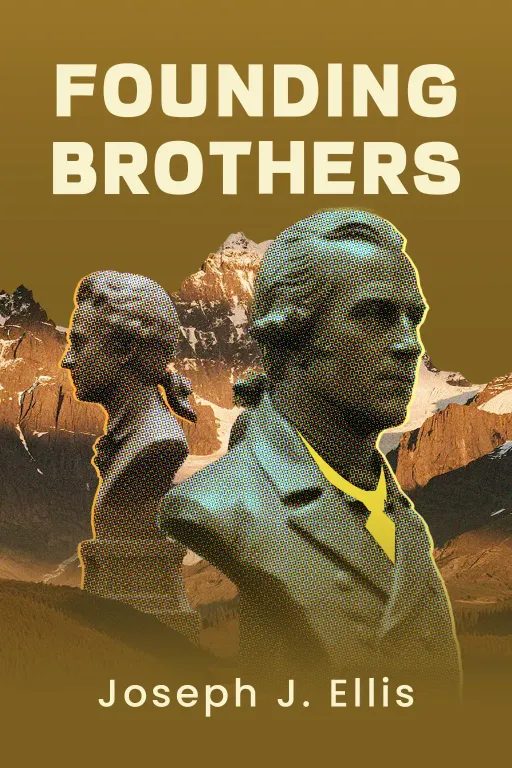
The Founders' Code: Leadership Lessons from America's First Startup
Golden Hook & Introduction
SECTION
Dr. Roland Steele: What does it take to build something that lasts? Not just a company, but a country. Imagine you're launching the most ambitious startup in history. Your co-founders are geniuses—brilliant, visionary, but also arrogant, thin-skinned, and locked in bitter rivalries. One of them, your star developer, is so obsessed with another's character that he'd rather die in a duel than apologize. This isn't a hypothetical; it's the story of America's founding.
Karthikeya challapalli: It's an incredible frame to think about it. We see them as these monumental figures, but they were just people in a room, or on a dueling ground, making incredibly high-stakes decisions under pressure.
Dr. Roland Steele: Exactly. And in Joseph J. Ellis's fantastic book,, we see these men not as marble statues, but as the brilliant, flawed team they were. Welcome to the show, Karthikeya. As a software engineer interested in leadership, I think you'll have a unique take on this.
Karthikeya challapalli: Thanks for having me, Roland. I'm fascinated by the 'operating systems' of leadership, and these guys were writing the original code for America.
Dr. Roland Steele: Perfectly put. Today we'll dive deep into this from two perspectives, using Ellis's book as our guide. First, we'll explore the ultimate leadership failure: the deadly duel between Aaron Burr and Alexander Hamilton, and what it teaches us about managing toxic rivalries.
Karthikeya challapalli: A total system crash.
Dr. Roland Steele: A total system crash. Then, we'll shift to a masterclass in leadership success: the secret dinner party that saved the nation, and what it reveals about the art of the deal.
Deep Dive into Core Topic 1: The Hamilton-Burr Operating System Crash
SECTION
Dr. Roland Steele: So let's start with that system crash, Karthikeya. The duel. To really get it, we have to go to Weehawken, New Jersey. It's dawn, July 11, 1804. The Vice President of the United States, Aaron Burr, and the former Secretary of the Treasury, Alexander Hamilton, are rowed in separate boats across the Hudson River to a secluded ledge.
Karthikeya challapalli: It’s already so dramatic. The setting itself feels like something out of a movie. Why were they there? What was the final trigger?
Dr. Roland Steele: The trigger was a newspaper clipping. For years, Hamilton had privately and publicly called Burr unprincipled, ambitious, and dangerous—a "Catiline of America," someone who would burn the whole thing down to rule the ashes. But the final straw was a letter published in the Albany Register. A Dr. Charles Cooper mentioned that Hamilton had described Burr as "a dangerous man, and one who ought not to be trusted with the reins of government." He even added that he could detail "a still more despicable opinion" Hamilton had expressed.
Karthikeya challapalli: That phrase, "a still more despicable opinion." It's so vague and inflammatory. It's like a comment in code that just says // TODO: Major security flaw here but gives no details. It invites the worst possible interpretation.
Dr. Roland Steele: Exactly. And Burr pounced. He sent a letter to Hamilton demanding a "prompt and unqualified acknowledgment or denial" of the phrase. This kicked off what Ellis calls a "verbal duel." Hamilton responded, but he was evasive. He said he couldn't recall the exact wording of a conversation from years ago, and more importantly, he wouldn't be interrogated about his political opinions.
Karthikeya challapalli: This is the escalation protocol that's so striking to me. Burr demands a specific disavowal. Hamilton can't give it without either admitting he was wrong or lying. It's a binary trap. In system design, you always build an escape hatch, a way to de-escalate. Why didn't they have one?
Dr. Roland Steele: Their escape hatch was supposed to be negotiation through their 'seconds,' their representatives. But the core problem was what you called the protocol: the Code of Honor. For a gentleman of that era, your public character was your entire net worth. It was your political capital. Hamilton believed Burr was fundamentally corrupt. To apologize would be to either lie, which was dishonorable, or to admit his judgment was flawed, which in his mind would destroy his credibility to lead and make him useless to the nation he'd helped build.
Karthikeya challapalli: So his personal 'API' for leadership was inextricably tied to this rigid, unforgiving code. He saw Burr as 'malicious code' that threatened the entire 'republican operating system.' From that perspective, he couldn't back down.
Dr. Roland Steele: He couldn't. Burr raised the stakes, demanding a general apology for insults over the past decade. Hamilton refused. A duel was now inevitable. So there they are, on the ledge at Weehawken. Ten paces apart. The seconds review the rules. The command is given. Two shots ring out. Hamilton is struck. He clutches his side and says to the doctor rushing toward him, "This is a mortal wound, Doctor." He died the next day.
Karthikeya challapalli: It's such a tragic waste of talent. Hamilton was, by all accounts, a genius. A 10x founder. But his inability to manage this one toxic relationship led to his own 'system crash.' He chose to risk deleting himself to try and quarantine Burr's influence. It's a devastating leadership failure, not just for him, but for the whole enterprise.
Dr. Roland Steele: Ellis makes that exact point. The duel revealed the dark side of the founders' brilliance. Their passions and convictions were so strong they could create a nation, but also so intense they could lead to self-destruction. The cost was immense. The 'startup' lost one of its most brilliant architects over a conflict of character.
Deep Dive into Core Topic 2: The Art of the Strategic Trade-Off
SECTION
Dr. Roland Steele: It's a perfect example of how personal dynamics can lead to total failure. But the founders could also do the opposite. They could use personal relationships to engineer incredible success. Which brings us to our second story: the dinner party that saved the nation.
Karthikeya challapalli: I love this. From a story of a fatal bug to a story of a brilliant feature deployment.
Dr. Roland Steele: Precisely. Let's set the scene. It's 1790, New York City, the temporary capital. The new government is just over a year old, and it's already on the verge of collapse. It's completely deadlocked. The issue is Hamilton's financial plan. The most controversial part was 'Assumption'—his proposal for the federal government to assume all the state debts from the Revolutionary War.
Karthikeya challapalli: Why was that so controversial? It sounds logical, to consolidate debt.
Dr. Roland Steele: Because some states, like Virginia, had already paid off most of their debts. They saw it as being forced to bail out less fiscally responsible states, like Massachusetts and South Carolina. The opposition, led by James Madison in the House, was fierce. The bill was defeated, and Hamilton was in despair. He told Thomas Jefferson he might resign, and that the union itself could fall apart.
Karthikeya challapalli: So this is a classic organizational deadlock. It's like two separate engineering teams working on different parts of the 'product'—the Finance team and the 'Virginia' team—are in a merge conflict. They can't integrate their code. The whole project is stalled.
Dr. Roland Steele: A perfect analogy. And this is where Jefferson, the Secretary of State, steps in. He sees a frantic, distraught Hamilton on the street outside President Washington's residence. He pulls him aside and, seeing an opportunity, invites Hamilton to have dinner with him and Madison the next night. A private meeting, away from the floor of Congress.
Karthikeya challapalli: So Jefferson decides to act as the 'chief architect' or 'product manager.' He facilitates an off-the-record meeting to resolve the conflict outside the formal, rigid process.
Dr. Roland Steele: Exactly. And at this dinner, a legendary bargain is struck. Ellis calls it "The Dinner Table Bargain." The conversation was a masterpiece of political horse-trading. Madison agreed that if the Assumption bill was brought back to the House, he would not lead the opposition and would quietly persuade a few Virginia congressmen to change their votes.
Karthikeya challapalli: Okay, so what did Hamilton give up? What was the other side of the trade?
Dr. Roland Steele: The permanent location of the national capital. This was the other huge, divisive issue of the day. Everyone wanted it in their region. Hamilton agreed to use his influence with northern congressmen to ensure the capital would be built on the Potomac River, essentially on Virginia's doorstep.
Karthikeya challapalli: Wow. That's brilliant. It's a classic strategic trade-off. They bundled two completely unrelated 'features'—the financial system and the capital's location—into one 'release.' Hamilton gets his critical 'backend' infrastructure, the financial stability the nation desperately needed. And Madison gets the massive 'frontend' victory, the symbolic and political power of the capital, which satisfies his stakeholders in the South.
Dr. Roland Steele: And it worked. The bills passed. The crisis was averted. Neither side got everything they wanted, but the 'product'—the Union—was able to ship. And Ellis argues this was the real genius of that generation. Not that they were all friends who agreed, but that their intense, competing interests forced them into these creative, balancing compromises.
Karthikeya challapalli: That's a lesson every tech leader needs to learn. You're never going to have perfect consensus. Sometimes, to move forward, you have to make a deal that gives another team a win on something that doesn't compromise your core objective. It’s not about winning every battle; it’s about shipping the product.
Synthesis & Takeaways
SECTION
Dr. Roland Steele: So we have these two incredible, contrasting stories from. A duel, where rigid adherence to a personal code and a refusal to compromise led to a destructive, fatal crash. And a dinner, where flexible, pragmatic, back-channel negotiation led to a breakthrough that saved the nation.
Karthikeya challapalli: Right. It's the central tension of leadership, isn't it? It's about knowing when to be principled to the point of breaking, like Hamilton felt he had to be with Burr's character, and when to be pragmatic to the point of bending, like he was with Madison's political needs. That's the art. It’s not a fixed algorithm; it’s a judgment call.
Dr. Roland Steele: A judgment call that defined the future of a continent. The ability to distinguish between a negotiable interest and a non-negotiable principle. Hamilton saw the capital's location as an interest, but Burr's character as a fundamental threat to the entire system.
Karthikeya challapalli: And that distinction is everything. In tech, we talk about 'must-have' features versus 'nice-to-have' features. A leader's job is to know the difference. Hamilton's financial plan was a 'must-have.' The capital's location was, for him, a 'nice-to-have' that he could trade. That clarity is what allowed the deal to happen.
Dr. Roland Steele: Beautifully summarized. It’s that clarity that separates effective leaders from the rest.
Karthikeya challapalli: It really is. This has been fascinating, Roland. Seeing these historical giants through the lens of a modern startup team makes their challenges feel so immediate and relevant.
Dr. Roland Steele: That’s the power of great history. So for everyone listening, especially young leaders like Karthikeya who are building the future, the question from is this: As you build your teams and your projects, look around you. Who is your brilliant but difficult Hamilton? Who is your ambitious Burr? And more importantly, what is the 'dinner table bargain' you need to broker to ensure your great enterprise doesn't just survive, but thrives?