Understanding the Engines of Human Progress
Golden Hook & Introduction
SECTION
Nova: You aren't working for money. You are working for a ledger entry that tells the world exactly how much energy you have captured.
Atlas: That sounds like a cynical take on my morning coffee run, but I suspect there is a terrifying amount of truth behind it.
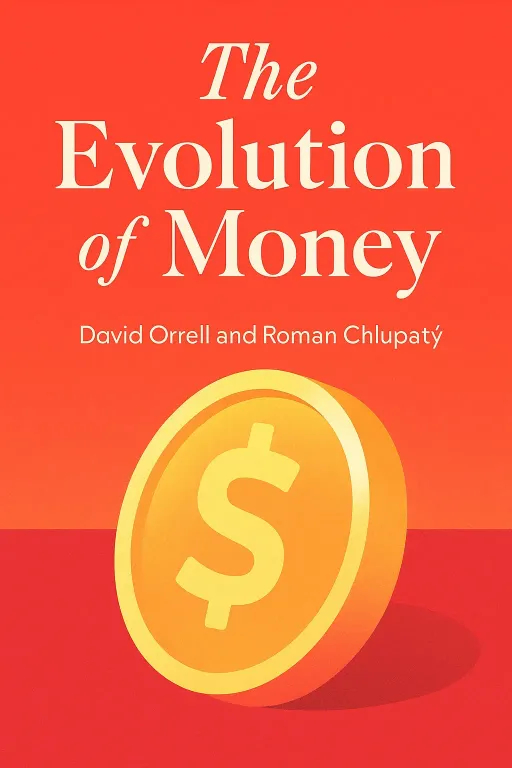
Nova: It is the reality we live in, Atlas. Today, we are exploring the deep architecture of that reality by diving into two transformative books. We are looking at The Evolution of Money by David Orrell and Roman Chlupatý, and Foragers, Farmers, and Fossil Fuels by Ian Morris.
Atlas: Two heavy hitters. One deals with the mechanics of the ledger, and the other deals with the fuel that keeps the whole machine running.
Nova: Exactly. Ian Morris is a historian who loves big data. He tracks human values across thousands of years, specifically looking at how our primary energy source dictates our morality and social structure. David Orrell and Roman Chlupatý, on the other hand, deconstruct the myth that money is just gold or paper. They show us that money is, and has always been, a system of credit and social trust.
Atlas: I am already seeing the connection. If money is trust, and energy is the fuel, then the professional architect or the learner building their future needs to understand how these two systems are shifting right now. Let us break this down.
The Energy-Value Connection
SECTION
Nova: Let us start with the Ian Morris thesis, because it provides the bedrock. Morris argues that human values are not random. They are not just ideas that float down from the heavens. They are a direct result of how much energy a society can capture.
Atlas: I have heard the argument that technology changes us, but you are saying it is deeper than that. You are saying our moral compass is calibrated by our energy intake.
Nova: That is precisely it. Think about the Forager era. Foragers lived in small groups, they had no way to store massive amounts of energy, and they were essentially egalitarian. If you have no surplus, you cannot have kings, and you cannot have massive wealth inequality. The energy capture was low, so the values were survival-oriented and communal.
Atlas: That makes sense. You cannot hoard what you cannot store. If you kill a mammoth, you have to eat it now or it rots. There is no point in being a billionaire hunter-gatherer.
Nova: Right. But then, the Agricultural Revolution happens. We learn to domesticate plants and animals. Suddenly, we can store energy in the form of grain. And what happens when you have a warehouse full of grain?
Atlas: You need guards. You need a system to manage the grain. You need a hierarchy.
Nova: You get a state. You get kings. You get massive inequality. The values shift from egalitarianism to rigid social stratification. Morris points out that the values of the farmer are drastically different from the values of the forager. The farmer values property, lineage, and authority because those things protect the energy surplus.
Atlas: And then we hit the Fossil Fuel era. We go from relying on muscle and sun to pulling ancient sunlight out of the ground in the form of coal and oil. That is a massive spike in energy capture.
Nova: It is an explosion. And this brings us to the modern dilemma. Morris argues that our current values are a chaotic mix because our energy capture is so high that it is destabilizing the old systems. We are essentially living in a high-energy society with a moral framework that is trying to catch up.
Atlas: This feels like the perfect moment to pull in Orrell and Chlupatý. Because if we are in this high-energy, high-complexity world, the way we handle money—the way we track that energy—has to change, too.
Nova: And it has changed. People often think money started as barter, and then we invented coins, and then we invented paper. But Orrell and Chlupatý dismantle that. They show that money actually began as credit. It began as a ledger. It began as a way to track social obligations before we ever had physical tokens.
Atlas: Wait, pause there. I always thought barter was the original system. You trade a chicken for a bag of wheat, and then eventually that gets too annoying, so we invent coins. Are you telling me that is a myth?
Nova: It is a myth that has been repeated so often people believe it is history. But the evidence suggests that ancient societies used credit systems long before they used coins. You didn't trade a chicken for wheat. You went to the village store, you took what you needed, and the storekeeper marked it down on a tablet. You owed the store, and the store owed the community. Money was a social relationship, not a physical object.
Atlas: That is a massive shift in perspective. If money is a social relationship, then the evolution of money is really the evolution of our social trust.
The Evolution of Power and Digital Currencies
SECTION
Nova: Precisely. And that brings us to the digital age. We have gone from stone tablets to gold coins to paper bills to digital entries in a bank database. Each step of this evolution has been an attempt to make the ledger more efficient, more scalable, and more powerful.
Atlas: I can see why this matters for the professional architect or the person trying to build a career. If money is just a ledger entry representing energy or trust, then the people who control the ledger control the reality.
Nova: That is the crux of it. When money was physical, it had constraints. You could only possess so much gold. But when money became credit, and then digital, it became decoupled from physical reality. It became information. And information scales infinitely.
Atlas: I see where this is going. If information is the new energy, then the professional edge isn't just about hard work anymore. It is about understanding the system of the ledger. But let me play devil's advocate for a second. If money is just a social construct, doesn't that make it fragile? Doesn't that make our entire professional future feel like a house of cards?
Nova: It makes it dynamic. Fragility is one way to look at it. Another way is to see it as a system of immense potential. The authors of The Evolution of Money point out that money has always been used to solve problems of complexity. When the world gets too complicated for simple bartering, we invent a new way to record value.
Atlas: So, the complexity of our careers today, the need for specialized skills, the need for strategic networking—this is all just our way of managing the complexity of the modern energy-money system.
Nova: Exactly. Think about the professional architect. You aren't just building structures. You are building systems that capture and store value for society. You are a node in the energy-capture network.
Atlas: That makes me feel like I have more agency. I am not just a cog in the machine. I am a participant in the ledger. But how do we apply this? If I am a learner, if I am trying to build my professional edge, how do I use the insight that money is credit and values are energy?
Nova: You start by looking at where you are directing your energy. Ian Morris would tell you that your values are shaped by your energy source. If your energy source is distraction, social media, and low-level tasks, your values will be fragmented. If your energy source is deep work, technical mastery, and strategic connection, your values will be focused and high-leverage.
Atlas: That is the link. You are saying that the "energy capture" of the individual is their daily output. If I spend my 20 minutes of deep work on high-value skills, I am essentially increasing my own capacity to store energy.
Nova: You are building your own personal capital. And because money is a system of credit, the more you demonstrate that you can capture and generate value, the more the system extends credit to you. It is not just about the paycheck. It is about the trust you build in the market.
Atlas: This is starting to feel much more actionable. The "Evolution of Money" isn't just a history lesson. It is a guide to how the system works. And the "Foragers, Farmers, and Fossil Fuels" idea is the "why" behind our behavior.
Synthesis & Takeaways
SECTION
Nova: It is. We are living in a moment where the old rules of the fossil fuel era are being challenged by the digital, high-information era. The old values of hierarchy and rigid property are being tested by the new values of connectivity and network power.
Atlas: And the professional who thrives is the one who understands that they are not just trading time for money. They are building a reputation—a form of credit—within a high-energy system.
Nova: That is the perfect way to phrase it. The takeaway for our listeners, especially those craving mastery, is to stop looking at their career as a linear path and start seeing it as a system of energy and trust.
Atlas: So, the architect builds the space, the learner builds the mind, and together they are building the ledger of the future. I love that.
Nova: We have covered a lot of ground today. We moved from the prehistoric forager to the digital nomad, and we have seen that the core of our progress is our ability to channel energy into value.
Atlas: And the most important part is that we have the power to choose where we direct that energy. We don't have to be slaves to the current energy-capture model. We can define our own values by choosing our own inputs.
Nova: That is the ultimate freedom. Before we wrap up, I want to leave our listeners with this thought. The next time you sit down for your 20 minutes of deep work, remember that you aren't just completing a task. You are performing an act of energy capture. You are building your own personal credit in the world.
Atlas: I love that. It turns a boring task into a strategic move. If you want to keep exploring these ideas, we encourage you to look at how your own professional habits are shaping your value system. Are you capturing the energy that leads to the future you want?
Nova: And remember, the ledger is always open. You are writing your entry every single day.
Atlas: This has been a fantastic exploration of how the past dictates the architecture of our present. Thank you for joining us on this deep dive.
Nova: This is Aibrary. Congratulations on your growth!