The Evolution of Power and Values
Golden Hook & Introduction
SECTION
Nova: Most people believe their personal values are a product of their upbringing, their philosophy, or their soul. But history suggests your values are actually a direct result of how you capture energy.
Atlas: That sounds like a radical claim. You are saying that if we changed the way we powered our civilization tomorrow, our entire moral compass would shift along with it.
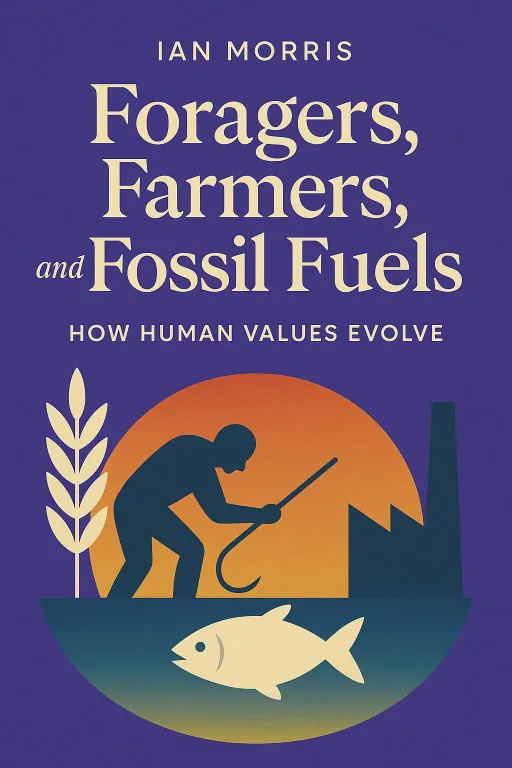
Nova: Exactly. And that is the central thesis of Ian Morris in his fascinating work, Foragers, Farmers, and Fossil Fuels. He argues that human values are fundamentally determined by the primary methods of energy capture available to a society. When you pair that with Francis Fukuyama’s analysis in Political Order and Political Decay, you get a complete picture of why our modern world feels like it is fraying at the edges.
Atlas: I have heard of both, but I have never thought to put them together. Fukuyama is usually the go-to for understanding why governments get stuck in gridlock, and Morris is the deep-time historian. Why do these two specific perspectives matter for someone trying to navigate the chaos of today?
Nova: Because we are currently living through an energy and digital transition that is just as significant as the shift from farming to fossil fuels. If we understand the mechanisms Morris describes, we can anticipate the values that will emerge. And if we understand the institutional traps Fukuyama warns us about, we can build the structures that actually survive the transition.
The Energy-Value Nexus
SECTION
Atlas: Okay, let us start with the Morris argument. It sounds almost like physics, where you are saying the fuel source dictates the outcome. Can you break that down? How does the way we get calories or electricity translate into how we treat our neighbors or view democracy?
Nova: Think about the progression of human energy capture. First, we had foragers. They relied on muscle power, their own and those of their companions. In that environment, you cannot accumulate massive surpluses of energy. If you cannot store energy, you cannot create deep hierarchies. Everyone in the group is roughly equal because everyone is equally dependent on the daily hunt.
Atlas: That makes sense. If I cannot hoard energy, I cannot hoard power. So, equality becomes a survival strategy rather than a moral choice.
Nova: Precisely. Now, shift to the farming era. Farming allowed us to capture solar energy through plants and store it as grain. Suddenly, you have a surplus. You can feed people who are not hunting or gathering. You can build armies, priesthoods, and bureaucracies. Hierarchies emerge because the energy surplus allows for inequality. The values of the farming era became about hierarchy, tradition, and centralized control.
Atlas: And then we hit the fossil fuel revolution. We went from harvesting sunlight through plants to burning millions of years of stored solar energy in the form of coal and oil. That is a massive density jump.
Nova: It is the ultimate energy density jump. Fossil fuels gave us the power to move mountains, literally. This changed our values again. We started to value individualism, secularism, and democratic accountability because the industrial economy required a more mobile, educated, and independent workforce than the feudal farm system did.
Atlas: So, the argument is that our current democratic ideals are a byproduct of the fossil fuel age. That is a sobering thought. It implies that if the energy source changes, the values might change too.
Nova: That is the core of the insight. We are moving into a digital and renewable energy landscape. We are moving from high-density, centralized fossil fuels to distributed, high-compute digital energy. We are already seeing the values of the fossil fuel era—like rigid industrial hierarchy and mass centralization—start to clash with the new reality of distributed networks and digital intelligence.
Atlas: I can see that in the workplace. The old model was the factory floor or the corporate office where you had to be physically present to be productive. The new model is remote, distributed, and digital. And the friction we feel is the clash between those two value systems.
Nova: You hit the nail on the head. The friction is not just a management problem. It is a fundamental realignment of how we define productivity, value, and cooperation.
The Institutional Balancing Act
SECTION
Atlas: If the values are shifting, I want to talk about how we hold it all together. This is where Fukuyama comes in. If the ground is moving under our feet because of this energy shift, how do we keep our institutions from falling apart?
Nova: Fukuyama provides the blueprint here. He argues that a stable society requires a delicate balance of three pillars: a strong state, the rule of law, and democratic accountability. When these three get out of alignment, you get decay.
Atlas: Most people think that the more democracy you have, the better. Is that a misconception?
Nova: It is a common one. Fukuyama shows that if you have democratic accountability without a strong state to enforce the rule of law, you end up with what he calls clientelism. This is where politicians use their power to hand out favors to their supporters rather than serving the public interest. The state becomes a mechanism for patronage instead of a mechanism for governance.
Atlas: I see this playing out everywhere. People feel like the system is rigged. It is not that democracy is absent, but that the state has been captured by interest groups.
Nova: Exactly. A strong state is necessary to provide public goods, but if that state is not constrained by the rule of law, you get tyranny. If you have the rule of law and a strong state but no democratic accountability, you get authoritarianism. The magic is in the triangle. You have to keep all three in tension.
Atlas: So, applying this to our current era of change. We are in a transition. New values are emerging because our energy capture is becoming digital and decentralized. But our institutions—the state, the law, and our democratic systems—were built for the fossil fuel era.
Nova: That is the crisis. Our institutions are rigid, hierarchical, and slow, which was perfect for the fossil fuel age. But we are moving into an era of rapid, distributed, and digital interaction. The institutions are lagging behind the energy shift.
Atlas: This explains why we feel such profound instability. It is not just one problem. It is a synchronization error. The energy substrate of our world has changed, but the software of our institutions is still running on an outdated operating system.
Nova: That is a perfect analogy. The operating system is failing to process the new data. When you have a society that values distributed intelligence and rapid information flow, but your institutions are built on centralized command and control, the system will inevitably suffer from decay.
The Pragmatist’s Dilemma
SECTION
Atlas: Let us bring this down to earth for the people listening. We have a listener who is a strategic architect, a leader trying to make sense of this. They are sitting in a high-stakes environment. They see these macro trends. They see the energy shift, they see the institutional decay. What is the takeaway for them? Do they just wait for the systems to collapse?
Nova: No, that is the opposite of the right approach. The strategic leader recognizes that they cannot control the macro transition, but they can control the micro-environment.
Atlas: So, how do they apply this?
Nova: They build resilient, balanced structures within their own domain. If you are a leader, you are essentially building a mini-state. You need to ensure you have capacity—the ability to get things done. You need to ensure you have clear rules—the rule of law. And you need to ensure you have accountability—a way for your team to participate and provide feedback.
Atlas: That is actually a very practical way to view management. It is not just about quarterly goals. It is about creating a healthy, balanced micro-society.
Nova: Precisely. And the conscious leader also recognizes that they need to align their values with the energy of the time. If they try to force a fossil-fuel-era hierarchy onto a team that is operating in a digital-first, high-autonomy environment, they will lose their best people. The values must match the energy.
Atlas: That resonates. I imagine a lot of listeners are feeling that tension right now. They are trying to lead teams that are more capable, more connected, and more informed than any team in history, yet they are stuck in reporting structures that were designed in the 1950s.
Nova: And that is where the frustration comes from. It is a structural incompatibility. To solve it, you have to lean into transparency and decentralization—the values of the digital energy age—while maintaining the core pillars of accountability and clear rules that Fukuyama insists are necessary for any functional order.
Atlas: It sounds like we are moving toward a model of "distributed governance." You give people the mandate, you give them the rules, and you give them the accountability, but you stop trying to manage every single move they make.
Nova: That is the evolution. You are moving from the manager as a foreman in a coal plant to the manager as an architect of a digital ecosystem. You are not managing the energy; you are designing the flow.
Synthesis & Takeaways
SECTION
Atlas: This has been a fascinating journey. We started with the idea that our values are essentially "energy-determined," and then we moved to the idea that our institutions need a delicate balance to survive. If we pull these two threads together, what is the final insight?
Nova: The final insight is that we are in a period of profound reconstruction. We cannot return to the values or the institutional structures of the past. The energy landscape has shifted permanently. The way we capture and use energy—be it digital compute, renewable power, or AI—is demanding a new set of human values, one that prioritizes adaptability and distributed networks.
Atlas: And our job is not to fight that current, but to build the institutional boats that can handle it.
Nova: Exactly. We need to stop clinging to the command-and-control structures that worked when energy was scarce and centralized. We need to embrace the accountability and the rule of law that Fukuyama highlights, but apply them in a way that respects the autonomy and speed of the digital age.
Atlas: I love the idea that we can build these resilient structures even at a micro-level. It makes the macro chaos feel much more manageable.
Nova: That is the mindset of the conscious leader. You are not a victim of the macro trends; you are an architect of the micro-reality. You take the principles of stability and balance, and you apply them to the new energy of your team, your organization, and your life.
Atlas: That is an empowering place to land. It turns a scary historical analysis into a blueprint for action.
Nova: That is always the goal. Understanding the historical forces at play does not paralyze us; it gives us the clarity to act with intention.
Atlas: I think that is a perfect note to end on. We’ve covered a lot of ground—from the foraging habits of early humans to the institutional decay of modern states—but it all comes back to how we show up today.
Nova: And how we choose to build our own little corner of the world.
Atlas: Thank you for walking us through that, Nova. This was a deep dive, but it felt incredibly relevant to the challenges we’re facing right now.
Nova: It was a pleasure. Understanding the "why" behind our values is the first step toward consciously choosing the future we want to build.
Atlas: For all our listeners, take that concept of the "institutional triad"—state capacity, rule of law, and accountability—and look at your own organization or your own life this week. Where is the balance off? Where are you leaning too hard on one pillar and neglecting the others? That is your starting point for impact.
Nova: We are excited to hear how you apply this. Keep questioning, keep building, and keep evolving.
Atlas: This is Aibrary. Congratulations on your growth!