The Great Ideological Debate on Freedom and Capital
Golden Hook & Introduction
SECTION
Nova: If history were a high-stakes dinner party, Karl Marx would be the guest trying to reorganize the entire kitchen because he believes the chef is underpaying the dishwashers, while Murray Rothbard would be the guest trying to dismantle the house entirely because he believes the building codes are an infringement on his personal property rights.
Atlas: That is a chaotic dinner party, Nova. I think I would be the one hiding in the hallway with the appetizers. But honestly, that comparison hits on something fundamental. We are looking at two of the most polarizing, influential, and misunderstood thinkers in human history today.
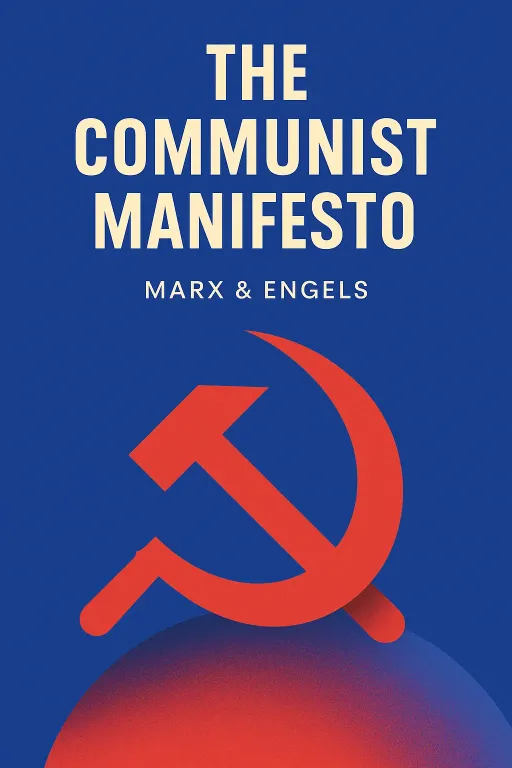
Nova: Exactly. We are diving into two heavyweights. On one side, we have The Communist Manifesto, written by Karl Marx and Friedrich Engels in 1848. It is a work forged in the fires of the Industrial Revolution, arguing that human history is basically a relentless engine of class struggle. Then, on the other side, we have For a New Liberty by Murray N. Rothbard, published in 1973. This is the foundational text for modern libertarianism, which makes the radical case that individual liberty and free markets, completely stripped of state intervention, are the only real paths to human flourishing.
Atlas: It is fascinating to see them side by side. One is obsessed with the collective, the other is obsessed with the individual. And yet, both are trying to answer the exact same question: How do we build a society that doesn't crush the human spirit?
Nova: That is the perfect framing. Both authors were writing during times of massive social upheaval. Marx and Engels saw the brutalization of the working class in the early factories of Europe and concluded that the system itself was the problem. Rothbard wrote in the shadow of the twentieth century’s massive government expansions, concluding that the state was the primary threat to freedom.
Atlas: So, we have two different diagnoses for the same patient. Marx says the system is rigged by the owners of capital, and Rothbard says the system is rigged by the state. This is exactly where I want to start. How do these two worldviews actually see the world?
The Clash of Philosophies
SECTION
Nova: Let’s pull on that thread. For Marx and Engels, the core mechanism of history is the struggle between those who own the means of production—the factories, the land, the technology—and those who have nothing to sell but their labor. They argue that capital, in the hands of a few, inevitably leads to the exploitation of the many. It is not just about greed; it is about the structural design of the economy.
Atlas: Right, so the "bourgeoisie" versus the "proletariat." It is a zero-sum game in their view. If the owner makes a profit, it is only because they have extracted value from the worker that they did not pay for.
Nova: Precisely. They see this as an inescapable friction. The capitalist is forced by the market to squeeze the worker to remain competitive, and the worker is forced by survival to accept those conditions. It is a structural trap.
Atlas: Okay, I get the logic. It is grim, but it is a coherent model of power. Now, flip that over to Rothbard. How does he look at that same factory floor?
Nova: Rothbard would look at that factory and ask, "Is the interaction voluntary?" For him, the entire Marxist critique misses the point because it focuses on the internal dynamics of the firm rather than the external interference of the state. Rothbard’s argument is that if two people agree on a wage and a service, that is a moral, voluntary exchange. The only way that exchange becomes "exploitative" is if the state steps in to create monopolies, grant subsidies, or enforce regulations that favor one group over another.
Atlas: So, where Marx sees the "system" as the problem, Rothbard sees the "state" as the problem.
Nova: That is the essential divide. Marx believes the state is just a tool the owners use to keep their power. Rothbard believes the state is an independent entity that creates the very problems Marx is complaining about. Rothbard’s vision is a society where property rights are absolute. If you own your labor, you own your output, and you can trade it with anyone without a third party—the government—sticking its hand in the till.
Atlas: It is wild to think about these two ideologies as operating systems. Marx is an operating system that prioritizes collective outcome and fairness through structural change. Rothbard is an operating system that prioritizes individual autonomy and voluntary association through the elimination of external force.
Nova: And both of them are incredibly suspicious of concentrated power. They just disagree on where that power lives. Marx locates it in the private corporation. Rothbard locates it in the public government.
Atlas: This brings us to the real-world friction. Because in the modern world, especially in tech, those two lines are blurring. We have corporations that have more power than some small nations, and we have governments that are deeply intertwined with those same corporations.
The Deep Question - Data Privacy and Corporate Responsibility
SECTION
Nova: This leads us to the deep question for our listeners today. How do these opposing philosophies influence your ethical stance on something like modern consumer data privacy? Think about it. We live in a world where our personal data is the currency.
Atlas: That is a great place to apply this. Okay, let’s run a thought experiment. Imagine a massive tech company that tracks every click, every purchase, and every location of its users to sell hyper-targeted ads.
Nova: If we look at this through the lens of The Communist Manifesto, the analysis is sharp. The company has captured the "means of digital production"—the algorithms, the servers, the user base. The users are the workers, but they are not getting paid. They are providing the data, the company is extracting the surplus value, and the company is the one getting rich. The users are being alienated from their own digital identity.
Atlas: That makes perfect sense. From a Marxist perspective, the user is the exploited party. The solution would be to reclaim that data, perhaps through collective ownership or strict regulation to prevent the company from profiting off the user’s labor without fair compensation.
Nova: Exactly. It frames the tech giant as a digital landlord, and the users as the serfs working the land.
Atlas: Now, let’s pivot to the Rothbardian view. How does he look at that same tech company?
Nova: This is where it gets interesting. Rothbard would start by asking, "Did the user agree to these terms?" If the user clicked "I Agree" on that massive, confusing Terms of Service document, then, in a strictly libertarian framework, they entered into a contract.
Atlas: But wait, hold on. A lot of people would argue that you cannot really agree to a contract you do not understand, or one that you are forced into because there are no competitors.
Nova: You have hit on the exact point of contention. A Rothbardian would argue that if there is no competition, it is because the state has created barriers to entry—regulations, patents, or lobbying—that protect the big players. So, the Rothbardian critique is not that the company is "exploiting" the user, but that the company is a beneficiary of a "crony" system. They would say the solution is not more government regulation, which would just entrench the big players further, but to break the state-corporate connection.
Atlas: So, for the Marxist, the solution is to regulate the corporation to protect the user. For the Rothbardian, the solution is to deregulate the market to allow competition to force the corporation to respect the user.
Nova: You have nailed the divergence. One seeks protection through the state; the other seeks protection through the market.
Atlas: This is why this debate is so relevant for our listeners who are navigating modern business. If you are an innovator, or if you are in marketing, or if you are just a conscious consumer, you are caught in the crossfire of these two ideas.
Nova: Consider corporate responsibility. The Marxist view would argue that a corporation has a moral duty to the society and the workers because the corporation exists only by the grace of that society. Profit cannot be the only goal; social equity must be a metric.
Atlas: And the Rothbardian view?
Nova: The Rothbardian view is that the only responsibility a corporation has is to its shareholders and its customers. Any attempt to force "social responsibility" is just another form of theft—taking money that belongs to shareholders and spending it on causes they did not choose.
Atlas: That is a harsh, cold logic, but it is internally consistent. If I own a company, it is my property. If I want to donate to charity, I do it. If the government forces me to, they are violating my property rights.
Nova: But here is the critical insight. Both of these frameworks, when pushed to their extremes, encounter real-world friction. If you follow the Marxist path, you risk creating a massive, bloated state that can become just as oppressive as the corporations it tries to tame. And if you follow the Rothbardian path, you risk creating a world where power is concentrated in the hands of whoever has the most capital, with no mechanism to prevent abuse of the vulnerable.
Atlas: Which is why the answer is rarely purely one or the other. We are living in a hybrid reality. We need the consumer protections that prevent predatory behavior, which leans a bit toward the Marxist concern for the "worker." But we also need the market freedom and the respect for property rights that Rothbard champions, to ensure we have innovation and competition.
Synthesis & Takeaways
SECTION
Nova: What’s truly insightful is how both these thinkers, despite their massive differences, are unified by their desire to strip away the illusions of the status quo. Marx wants to show you that the game is rigged. Rothbard wants to show you that the referee is on the take.
Atlas: So, the takeaway for our listeners isn't to pick a side and wear a jersey. It is to use these two lenses to analyze your own life and work.
Nova: Exactly. When you look at a problem—whether it is data privacy, AI ethics, or your own career path—ask yourself: Is the problem a result of unchecked corporate power? That is the Marxist question. And then ask: Is the problem a result of state-granted privileges or a lack of individual agency? That is the Rothbardian question.
Atlas: I love that. It turns these complex, heavy philosophies into a diagnostic tool. If you are feeling frustrated with a corporate policy, don't just get angry. Ask: "Is this a structural exploitation of my labor and data?" And then ask: "Is this a result of a system that is preventing competition and protecting incumbents?"
Nova: And remember what we talked about in the growth recommendations for our listeners. This is about strategic foresight. If you can see the power dynamics at play, you can anticipate where the market is going, where the regulation is going, and where the tension will snap.
Atlas: It is about building a sustainable solution. If you are an innovator, you want to build something that respects the user's property rights—the Rothbardian win—while also ensuring you are not alienating the community or the workforce—the Marxist concern. You can build a bridge between these two worlds.
Nova: That is the ultimate goal. To move beyond the binary of "state versus market" and find the "human" in the middle. We need to value individual liberty, but we also need to recognize our collective responsibility to one another.
Atlas: This has been a heavy, but incredibly necessary, conversation. It is amazing how two books written decades, even centuries ago, can still feel like they are describing our Twitter feeds and our privacy settings this morning.
Nova: History doesn't repeat, but it certainly rhymes. And if you understand the underlying rhythms—the class struggle and the state-market tension—you are going to be much better equipped to navigate the future.
Atlas: Before we wrap up, I want to leave our listeners with this: The next time you click "Accept" on a digital agreement, just pause for a second. Think about the power structure behind that button. Think about who owns what, and who is really in control. It changes how you see your own digital life.
Nova: It really does. Thank you for joining us in this exploration of ideology and reality. We hope this sparks some deep reflection in your day. This is Aibrary. Congratulations on your growth!