Mastering the Art of Language Acquisition: Beyond Grammar Rules
Golden Hook & Introduction
SECTION
Nova: Raise your hand if your experience with language classes in school felt less like an exciting journey and more like a linguistic labyrinth. All those verb conjugations, endless vocabulary lists, grammar rules that seemed designed to confuse… It often felt like a chore, didn't it?
Atlas: Oh, I'm raising both hands, Nova! It felt like I was trying to memorize an encyclopedia, not learn to to another human being. The joy was often completely sucked out of it, replaced by this pressure to perform.
Nova: Exactly! But what if I told you that much of what we've been taught about learning a language, the conventional wisdom, is actually hindering our progress? What if the real secret to fluency isn't more grammar drills, but understanding how our brains acquire and retain information?
Atlas: That’s a bold claim, and frankly, a bit of a relief for anyone who's ever felt defeated by DuoLingo. So, are we talking about some revolutionary new method, or just a different way of looking at it?
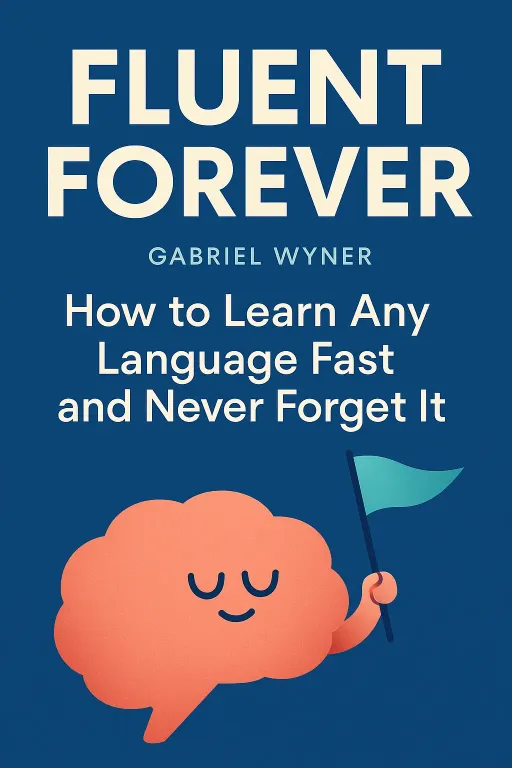
Nova: Well, it's both, actually. Today, we're diving into a paradigm shift in language acquisition, drawing incredible insights from two brilliant minds. First, we have Gabriel Wyner, author of "Fluent Forever." What's fascinating about Gabriel is that he's a baritone opera singer who, out of sheer necessity, needed to master four languages in a few short years to sing his roles authentically. He developed his entire method because traditional approaches simply failed him.
Atlas: That’s amazing! Talk about high stakes motivation. And it speaks to the idea that necessity truly is the mother of invention. But he’s not the only one guiding us today, right?
Nova: Absolutely not. We’re also pulling from the universal principles of accelerated learning found in "The Art of Learning" by Josh Waitzkin. Josh, for those unfamiliar, is a former child chess prodigy and a Tai Chi Push Hands world champion. His journey demonstrates how to achieve mastery across vastly different, complex domains.
Atlas: So, we're looking at language learning not just as a subject, but as a master skill, through the lens of someone who's conquered diverse fields. That’s a powerful combination.
Nova: It truly is. We’re going to explore how to effectively 'rewire' your brain for fluency using cutting-edge techniques. Then, we'll discuss the art of making language learning a sustainable and enjoyable lifestyle, drawing lessons from these universal principles of mastery.
Brain-First Language Learning: Rewiring for Fluency
SECTION
Nova: So, let's start with this idea of rewiring your brain. Most of us, when we think of learning a new language, immediately jump to vocabulary lists and grammar tables. We think, "I need to know how to say 'hello' and 'thank you,' then conjugate verbs."
Atlas: Yeah, and we probably spend countless hours trying to memorize these things, only to forget them a week later. It feels like we're just cramming information into a leaky bucket.
Nova: Exactly! And that's where Wyner's approach in "Fluent Forever" offers such a profound shift. He argues that the absolute thing you should focus on is pronunciation. Not just for sounding "native," but because it fundamentally changes how your brain processes the language.
Atlas: Wait, hold on. Pronunciation first? That sounds a bit out there. I always thought you learned words, then grammar, and maybe refined your accent. Why is pronunciation so foundational?
Nova: It’s all about creating the right neural pathways from day one. If you can't a sound distinction, you can't it, and you certainly can't it effectively. For example, if your native language doesn't distinguish between a short 'i' and a long 'ee' sound, like in English 'ship' versus 'sheep,' your brain literally filters out that difference. It treats them as the same sound.
Atlas: Oh, I see. So if I'm learning a language that relies heavily on those subtle vowel differences, and my brain isn't even registering them, I'm already at a disadvantage. I'm building my house on a shaky foundation.
Nova: Precisely. Wyner suggests that by starting with pronunciation, using minimal pairs and focusing on the sounds that are foreign to your ear, you force your brain to create new neural maps for those sounds. You're literally rewiring your auditory cortex. Once you can accurately and these sounds, then everything else—vocabulary, grammar—becomes significantly easier because you're working with the actual building blocks of the language.
Atlas: That makes sense. It’s like learning to distinguish different colors before you try to paint a masterpiece. And you mentioned spaced repetition. How does that fit into this brain-first approach?
Nova: Spaced repetition is the ultimate memory hack, and it's backed by decades of cognitive science. Our brains are designed to forget. It’s a feature, not a bug, allowing us to clear out less important information. Spaced repetition systems, like digital flashcard apps, present information to you just as you're about to forget it.
Atlas: So it's not about brute-force memorization, but strategically revisiting information right when your brain needs a nudge. That sounds incredibly efficient.
Nova: It is. It optimizes your memory retention, moving information from short-term to long-term memory with minimal effort. Combined with pronunciation, it means every new word or phrase you learn is deeply embedded, linked to its correct sound, not just a phonetic approximation in your head.
Atlas: And then there's immersion from day one. For someone just starting out, that might sound overwhelming, like being dropped into the deep end of a pool. How do you do that effectively without just drowning?
Nova: The key is "immersive input without explicit translation." This doesn't mean you have to move to France tomorrow. It means consistently exposing yourself to the language through listening and reading, but constantly stopping to translate every single word.
Atlas: So you’re saying I shouldn't have Google Translate open on my phone for every single foreign phrase?
Nova: Exactly. The goal is to let your brain infer meaning from context, from visual cues, from the overall gist. It’s how children learn their first language. They don't have a dictionary; they piece together meaning from the world around them. It's about letting your brain work naturally, rather than forcing a rigid, analytical translation process onto it.
Atlas: That’s a huge mindset shift for anyone who’s used to dissecting every sentence. So, the "tiny step" you recommend involves 70% active recall and 30% immersive input without explicit translation. That seems like a very deliberate balance.
Nova: It is. The active recall, through spaced repetition flashcards for instance, builds that strong, retrievable foundation. The immersive input, even if you understand only 10-20% at first, starts building those contextual connections and helps your brain get used to the rhythm and flow of the language. It’s a powerful combination for rewiring.
The Zen of Deliberate Practice: Making Language Mastery a Lifestyle
SECTION
Nova: This brain-first approach naturally leads us to our second core idea: how to make language mastery a sustainable and enjoyable part of your life, drawing lessons from broader principles of accelerated learning. This is where Josh Waitzkin's "The Art of Learning" really shines.
Atlas: I'm curious how someone who mastered chess and Tai Chi can inform language learning. Are we talking about some kind of linguistic martial art?
Nova: In a way, yes! Waitzkin emphasizes universal principles, like "investing in the fundamentals" and "making small circles to make big circles." For language, investing in the fundamentals means what we just talked about: mastering pronunciation, building a solid core vocabulary through spaced repetition, and understanding the core grammatical structures through exposure, not just rote rules.
Atlas: Okay, but "making small circles to make big circles"—that sounds a bit abstract. Can you give me a tangible example for language learners? How does that apply to, say, learning a complex verb tense?
Nova: Absolutely. Imagine you're learning the subjunctive mood in Spanish. It's notoriously tricky. A "big circle" approach might be trying to master all its uses, all its irregular forms, and applying it perfectly in conversation from day one. That's overwhelming.
Atlas: And probably leads to a lot of frustration and mistakes.
Nova: Exactly. A "small circles" approach would involve isolating one tiny aspect of the subjunctive. Perhaps just one common phrase, like "Espero que te guste". You practice that one phrase, perfectly, understanding its nuances, its pronunciation, its specific context. You make that one "small circle" incredibly robust.
Atlas: So you're not trying to learn the subjunctive, but one perfect slice of it.
Nova: Precisely. And once that small circle is solid, you expand it slightly. Maybe you add another common phrase, or you try to adapt "Espero que te guste" to a slightly different context. You're gradually elaborating on a perfectly mastered fundamental, slowly making bigger and bigger circles, building out the complexity from a place of strength.
Atlas: That makes so much more sense than trying to tackle the whole beast at once. It feels less daunting, more achievable. And Waitzkin also talks about the role of adversity in growth. Most people want to avoid struggle in language learning. How does embracing adversity help?
Nova: This is where many traditional approaches miss the mark. We're taught to avoid mistakes, to get things "right" immediately. But Waitzkin highlights how adversity, challenges, and even outright failure are crucial for deeper learning. In his world, losing a chess game or making a mistake in Tai Chi isn't a setback; it's a data point, an opportunity for profound insight.
Atlas: So it's not about avoiding mistakes, it's about to learn from them? That's a huge mindset shift. How do we integrate this "deliberate practice," this embrace of adversity, into a daily routine so it's not a chore, but an enjoyable, sustainable habit, which was our deep question?
Nova: That’s the million-dollar question, isn't it? It starts with reframing mistakes not as failures, but as essential feedback. When you use that active recall and stumble, that's your brain telling you where the neural pathways are weak. That's an opportunity to strengthen them. For example, instead of dreading those flashcards where you always get the answer wrong, see them as your personal trainers, highlighting exactly what needs attention.
Atlas: I like that – your personal linguistic trainer. So, it's about shifting from a performance mindset to a learning mindset.
Nova: Exactly. And the "enjoyable habit" part comes from connecting language learning to your intrinsic motivations. If you love a certain type of music, find songs in your target language. If you enjoy cooking, find recipes. If you're passionate about a specific topic, find podcasts or articles about it in the language. It's about consciously designing your practice around what already brings you joy, rather than forcing yourself through activities you dislike.
Atlas: That’s a much more sustainable path. It feels less like climbing a steep mountain and more like exploring a beautiful new landscape. And for someone who values deep understanding and building strong foundations, this approach resonates deeply.
Synthesis & Takeaways
SECTION
Nova: So, what we've really been talking about today is moving beyond surface-level language acquisition to a more profound, brain-aware, and mastery-driven approach. It’s about understanding that language isn't just a set of rules; it's a living system that your brain is uniquely equipped to learn, provided you give it the right inputs.
Atlas: And for the strategic seeker, the academic architect in all of us, it’s about applying universal principles of accelerated learning to a domain that often feels impenetrable. It’s turning a perceived chore into a deliberate, enjoyable, and ultimately sustainable practice.
Nova: Absolutely. The ultimate takeaway is to stop fighting your brain and start collaborating with it. Invest in those foundational sound systems first, leverage the power of spaced repetition for efficient memory, and immerse yourself passively to build context. Then, adopt that "small circles to big circles" mentality, embracing challenges as learning opportunities.
Atlas: It’s truly about shifting your perspective from "I'm trying to learn a language" to "I'm training my brain to operate in a new linguistic reality." And that's a profoundly empowering thought.
Nova: Indeed. It transforms language learning from a daunting task into a consistent, rewarding journey of personal growth and expanded consciousness.
Atlas: That’s actually really inspiring. So, for our listeners, the challenge is to look at how they're approaching language learning, or any new skill, and ask themselves: am I working with my brain, or against it?
Nova: Precisely. Start with the sounds, build through smart repetition, and let your passions guide your immersion. You’ll be amazed at how quickly your 'linguistic leap' transforms into genuine fluency.
Atlas: Incredible. Thank you, Nova, for shedding light on such a fundamental and often intimidating topic.
Nova: My pleasure, Atlas.
Atlas: To all our listeners, we'd love to hear about your own language learning journeys and what insights resonated with you today. Share your stories and breakthroughs with us.
Nova: This is Aibrary. Congratulations on your growth!