

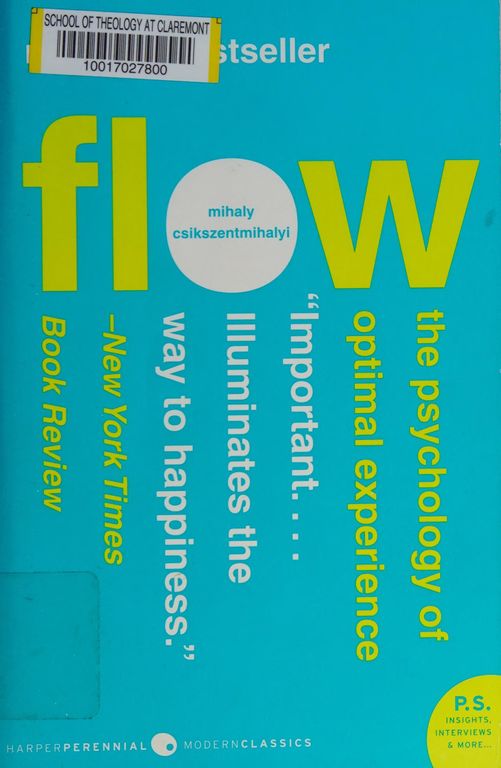
Flow
Introduction: The Secret to Optimal Experience
Introduction: The Secret to Optimal Experience
Nova: Welcome to Aibrary, the show where we dissect the ideas that shape how we live, work, and think. Today, we’re diving into a concept so powerful it’s been called the secret to lasting happiness: Flow.
Nova: : Happiness? That sounds like a big promise for a single book. What are we talking about? Is this another self-help guide promising instant bliss?
Nova: Not at all. We’re talking about the seminal work, "Flow: The Psychology of Optimal Experience," by the legendary psychologist Mihaly Csikszentmihalyi. And the key isn't bliss; it's deep, active enjoyment. Csikszentmihalyi spent decades studying what makes an experience genuinely satisfying, and he found it wasn't relaxation or passive pleasure.
Nova: : That’s immediately interesting. Most people associate happiness with kicking back, maybe a good meal or a long vacation. So, this psychologist is saying the best moments aren't the easiest ones?
Nova: Precisely. He found that the moments people remember as truly making their lives worthwhile—moments of deep enjoyment, creativity, and total involvement—all shared a common psychological state. He called it Flow. It’s when you are so absorbed in an activity that nothing else seems to matter.
Nova: : So, it’s that feeling where you look up, and three hours have vanished? I’ve felt that while coding, or maybe when I was deep into a complex research paper. But how do you bottle that? And why is it different from just being entertained?
Nova: That’s the million-dollar question, and it’s what we’re unpacking today. We’re going to explore the architecture of Flow—the eight essential components that build this optimal state—how it differs fundamentally from mere pleasure, and where we can find it in our everyday, often mundane, lives. Get ready to rewire how you think about productivity and joy.
Nova: : I’m ready. Let’s start with the basics. What is the fundamental difference between this 'Flow' and just feeling good?
Key Insight 1: The Distinction Between Passive and Active States
Flow vs. Pleasure: The Active Pursuit of Enjoyment
Nova: The crucial first step in understanding Flow is separating it from pleasure. Csikszentmihalyi makes a very clear distinction. Pleasure, like eating a rich dessert or watching a binge-worthy show, is typically a passive state. It requires little psychic energy.
Nova: : Right, it’s restorative, but it doesn't build anything new in us. It’s consumption.
Nova: Exactly. It’s restorative, but it doesn't build psychic complexity or lead to lasting satisfaction. Flow, conversely, is an active state. It’s an experience that is completely within the control of the person, demanding high levels of focused energy and skill application.
Nova: : So, if I’m lying on the couch scrolling through my phone, that’s pleasure, or maybe even apathy, but definitely not Flow. Flow requires effort.
Nova: It requires effort. The research shows that people who report the highest levels of life satisfaction aren't those who spend most of their time relaxing. They are those who frequently engage in activities that stretch them. Think of a surgeon performing a delicate operation, or a musician mastering a difficult concerto. They aren't 'relaxing,' but they are experiencing deep enjoyment.
Nova: : That makes sense in those high-stakes scenarios. But what about the average person? If I’m just doing my quarterly budget report, which is necessary but not exactly thrilling, can I find Flow there?
Nova: You absolutely can, provided you structure the task correctly. The goal isn't to avoid the budget report; it’s to transform the of doing it. Flow is about ordering the information entering our consciousness. When we are in Flow, our attention is so focused that there is no room for the usual mental static—worry, boredom, self-doubt.
Nova: : That mental quiet is what I crave. It sounds like Flow is the antidote to the modern condition of constant distraction. If we’re not actively engaged, our minds wander into anxiety or rumination.
Nova: That’s a perfect summary. Csikszentmihalyi noted that when we are bored, we seek stimulation, and when we are anxious, we seek distraction. Flow is the sweet spot where neither is necessary because the activity itself is intrinsically rewarding. It’s not about escaping reality; it’s about becoming intensely present within it.
Nova: : So, the pursuit of Flow is essentially the pursuit of a more meaningful, engaged existence, rather than just chasing fleeting dopamine hits from easy pleasures. It’s about that deep satisfaction.
Nova: Precisely. It's the difference between eating candy and mastering a complex recipe. One satisfies a momentary craving; the other builds a lasting skill and provides enjoyment in the process. The key is that the activity must be intrinsically motivating—you do it because the doing is the reward itself.
Nova: : I’m sold on the concept. But how do we actually engineer this state? What are the building blocks? I heard there are eight components. That sounds like a very specific blueprint for optimal experience.
Key Insight 2: The Blueprint for Total Absorption
The Eight Components: Engineering Optimal Experience
Nova: Let’s break down the architecture. Csikszentmihalyi identified eight core characteristics that consistently appear when people describe being in Flow. The first two are the setup: and.
Nova: : Clear goals are easy enough—I know what I need to achieve. But immediate feedback is huge. In many jobs, feedback is quarterly, or worse, only when something goes wrong. How does that work in Flow?
Nova: That’s why Flow often appears in activities with built-in feedback loops, like sports or music. A tennis player knows instantly if the serve was good. A programmer knows if the code compiled. If your job doesn't offer that, you have to create it. For instance, if you’re writing a long report, you might set micro-goals: 'I will complete this section outline perfectly in the next 30 minutes, and I will check my structure against the outline.' That micro-feedback keeps the engine running.
Nova: : That’s a practical application right there. Okay, what’s the third, and perhaps most famous, component?
Nova: That would be. This is the heart of the Flow channel. If the challenge is too high for your skill level, you get anxiety. If your skill level is too high for the challenge, you get boredom. Flow lives in that narrow corridor where the task is just slightly beyond your current comfort zone.
Nova: : I’ve seen this visually represented as a graph. If I’m a beginner guitarist, trying to play a Van Halen solo immediately puts me in anxiety. If I’m just strumming 'Twinkle Twinkle Little Star,' I’m bored. Flow is that intermediate piece that makes my fingers hurt a little but my mind completely engaged.
Nova: Exactly. It requires stretching. Now, the next set deals with attention: on the present moment, leading to.
Nova: : That’s where the self disappears, right? The internal critic shuts down because all cognitive resources are dedicated to the task at hand.
Nova: Precisely. You stop thinking about you are doing it, and you just it. This leads directly to. You’re not worried about how you look, what others think, or if you’re making a mistake. The ego dissolves into the activity.
Nova: : That loss of self-consciousness is huge. It’s the ultimate stress reliever. What about time? I always lose track of time.
Nova: That’s component. Time either speeds up dramatically, or in some high-focus activities, it can seem to slow down, allowing you to perceive micro-movements. And finally, component.
Nova: : Control, but not in the sense of dominating the situation, right? It’s an internal sense of agency over the process.
Nova: It’s a feeling of effortless mastery, even if the task is incredibly difficult. You feel capable of handling whatever comes next. So, to recap: Clear Goals, Immediate Feedback, Skill/Challenge Balance, Intense Focus, Merged Action/Awareness, Loss of Self, Time Distortion, and Control. That’s the recipe for optimal experience. It’s a demanding recipe, but the payoff is profound engagement.
Nova: : It sounds like a mental workout. If we can achieve this state consistently, we’re not just happier; we’re actively building our skills and our sense of self-efficacy. Where do we see this in the real world, beyond the lab?
Case Study: Peak Performance Examples
The Flow State in Action: Athletes, Artists, and the Workplace
Nova: The research is rich with examples. Let’s look at sports first, because it’s such a clear illustration of the skill-challenge balance. Athletes often describe Flow as having a 'totally clear head,' focusing entirely on performance without any self-consciousness.
Nova: : I remember reading about LeBron James' pre-game chalk toss. That ritual isn't just for show; it’s a deliberate act to transition his mind into that focused state, signaling to his brain: 'The noise stops now.'
Nova: Absolutely. It’s a trigger. Similarly, Roger Federer’s rhythmic bouncing of the tennis ball before a serve isn't random; it’s a way to calibrate his focus and ensure immediate feedback is ready. These rituals are often unconscious methods of setting the stage for Flow by establishing clear goals and focusing attention.
Nova: : What about the creative side? I imagine artists and musicians are natural Flow practitioners.
Nova: They are prime examples. A painter can be so absorbed in mixing colors and applying brushstrokes that the entire day disappears. The feedback is immediate—the canvas changes with every stroke. The challenge is high because the vision in their head must be translated through their physical skill onto the medium.
Nova: : And in the professional world, where the stakes are often less life-or-death than sports or art? Where does Flow show up in the office?
Nova: It shows up in deep work. Think of a software engineer solving a particularly thorny bug. They are intensely focused, the code provides instant feedback—it either runs or it crashes—and the challenge is perfectly matched to their expertise. They aren't thinking about their mortgage or what they’ll have for dinner; they are one with the logic problem.
Nova: : That’s the state where you produce your best, most innovative work. It’s counterintuitive because many workplaces structure themselves around interruptions, meetings, and context-switching, which are the absolute enemies of Flow.
Nova: They are. Csikszentmihalyi’s work is a direct challenge to the modern open-plan office, for example. If you are constantly interrupted, you can never achieve that intense concentration required for the merging of action and awareness. You are stuck in a cycle of anxiety and low-level engagement.
Nova: : So, the practical takeaway here is that if we want more Flow, we need to aggressively protect blocks of time where we can set our own clear goals and receive rapid feedback, whether that’s through task batching or designing better feedback loops into our projects.
Nova: Exactly. It’s about taking control of your attention. The activity doesn't have to be inherently exciting; it just has to demand your full, focused self. The excitement is generated internally by the successful navigation of the challenge, not externally by the task itself.
Nova: : This all sounds incredibly positive, Nova. But I feel like any major psychological theory eventually faces pushback. Are there any significant criticisms of Flow theory that we should be aware of before we declare it the ultimate path to enlightenment?
Key Insight 3: Oversimplification and External Focus
The Fine Print: Critiques and Modern Context
Nova: That’s a necessary step for any serious discussion. While Flow is incredibly influential, modern psychology and philosophy have pointed out a few areas where the theory can be seen as incomplete or even slightly misleading.
Nova: : I’m curious about the internal causes. You mentioned earlier that some critics feel the theory focuses too much on external correlates. What does that mean?
Nova: It means that by focusing so heavily on the —the challenge-skill balance, the feedback—the theory sometimes glosses over the psychological readiness required. For example, someone might be in a high-challenge, high-skill situation, but if they are dealing with acute trauma or severe depression, they won't enter Flow. The internal state matters immensely.
Nova: : So, Flow isn't a magic switch you can flip just by setting up the right external environment. You still need a baseline level of psychological stability to even access that focused state.
Nova: Precisely. Another common critique is the oversimplification of the challenge-skill ratio. People often reduce it to a simple formula, but the reality is far more nuanced. What one person perceives as a manageable challenge, another might find terrifyingly overwhelming, even if their objective skills are identical.
Nova: : And what about the idea that Flow requires us to temporarily disable our self-critical impulses? Is that always a good thing? Sometimes that self-criticism is what keeps us ethical or prevents us from making careless errors.
Nova: That’s a very sharp point. Csikszentmihalyi suggests that losing self-consciousness is key, but critics argue that if you completely disable your reflective impulses, you might lose the capacity for ethical monitoring or long-term strategic thinking that requires stepping the immediate task.
Nova: : It’s the difference between being fully immersed in the moment and being a responsible agent in the world. You can’t be in Flow forever; you have to come back out and process.
Nova: Exactly. The theory is sometimes criticized for promoting a kind of hyper-focus that might not be sustainable or even desirable in all aspects of life. It’s a tool for optimal performance, not necessarily a blueprint for a balanced life if pursued exclusively.
Nova: : So, the modern takeaway isn't just 'chase Flow,' but 'understand the conditions for Flow so you can strategically deploy it when it matters most—like during deep work sessions or creative endeavors—while recognizing its limitations in passive or reflective time.'
Nova: You’ve nailed it. Flow is a powerful state of, but it is not the same as, which is a broader, more complex evaluation of one's life. Flow is a peak experience, a high point on the map, but it’s not the entire journey.
Conclusion: Integrating Flow into a Meaningful Life
Conclusion: Integrating Flow into a Meaningful Life
Nova: We’ve covered a lot of ground today, moving from the basic definition of Flow as an active, optimal experience to the intricate eight-component blueprint that makes it possible.
Nova: : We learned that Flow isn't about passive pleasure; it’s about the deep satisfaction that comes from mastering a challenge slightly beyond our current grasp. And we saw how athletes use rituals to trigger that focused state, while knowledge workers need to aggressively defend their time to achieve it.
Nova: The most actionable takeaway, I think, is recognizing that we have agency over our experience. We can audit our daily activities and ask: Where is the challenge too low, leading to boredom? Where is it too high, leading to anxiety? And how can I inject immediate feedback into this task?
Nova: : It’s about transforming the mundane by injecting intention. If we can engineer just a few hours of true Flow into our week, we are investing directly in our long-term sense of fulfillment, not just momentary comfort.
Nova: It’s about building an 'autotelic personality'—a person who is intrinsically motivated and finds enjoyment in the process of living itself. Csikszentmihalyi showed us that the quality of our lives is not determined by what happens to us, but by how we order the information that enters our consciousness while it happens.
Nova: : A powerful, and frankly, empowering message. It puts the responsibility for deep satisfaction squarely back in our own hands. Thank you for guiding us through this essential text.
Nova: My pleasure. Remember, the path to optimal experience isn't about finding an easier life; it’s about finding the right challenges to meet your growing skills. This is Aibrary. Congratulations on your growth!