The Crisis Advantage: Why 'Normal' Isn't Enough When Chaos Strikes
Golden Hook & Introduction
SECTION
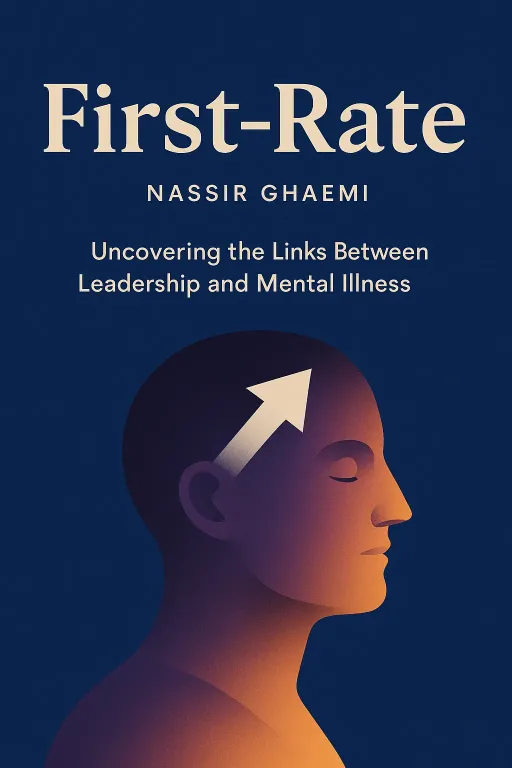
Nova: Picture this. You are in a flight simulator, and suddenly, both engines fail. The alarms are blaring, the cabin is losing pressure, and you have seconds to react. Who do you want at the controls? A perfectly happy, optimistic pilot who believes everything will just work out, or someone who has stared into the abyss, expects the worst, and knows exactly how to handle a crash? Today, we are challenging everything you think you know about mental health and leadership. We are diving into Nassir Ghaemi's provocative book, First-Rate: Uncovering the Links Between Leadership and Mental Illness. Today, we are going to tackle this book from three different angles. First, we will explore the Inverse Law of Sanity and why mild depression can actually grant us a superpower called depressive realism. Second, we will look at how trauma acts as the mind's vaccine to build bulletproof resilience. And finally, we will unmask the homoclite trap, showing why perfectly normal people often freeze when the script breaks. Joining us today is Mehedi Onik, a customer support specialist in the engineering manufacturing industry. Mehedi, welcome to the show.
Mehedi Onik: Thanks, Nova. It is great to be here. You know, that flight simulator analogy really hits home for me. In customer support, especially in engineering and manufacturing, when a critical system goes down on the factory floor, it feels exactly like both engines failing. The client is panicking, the engineers are scrambling, and the standard operating procedures suddenly do not work anymore. You quickly realize that blind optimism is a liability. You need someone who can look at a terrible situation with absolute, unvarnished realism.
Nova: Exactly. And that is the core argument of Ghaemi's book. He calls it the Inverse Law of Sanity. The idea is that when times are good, when peace reigns, and the ship of state only needs to sail straight, mentally healthy people function beautifully as our leaders. But when our world is in tumult, when crisis strikes, it is actually the mentally ill or abnormal leaders who perform the best. It is a wild concept, right? We are taught to value sanity above all else, but Ghaemi suggests that a degree of psychological abnormality is actually a prerequisite for great crisis leadership.
Mehedi Onik: It is incredibly counterintuitive, but the more you think about it, the more it makes sense. In a stable environment, you want a leader who keeps everyone calm and follows the rules. But in a crisis, the rules are gone. You need someone who is comfortable with chaos, someone whose mind is already wired to handle extreme stress because they live with it every day. I am really curious to look at the science behind this, especially this idea of depressive realism. How does a negative mood state actually make someone a better leader?
Deep Dive into Core Topic 1
SECTION
Nova: Let us look at the science, because Ghaemi points to some fascinating psychological studies that back this up. In 1979, two psychologists named Lauren Alloy and Lynn Abramson conducted a famous experiment at an American university. They took a group of undergraduate students, some of whom had mild symptoms of depression and some who had no symptoms at all. They put them in a room with a button and a green light. The students were told to press the button and try to figure out how much control they had over whether the green light came on. Now, here is the trick. The researchers manipulated the light. Sometimes the light came on seventy-five percent of the time, regardless of whether the button was pressed. Other times it was fifty percent or twenty-five percent. Afterward, they asked the students to estimate their level of control.
Mehedi Onik: Let me guess. The mentally healthy students thought they were master operators, right?
Nova: You nailed it. The normal, non-depressed students completely overestimated their control. When the green light came on frequently, they were convinced their button-pressing was causing it, even when the light was completely random. They had what psychologists call the illusion of control. But the depressed students? They were brutally accurate. They judged their level of control almost perfectly, even when the researchers introduced a monetary incentive where they could win or lose money. The depressed students did not fall for the positive illusions. They saw the situation exactly as it was. This is what we call depressive realism.
Mehedi Onik: That is mind-blowing. So, what we call mental health is actually built on a foundation of positive illusions? We survive by lying to ourselves about how much control we have?
Nova: Yes, exactly. Most people have a natural optimism bias. We think we are smarter, healthier, and more in control than we actually are. And usually, that is a good thing. It keeps us happy and motivated. But in a crisis, that bias can be deadly. Ghaemi also points to a study by Ellen Langer and Jane Roth at Yale, where they had students predict the outcomes of rigged coin tosses. The students who had early success in guessing heads or tails actually believed they were skilled at predicting coin tosses and that they would get better with practice. They treated a completely random event as a skill they could master.
Mehedi Onik: That is a perfect description of how people get trapped by early success. In manufacturing, if a new production line runs smoothly for the first month, everyone assumes the system is perfect. They ignore the minor warning signs because they are blinded by that early success. But when a real failure happens, they are completely unprepared. It takes a certain level of skepticism, a willingness to look for the flaws, to keep things running.
Nova: That is precisely how Winston Churchill saved Britain in World War II. Churchill suffered from severe, recurrent depressive episodes throughout his life, what he famously called his Black Dog. During the 1930s, while he was out of power and politically isolated, he spent his time warning the British government about the growing threat of Nazi Germany. But the Prime Minister at the time, Neville Chamberlain, was a mentally healthy, optimistic homoclite. Chamberlain genuinely believed he could negotiate with Hitler. He had this positive illusion that if he was reasonable and polite, Hitler would be reasonable too. He signed the Munich Agreement in 1938, declaring peace for our time, completely blind to the reality of the situation.
Mehedi Onik: And Churchill, because of his depression, did not have those filters of optimism. He did not need to believe the world was a safe, reasonable place because his internal world was often dark and turbulent. He was already familiar with threat and despair, so he could recognize it in the external world when everyone else was in denial.
Nova: Exactly. Churchill's depressive realism allowed him to see Hitler for what he truly was: an unappeasable tyrant. When Churchill became Prime Minister in 1940, the odds were heavily against Britain. A leader with sober, realistic, healthy judgment might have concluded that the war was lost and surrendered. But Churchill's unique combination of depressive realism and hypomanic energy allowed him to see the danger clearly, yet still have the creative drive to fight on. He did not suffer from the illusion of control, but he had the resilience to endure the lack of control.
Mehedi Onik: It is like he was psychologically inoculated against the panic of the situation. In customer support, when a major client calls and they are absolutely furious because a machine we manufactured has broken down, my first instinct cannot be to placate them with false promises. If I say, oh, don't worry, we will have it fixed in five minutes, and then it takes five hours, I have destroyed that relationship. I have to use a bit of that depressive realism. I have to say, look, this is a serious failure. It is going to take time to diagnose, and here is the realistic timeline. It is hard for people to hear, but in a crisis, honesty and realism are the only things that build trust.
Deep Dive into Core Topic 2
SECTION
Nova: That is a beautiful connection, Mehedi. And it leads us right into our second core topic: resilience. Ghaemi describes resilience as the mind's vaccine. And just like a physical vaccine, psychological resilience is not something you are born with. It is developed through controlled exposure to hardship and trauma. He talks about the steeling effect, where overcoming a major life challenge actually makes you psychologically stronger and better equipped to handle future crises.
Mehedi Onik: That concept of a psychological vaccine is fascinating. In engineering, we put materials through stress testing. We bend them, heat them, and expose them to pressure to find their limits and actually make them stronger through processes like tempering. It sounds like the human mind goes through a very similar process.
Nova: It absolutely does. Look at Franklin D. Roosevelt. Before 1921, FDR was a wealthy, somewhat arrogant, and aristocratic young politician. He had lived a relatively easy, successful life. But at the age of thirty-nine, he contracted polio. He was suddenly paralyzed from the waist down. He spent years in painful physical rehabilitation, trying to regain the use of his legs, which he never fully did. But that trauma completely transformed him. His wife, Eleanor, and many of his close friends noted that the experience purged him of his arrogance. It gave him a deep humility, a profound empathy for human suffering, and an unbreakable resilience.
Mehedi Onik: So, the physical paralysis actually unlocked his emotional and psychological strength?
Nova: Yes. When he returned to the public eye in 1924 to deliver his famous Happy Warrior speech at the Democratic convention, he was a different man. He had developed what researchers call hardiness, which is a commitment to finding meaning in life, a belief that you can influence your surroundings, and the conviction that you can learn and grow from both positive and negative experiences. When the Great Depression hit, FDR's hyperthymic temperament, combined with the resilience he forged during his battle with polio, made him the perfect leader. He was not afraid of the crisis because he had already survived his own personal catastrophe.
Mehedi Onik: That is incredible. And it shows that empathy is not just a soft, passive feeling. It is a hard-wired biological tool. Ghaemi mentions the discovery of mirror neurons and the role of oxytocin in social bonding. When we experience pain, our brain's mirror neuron system is activated. And when we see someone else in pain, those same neurons fire, allowing us to literally feel their suffering. If you have never experienced deep pain or hardship, your mirror neuron system does not have that reference point. You cannot truly empathize because you do not know what that pain feels like.
Nova: That is a brilliant scientific connection, Mehedi. Yes, Ghaemi points out that about ten percent of the human brain is wired for empathy through this mirror neuron system. And studies show that individuals who have experienced depression often score much higher on empathy scales. They have a deeper capacity to share the feelings of others. This is what Ghaemi calls radical empathy. We see it in leaders like Abraham Lincoln, whose lifelong struggle with severe melancholy gave him a profound empathy for both the Union soldiers and the defeated South. In his second inaugural address, even as the Civil War was ending in victory, he did not gloat. He spoke of binding up the nation's wounds, with malice toward none, with charity for all.
Mehedi Onik: That is a level of empathy that is almost impossible to achieve without having been broken yourself. In my role, when a customer is screaming at me over the phone, it is very easy to get defensive or to view them as the enemy. But if I can tap into that empathy, if I can remember what it feels like to be completely helpless, stressed, and facing a deadline because a system has failed, my entire approach changes. I do not see an angry customer anymore; I see a person in distress. And that shift in perspective completely changes the dynamic of the conversation. It de-escalates the tension immediately.
Nova: It really does. And Ghaemi also looks at John F. Kennedy, who had a very different kind of temperament but still developed incredible resilience through constant physical suffering. JFK had Addison's disease, chronic back pain, and was hospitalized numerous times throughout his life. He even went into a coma after a dangerous spinal fusion surgery in 1954. He lived in constant pain and was on a massive regimen of medications, including steroids and amphetamines. Ghaemi argues that this constant battle with illness, combined with his hyperthymic personality, gave him a unique resilience. During the Cuban Missile Crisis in 1962, when the world was on the brink of nuclear war, JFK was able to remain calm, ignore the aggressive advice of his generals, and find a peaceful, realistic resolution with Khrushchev.
Mehedi Onik: It is like his daily struggle for survival made the global crisis seem manageable. He was used to living on the edge, so he did not panic when the world was on the edge. But what about the leaders who do not have these struggles? What happens to the perfectly normal, healthy leaders when they face a crisis?
Deep Dive into Core Topic 3
SECTION
Nova: That brings us to our third core topic: the homoclite trap. Ghaemi uses the term homoclite, which was coined by psychiatrist Roy Grinker in the 1950s. Grinker did a study on mentally healthy, normal individuals. He selected sixty-five male students from a college in Chicago who scored in the middle of the healthy range on psychological tests. He interviewed them over two years and found that they shared very specific traits. They had stable childhoods, strong community ties, very little uncertainty about the future, and a lack of ambition for upward social or economic mobility. They were well-adjusted, reliable, and content. Grinker concluded that these homoclites formed the stable core of society. But, and this is the catch, they were completely unsuited for leadership roles, especially in times of crisis.
Mehedi Onik: They were too well-adjusted to the status quo. If your entire life has been stable and predictable, you have never had to develop the psychological muscles to handle chaos. You are like a machine that is designed to run only in a temperature-controlled cleanroom. The moment you put it in a dusty, high-heat factory environment, it seizes up.
Nova: Exactly. Homoclite leaders excel in peacetime because they follow the rules and maintain order. But when a crisis hits, they tend to make disastrous decisions. Ghaemi points to George McClellan, the Union General during the Civil War. McClellan was a brilliant organizer and administrator. He was loved by his men and was perfect at preparing the army for war. But when it came to actual battle, he froze. He was so afraid of making a mistake, so obsessed with having everything perfect, that he repeatedly refused to attack, even when he had a massive advantage over Robert E. Lee. He could not handle the uncertainty and chaos of war.
Mehedi Onik: He was trapped by his own need for order. He wanted a clean, predictable battle, which does not exist. Contrast that with William Tecumseh Sherman, who was relieved of command early in the war because of perceived insanity and severe depression. But when he returned, his manic-depressive illness gave him the divergent thinking and creative resilience to invent the strategy of total war. He realized that to win, he had to break the South's economic and moral will to fight. He threw out the traditional Napoleonic playbook and marched his army through Georgia, living off the land and destroying infrastructure. It was brutal, but it was highly creative and decisive.
Nova: Yes, Sherman redefined the problem itself. And we see the same homoclite trap in modern history. Ghaemi argues that leaders like George W. Bush and Tony Blair were mentally healthy homoclites. They were successful, charismatic peacetime leaders. But when the crisis of September 11 occurred, they responded with a rigid, idealistic worldview. They believed they could easily transplant democracy into the Middle East through military force, leading to the invasion of Iraq. They lacked the realistic, self-critical skepticism that comes with depressive realism. They fell victim to their own positive illusions and the hubris syndrome, which is a disorder of power that makes leaders unwilling to accept criticism or see the limits of their own capabilities.
Mehedi Onik: That is a powerful warning. In customer support and engineering, we have standard operating procedures, or SOPs. They are great for ninety-five percent of daily operations. But if you rely solely on SOPs during a major, unprecedented system failure, you will fail. You need what Martin Luther King Jr. called creative maladjustment. You have to be willing to be nonconforming, to look at the situation with fresh eyes, and to make bold, unconventional decisions. If you are too well-adjusted to the rules, you cannot innovate when the rules no longer apply.
Synthesis & Takeaways
SECTION
Nova: That is such a profound insight, Mehedi. Creative maladjustment is exactly what we need in times of crisis. As we wrap up our conversation today, let us synthesize what we have discussed. We have looked at the Inverse Law of Sanity, which challenges the idea that perfect mental health is always a prerequisite for leadership. We have seen how mild depression can foster depressive realism and radical empathy, giving leaders like Churchill and Lincoln the tools to see threats clearly and connect deeply with human suffering. And we have explored how trauma, like FDR's polio, can act as a psychological vaccine, building the resilience needed to navigate chaos. Finally, we unmasked the homoclite trap, showing that being too well-adjusted can leave us unprepared for when the world breaks.
Mehedi Onik: This conversation has really shifted my perspective on personal development. We spend so much time trying to be normal, trying to smooth out our quirks, our anxieties, and our struggles. But Ghaemi's book shows that our scars, our vulnerabilities, and even our mental health challenges can be the very source of our greatest strengths. They are the things that build our empathy, our realism, and our resilience.
Nova: They really are. Our imperfections can be the catalyst for our greatness. So, we want to leave our listeners with a question to ponder. The next time you face a major setback, a personal crisis, or a period of deep struggle, instead of asking, why is this happening to me, ask yourself: How is this experience vaccinating my mind for the future? How is it building the realism, empathy, and resilience I will need for the challenges ahead? Mehedi, thank you so much for sharing your incredible insights with us today.
Mehedi Onik: Thank you, Nova. This was a truly enlightening conversation.
Nova: And thank you to all our listeners. Remember, in a world that often demands conformity, sometimes it is our creative maladjustment that makes us first-rate. Until next time, keep exploring, keep connecting, and stay resilient.