Deconstructing Power Structures Across Human History
Golden Hook & Introduction
SECTION
Nova: We are often told that history is written by the victors. It is a convenient phrase, one that suggests we can just sit back, accept the official record, and assume the truth is buried somewhere under the weight of the winning side. But what if the victors did not just write the history, but fundamentally misread the entire human experience?
Atlas: That is a dangerous thought. It implies that everything we have been taught about how societies rise, fall, and function might be based on a filtered, curated version of reality. If we accept the standard narrative without question, we are essentially outsourcing our worldview to people who had a vested interest in keeping us in the dark.
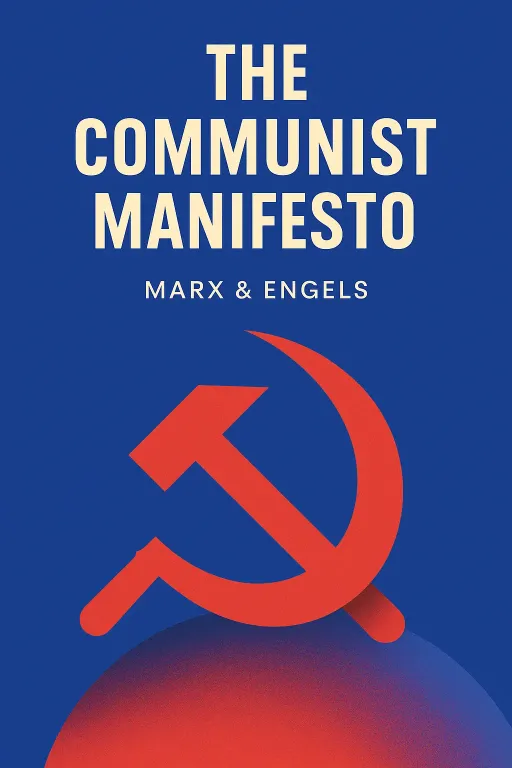
Nova: Exactly. And that is why today we are cracking open two very different books that, when read together, dismantle the way we perceive power. We are looking at The Communist Manifesto by Karl Marx and Friedrich Engels, and Fifth Sun by Camilla Townsend. These are not just history books or political tracts. They are tools for deconstructing the structures that govern our lives, whether those structures are economic, cultural, or historical.
Atlas: I love the pairing. On one hand, you have Marx and Engels, who looked at the Industrial Revolution and saw a massive, grinding machine of class struggle that defined every human interaction. On the other, you have Camilla Townsend, who takes the history of the Aztecs—a civilization often reduced to a footnote of conquest—and gives it back its voice, its complexity, and its humanity by going directly to the source.
Nova: It is the ultimate exercise in perspective. One looks at the engine of history, the other looks at the narrative of history. And for our listeners who value impact and efficiency, understanding these two lenses is the fastest way to stop being a passive consumer of information and start being an active analyst of the world.
The Engine of History and Class Struggle
SECTION
Atlas: That makes sense, but let’s start with the heavy hitter. Marx and Engels. The Communist Manifesto is one of those books that everyone references, but very few people actually engage with as a piece of analytical writing. When we talk about class struggle, I think a lot of people immediately jump to political slogans or twentieth-century regimes. But if we strip away the baggage and look at it as a lens for power, what is the core insight?
Nova: The core insight is that history is not a collection of random events or the whims of great men. It is a process driven by economic necessity and the friction between groups. Marx and Engels argued that every society is defined by who owns the means of production and who does the labor. They saw history as a series of stages—feudalism, then capitalism—each one driven by the tension between those who hold the power and those who provide the value.
Atlas: That sounds like a very rigid way to look at the world. Are they saying that human relationships are nothing more than transactional, economic power plays?
Nova: They are, but think of it as a structural analysis rather than a moral one. In the middle of the nineteenth century, when the Industrial Revolution was tearing apart the old social fabric, they were observing a shift. They saw that the old feudal ties—where people had a sense of place, however oppressive—were being replaced by the cold, hard cash nexus of the market. They identified that this system creates a dynamic where the people who own the tools and the capital have the power to dictate the terms of life for everyone else.
Atlas: I can see the efficiency in that perspective. It cuts through the noise of tradition or ideology and points straight to the material conditions. If you want to know why a society functions the way it does, look at who holds the purse strings. But does it hold up today? We live in an era where the means of production are not just factories and steam engines, but information, algorithms, and digital platforms.
Nova: That is the brilliant part. The foundational principle of the Manifesto is about how technology and economic organization change the way we relate to each other. When you look at the modern gig economy, or the way tech giants control the flow of information, you are seeing the exact same dynamic Marx and Engels described. It is the centralization of power in the hands of those who own the infrastructure. When you ask yourself why you feel the way you do about your work, or why you feel a constant pressure to produce, you are brushing up against the same economic structures they were analyzing.
Atlas: That is a sobering thought. It suggests that our personal frustrations—like feeling burnt out or feeling like a cog in a machine—are not just individual failings or bad luck. They are the natural output of a system designed to prioritize capital over the human experience.
Nova: Precisely. And that is the value of this lens. It moves you from a place of self-blame to a place of systemic analysis. You stop asking, why am I not working hard enough? And you start asking, how is this system designed to extract value from me, and how can I navigate that or change it?
Atlas: I like that shift. It turns the feeling of being overwhelmed into a data point. It is a diagnostic tool. But let’s look at the other side of this. If Marx is the engine, then the history we are told is the steering wheel. That brings me to the second book you mentioned, Fifth Sun. If Marx tells us to look at the economic structure, Townsend seems to be telling us to look at the cultural archive.
Rewriting the Narrative and the Power of Sources
SECTION
Nova: That is a perfect transition. Because even if you understand the economic engine, if the history you are fed is biased, you are still operating in the dark. Camilla Townsend’s Fifth Sun is a masterclass in challenging the dominant narrative. For centuries, the story of the Aztecs was told primarily through the eyes of the Spanish conquerors. It was a story of savages, of primitive rituals, of a civilization that was destined to fall because it was inferior.
Atlas: I remember learning that in school. It was always presented as this inevitable clash between the enlightened Europeans and the barbaric indigenous empire. It felt like a settled fact.
Nova: And that is exactly what Townsend dismantles. She did something incredibly rigorous and, frankly, daring. She ignored the Spanish accounts, which were designed to justify the conquest, and instead went directly to the Nahuatl-language sources. She found indigenous chronicles written by the Aztecs themselves, often generations after the conquest, describing their own lives, their politics, and their cosmology.
Atlas: That is such a powerful methodology. It is the difference between reading a press release from a company and talking to the employees who actually built the product. What did she find when she started listening to them?
Nova: She found a society that was deeply sophisticated, political, and, most importantly, human. She discovered that the Aztecs were not just passive victims of history; they were active agents in their own story. They had complex political negotiations, internal power struggles, and a way of viewing the world that was internally consistent and deeply intellectual. The idea of the Fifth Sun itself—their cosmological belief that we live in the fifth era of the world—shows a culture that was constantly reflecting on its own existence and its place in time.
Atlas: It makes me wonder about the things we take for granted today. If we are still operating on a history that was written by the victors five hundred years ago, what other stories are we accepting as truth when, in reality, they are just the propaganda of the winners?
Nova: That is the deep question. Think about how we talk about modern technological progress or globalization. We often hear the narrative of the victors—the companies that won, the platforms that dominated, the economic models that succeeded. We rarely hear the "Nahuatl-language" version of the story: the perspective of the people who were disrupted, the communities that were displaced, or the alternative ways of living that were pushed aside.
Atlas: So, Townsend is basically giving us a manual on how to do primary source research in our own lives. She is saying, don’t just take the headline. Find the original source. Find the people who were actually there. Even if it is difficult, even if it is in a different language or a different context, the effort to find the raw data is what separates the informed observer from the passive follower.
Nova: Exactly. And the beauty of her work is that it restores agency. When you realize that the Aztecs were making rational, political choices in an impossible situation, you stop seeing them as historical props and start seeing them as people. You start to see the complexity of their world. And when you apply that to your own life, you stop seeing your environment as something that just happens to you. You start seeing the choices, the politics, and the agency involved in every interaction.
Synthesis and Navigating Power
SECTION
Atlas: This is fascinating because I see a bridge between the two books. Marx gives us the framework to analyze the power structures, and Townsend gives us the methodology to verify the truth beneath the narrative. If you combine them, you have a pretty formidable toolkit for navigating the modern world.
Nova: That is the takeaway. It is about becoming a critical architect of your own worldview. Marx forces you to look at the invisible architecture—the economic forces that shape your daily life. Townsend forces you to look at the invisible bias—the narratives that shape your understanding of reality. When you combine those, you are no longer just a participant in the system; you are an observer who understands how the machine works and who is writing the manual.
Atlas: I imagine a lot of our listeners are thinking, okay, this sounds intellectually stimulating, but how do I actually apply this on a Tuesday morning? How does an understanding of class struggle and the importance of primary sources help me in a meeting, or with my career, or in how I consume news?
Nova: It helps by changing the questions you ask. When you are in a meeting and someone presents a "best practice" or a "corporate strategy," don’t just accept it as the objective truth. Ask, who benefits from this structure? That is the Marxist lens. And then ask, what is the alternative story here? What are the voices that are not being heard in this room? That is the Townsend lens. You are effectively deconstructing the power dynamics in real-time.
Atlas: I love that. It takes it from abstract philosophy to a practical skill set. It is about moving from being a passive recipient of information to an active investigator.
Nova: And it requires courage. It is much easier to accept the narrative you are given. It is much more comfortable to believe that the system is just "the way things are." But the moment you start digging—the moment you look at the economic interests behind a decision, or the missing voices in a story—you start to see the world as it is, not as you are told it is.
Atlas: That is a powerful shift. It reminds me that our time is our most valuable resource. Using that time to cultivate a critical, investigative mindset is the highest form of efficiency. We aren't just consuming information; we are curating our reality.
Nova: And that is exactly how you reclaim your hours. You stop wasting time on narratives that don't serve you, and you start focusing on the structures that actually define your life. It is not about being cynical. It is about being strategic.
Atlas: I think that is a perfect place to land. It is not about tearing everything down; it is about seeing everything clearly.
Nova: Exactly. We have explored the engine of history and the power of the narrative. Now, the rest is up to you. As you go about your week, look for the structures behind the scenes and listen for the voices that are being left out. You might be surprised at what you find when you stop accepting the official version of the story.
Atlas: It is a challenge, but a necessary one. Thank you for walking through this with me. This has been a great way to reframe how I approach the world.
Nova: It has been a pleasure. And to our listeners, remember that the most powerful thing you can do is ask the right questions. This is Aibrary. Congratulations on your growth!