The Architecture of Emotional Resilience
Golden Hook & Introduction
SECTION
Nova: We spend an enormous amount of energy trying to edit our internal monologue, usually by grabbing a metaphorical red pen and slashing through our own thoughts. We think if we just argue with ourselves enough, we can logic our way into happiness.
Atlas: That is the ultimate trap, isn't it? We treat our brains like a faulty spreadsheet that just needs a few formulas fixed, and suddenly, the output will be perfect. But I have a feeling that approach might be missing something fundamental.
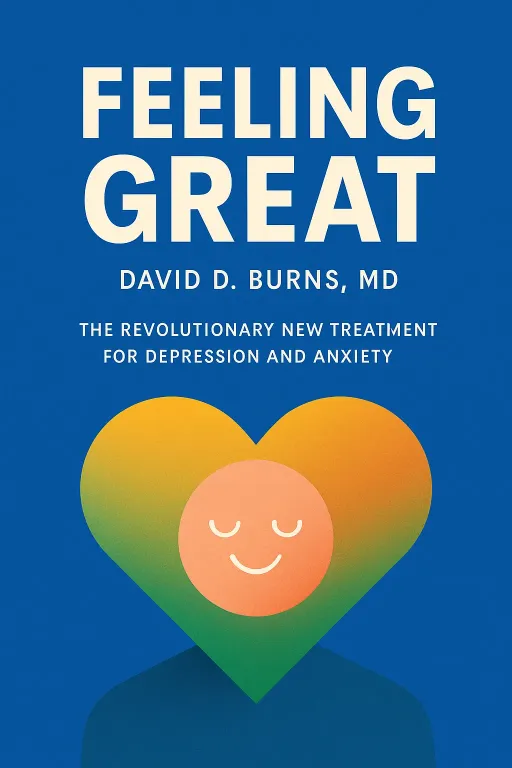
Nova: You hit the nail on the head. Today we are diving into the Architecture of Emotional Resilience. We are looking at two very different, but deeply complementary, approaches to the human experience. First, we have the work of David D. Burns in his book, Feeling Great. He is a pioneer in the field of cognitive behavioral therapy, and his work is legendary for giving people a concrete toolkit to dismantle negative self-talk.
Atlas: And to balance that, we are also looking at Megan Devine’s, It’s OK That You’re Not OK. Her perspective is almost the inverse of the traditional fix-it mentality. She argues that there are some things in life you cannot fix, and trying to do so is actually part of the problem.
Nova: Exactly. Burns gives us the scalpel to dissect the distortions, and Devine gives us the permission to stop trying to perform surgery on our own grief. Bringing these two together creates a much more robust system for living.
The Mechanics of Cognitive Distortions
SECTION
Atlas: Okay, let’s start with that scalpel. I think most of us are familiar with the idea that our thoughts dictate our feelings. But Burns takes it a step further. He talks about cognitive distortions. For anyone listening who hasn't encountered that term, how do we actually spot these things in real-time?
Nova: Think of cognitive distortions as glitches in your mental software. They are logical fallacies that your brain uses to interpret reality, but they are consistently wrong. Burns identifies a whole list of them, but they all share one trait: they make you feel worse than the reality of the situation warrants.
Atlas: Give me an example of one of these glitches. Because when I am in the middle of a bad day, it feels like I am seeing the world with perfect clarity. It doesn't feel like a glitch.
Nova: That is the danger. One classic distortion is all-or-nothing thinking. Let’s say you are working on a project, and you make one small error. Your brain immediately jumps to the conclusion that the entire project is a failure and that you are incompetent.
Atlas: Oh, I know that one well. It is the classic black-and-white trap. You either win, or you are a total disaster. There is no middle ground.
Nova: Exactly. And the moment that thought lands, your brain treats it as a fact. You feel the shame, the anxiety, the pressure. Burns’s method is to pause and ask for evidence. What is the actual proof that the entire project is a failure? Did you miss the deadline? Did the client reject it? Or did you just make a minor typo on page four?
Atlas: When you lay it out like that, it sounds so obvious. But when I am in the heat of the moment, I am not thinking about evidence. I am thinking about the catastrophe. How do you actually build the habit of catching this?
Nova: That is where the action-oriented part comes in. Burns suggests a technique called the Daily Mood Log. You write down the negative thought, you name the specific distortion—like all-or-nothing thinking or emotional reasoning—and then you write a rational response.
Atlas: So you are basically putting your brain on trial.
Nova: Precisely. You are the judge, the jury, and the defense attorney. You are forcing your brain to present the evidence. If the thought is that you are incompetent because of a typo, the defense attorney points out that you have successfully completed ten other projects this year. The jury looks at the evidence, and the verdict is that you are human, not a failure.
Atlas: I can see why a pragmatic learner would love this. It is a system. It is like debugging code. You find the bug, you document it, you write the patch, and you deploy the fix.
Nova: It is very much like that. But here is the catch, and this is where it gets interesting. This works perfectly when the problem is a distorted thought. But what happens when the problem is not a distortion, but a reality? What happens when the thing you are sad about is actually, objectively, a tragedy?
The Limits of Reframing
SECTION
Atlas: That is where I get skeptical. If I am dealing with a real loss, or a genuine setback that cannot be "fixed," using a logic log feels almost insulting. It feels like gaslighting myself.
Nova: You are spot on. And that is exactly where Megan Devine enters the conversation. She points out that our culture is obsessed with fixing. If you tell someone you are sad, they immediately try to cheer you up. They offer platitudes. They tell you to look on the bright side.
Atlas: I am definitely guilty of that. It comes from a good place, but I realize now it is an attempt to make my own discomfort go away. If you stop being sad, I don't have to witness your pain.
Nova: That is a profound insight. Devine calls this the cultural rush to fix. She argues that when we face real, heavy, life-altering pain, the goal is not to reframe it into a positive thought. The goal is to be witnessed. The goal is companionship.
Atlas: So, if I am using Burns’s method for a work mistake, I am reframing. But if I am dealing with something like a breakup, a loss, or a major life disruption, reframing is the wrong tool. How do I know the difference?
Nova: That is the million-dollar question. The distinction lies in the nature of the event. If the event is something you are misinterpreting—like your brain telling you that you are worthless because you missed a meeting—that is a cognitive distortion. That is a job for the logic log. You need to correct the internal software.
Atlas: But if the event is a reality—like you actually lost the job, or someone you love is gone—that is not a distortion. That is a fact.
Nova: Exactly. And trying to reframe the death of a loved one as a positive growth opportunity is not healing; it is spiritual bypassing. It is a way to avoid the weight of the experience. Devine’s framework is about validation. Instead of saying, "I should be over this by now," you say, "This is happening, and it is painful, and it is okay that I am not okay."
Atlas: I find that incredibly freeing. It takes the pressure off. If I am struggling, I don't have to immediately find the silver lining. I just have to be present with the pain.
Nova: Think of it as the difference between a problem you need to solve and a landscape you need to inhabit. Cognitive distortions are problems to be solved. Grief and deep, existential pain are landscapes you have to walk through. You cannot solve a landscape. You can only traverse it.
Atlas: This reminds me of the concept of emotional agility. We need the skill to know when to engage the analytical brain and when to engage the compassionate heart.
Nova: That is the architecture of resilience. It is not just about being positive. It is about being accurate. Sometimes, accuracy means identifying a lie your brain is telling you. Other times, accuracy means acknowledging that life is currently very difficult, and that is a perfectly valid response.
Building the System
SECTION
Atlas: Let’s make this actionable for the listener. If I am a person who values efficiency and autonomy, I want a blueprint. How do I combine these two? How do I integrate the logic of Burns with the validation of Devine?
Nova: Start with a simple diagnostic. When you feel that wave of negative emotion, pause for a moment before you jump to the logic log. Ask yourself: "Is this pain coming from a story I am telling myself, or is it coming from a reality I am experiencing?"
Atlas: Okay, that is a great diagnostic. If I am telling myself, "I am a failure because I missed that deadline," that is a story. I can use the logic log. I can dismantle that distortion.
Nova: Exactly. You are the architect of your own thoughts there. You have the autonomy to change the narrative because the narrative is based on a false premise.
Atlas: But if the thought is, "I am really hurt that my friend forgot my birthday," or "I am struggling with the stress of this transition," that is not a story. That is a reality.
Nova: Right. And for that, you use the Devine approach. You validate it. You say, "This hurts. It makes sense that I am feeling this way." You give yourself permission to feel the pain without adding the second layer of suffering—which is the judgment that you shouldn't be feeling it.
Atlas: That judgment is often the heaviest part, isn't it? It is not the event that kills you; it is the secondary suffering of telling yourself you are weak for feeling it.
Nova: That is precisely it. The judgment is the distortion. The pain itself is just the reality. By separating the two, you gain massive amounts of mental energy. You stop fighting the reality and start using your energy to navigate it.
Atlas: I love that. It is about using the right tool for the right job. Use the scalpel for the distortions, and use the blanket for the grief.
Nova: That is a beautiful way to put it. We often think we have to choose one philosophy—either the "mindset" approach where you change your thoughts, or the "acceptance" approach where you just feel your feelings. But the most resilient people I know do both. They are rigorous about their thoughts, but they are incredibly gentle with their hearts.
Atlas: It sounds like the ultimate goal is not to be happy all the time. It is to be honest with yourself.
Nova: That is the core of it. Happiness is a byproduct of living an honest life. When you stop lying to yourself about your capabilities, and you stop lying to yourself about the difficulty of your circumstances, you become much more grounded.
Atlas: I am thinking about our listeners who are constantly building, constantly striving. This approach might actually make them more efficient. If you stop wasting energy on distorted guilt or performative positivity, you have more focus for the work that actually matters.
Nova: You hit on a key point. Efficiency is not just about speed; it is about alignment. When your internal state is aligned with reality, your actions become much more effective. You are not fighting yourself anymore. You are working with yourself.
Atlas: This is such a shift from the typical "just think positive" advice. It feels more like a strategy for life than a temporary fix.
Synthesis & Takeaways
SECTION
Nova: It really is. And the beauty of this is that it is a practice. You don't master it in a day. You master it by showing up for yourself consistently, in 15-minute windows, just like we talk about with any other skill.
Atlas: So, for the listener who wants to start today, what is the one concrete step?
Nova: Start by observing. The next time you feel that sharp sting of a negative emotion, don't try to fix it. Just label it. Ask yourself: "Is this a story, or is this a reality?" If it is a story, write it down and look for the distortion. If it is a reality, take a breath and acknowledge that it is okay to feel exactly what you are feeling.
Atlas: That is simple, it is actionable, and it is deeply respectful of the human experience. You are giving yourself the agency to change what you can, and the grace to accept what you cannot.
Nova: And that, ultimately, is the architecture of a life that lasts. It is built on a foundation of truth, not a facade of forced positivity.
Atlas: I think that is the perfect place to leave it. We have explored the mechanics of the mind, the necessity of feeling, and the bridge between the two.
Nova: It has been a pleasure diving into this with you, Atlas. The ability to distinguish between what needs to be changed and what needs to be witnessed is perhaps the most important skill we can develop.
Atlas: Absolutely. It is the difference between surviving your thoughts and actually living your life. For all our listeners, remember that this is a practice. Be patient with the process, and trust your pace.
Nova: We are grateful you joined us for this exploration. Keep building that foundation.
Atlas: This is Aibrary. Congratulations on your growth!