The Data Literacy Leap: Unlocking Deeper Insights for Decision-Makers.
Golden Hook & Introduction
SECTION
Nova: What if the biggest obstacle to your next breakthrough isn't a lack of data, but a profound misunderstanding of what the data is telling you? What if the numbers you trust implicitly are subtly sabotaging your best intentions?
Atlas: Whoa, Nova, that's a bold claim. Are you saying our meticulously crafted data dashboards, the ones we pour over for strategic insights, are essentially lying to us? Because that feels like a direct hit to anyone trying to keep pace in a rapidly evolving tech landscape.
Nova: Not lying, Atlas, but often incomplete, or even worse, misleading. That's the core message of "The Data Literacy Leap: Unlocking Deeper Insights for Decision-Makers" by Dr. Evelyn Reed. Dr. Reed spent years as a data scientist for Fortune 500 companies, but what truly compelled her to write this book was seeing brilliant, sharp leaders make flawed decisions, not because they lacked data, but because they lacked a deeper understanding of its nuances and our own human biases in interpreting it.
Atlas: That resonates. For any leader trying to optimize collaboration or align IT with business goals, a "blind spot" in data sounds like a strategic nightmare. It's like having a high-resolution map, but still getting lost because you're misreading the legend.
Nova: Exactly! It’s about looking beyond the obvious. And that's where we start today: by exposing the common, almost invisible traps that even savvy leaders fall into when looking at data.
The Data Blind Spot: Beyond Surface Metrics
SECTION
Nova: Many leaders genuinely believe they understand their data. They see the reports, the KPIs, the dashboards. But often, they miss the subtle biases and hidden truths woven into the fabric of that data. Relying solely on surface-level metrics can lead to decisions that, while seemingly data-driven, are actually flawed.
Atlas: But in a fast-paced tech environment where we're often drowning in data streams, isn't data better than none? How do we even begin to look 'beyond' the obvious when we're constantly fighting to keep our heads above water?
Nova: That's the trap, isn't it? The sheer volume of data gives us a false sense of security. The danger comes from what I call "convenient data"—data that confirms our existing hypotheses or simply tells us what we to hear. The real insight often lies in the contradictory data, the inconvenient truths.
Atlas: Okay, but what does a "subtle bias" in data actually look like in practice? Can you give me an example of a bias that might actually derail a major IT project, even with all the right metrics in place? Because for someone in strategic IT leadership, that's a very real concern.
Nova: Absolutely. Imagine a company rolling out a new internal collaboration platform, a significant IT investment aimed at optimizing team efficiency. The project team proudly presents data: high login rates, thousands of messages exchanged daily, positive feedback in quarterly surveys. On the surface, it’s a resounding success.
Atlas: Sounds great. High adoption, engagement... what's the catch?
Nova: The catch is the subtle bias. The login rates might be high because it's mandatory to log in, not because it's genuinely useful. The message count could be inflated by superficial chatter or "reply-all" storms, not deep collaborative work. And those positive survey responses? They might be a product of "social desirability bias"—employees giving the answers they think management wants to hear, especially if they know their responses are tied to a new, expensive tool.
Atlas: Oh, I see that. So, the data looks good, but the isn't there. The actual collaboration isn't optimized, despite what the metrics suggest. That's a huge blind spot for leaders trying to improve workflows and efficiency. It’s like measuring the number of steps a person takes, but not if they're actually moving forward.
Nova: Exactly! The hidden truth is that the tool isn't truly integrated into critical workflows; it's just another tab people grudgingly open. And relying on those surface metrics means you're making strategic decisions based on an illusion of success, potentially throwing more money at a problem that isn't being solved.
Unmasking Hidden Truths: The Power of Unconventional Data & Fact-Based Thinking
SECTION
Nova: That example perfectly illustrates why we need a fundamental shift in how we approach data. It means looking for the unspoken, the uncomfortable, the truly real. This is where thinkers like Seth Stephens-Davidowitz and Hans Rosling offer revolutionary insights.
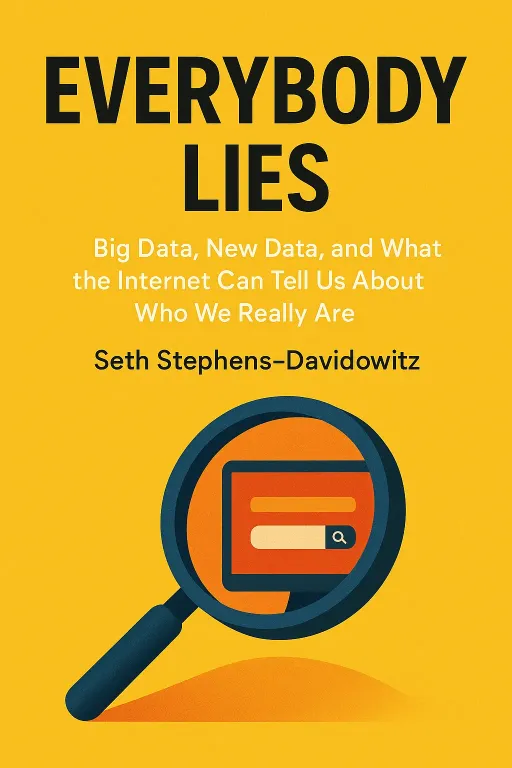
Atlas: I'm curious. Stephens-Davidowitz, I know from "Everybody Lies," talks about how search data reveals our true selves. How does that connect to this data blind spot?
Nova: In "Everybody Lies," Stephens-Davidowitz makes a compelling case that people lie. They lie in surveys, they lie to friends, sometimes they even lie to themselves. But they are brutally, unflinchingly honest with search engines. What people for online reveals their deepest fears, desires, and prejudices, often contradicting what they publicly.
Atlas: Wow. So for advanced data analytics, we should be looking at "dark data," the unspoken data, not just the structured reports? That's a mind shift. It means the most powerful insights might be hidden in plain sight, in the anonymous digital footprints we leave every day.
Nova: Precisely. He gives examples of how Google search trends reveal uncomfortable truths about racism, anxiety, and even health conditions that people would never admit to in a survey. Imagine the power of tapping into that kind of raw, unfiltered truth for understanding market needs, employee sentiment, or even societal trends. It's a goldmine for an innovator striving to shape the future through technology.
Atlas: That's fascinating. But how does Hans Rosling's "Factfulness" fit into this? He was all about seeing the world through facts, not drama.
Nova: Rosling's work in "Factfulness" is the perfect complement. He demonstrates how our innate human biases—our dramatic instincts for fear, urgency, blame, and generalization—distort our perception of reality, even when presented with readily available data. We the world is getting worse, when in many objective ways, it’s improving. We we know the facts, but our brains are wired to create a dramatic, often inaccurate, worldview.
Atlas: So, it's not just that the data itself can be misleading, but that our own brains are actively sabotaging our ability to see the truth, even when it's staring us in the face? That feels almost impossible to fight against, especially when you're making high-stakes decisions.
Nova: It's a powerful point, isn't it? Rosling wasn't saying we're stupid; he was saying we're human. Our brains evolved to react to immediate threats, to categorize, to simplify. But in a complex, data-rich world, those instincts betray us. He advocates for a fact-based worldview, urging us to constantly question our assumptions and to actively seek out data that challenges our dramatic narratives.
Atlas: That makes me wonder about effective technical communication. If our brains are wired for drama, how do we communicate complex data insights in a way that bypasses those dramatic instincts and makes the facts undeniable, especially when trying to align technology with business goals?
Nova: That's a huge challenge, and it means being incredibly deliberate. Rosling showed that presenting data simply, visually, and in context can cut through the noise. It’s about framing the narrative around the, not the fear. It's about showing trends, not just snapshots, and constantly comparing against baselines. For a leader, it’s about demanding evidence, not just anecdotes, and being humble enough to admit when your initial assumptions were wrong.
Atlas: So, it's not just about getting the right data, but also about we present it and we train ourselves to interpret it, overcoming our own internal biases. It's an active practice, not a passive consumption.
Nova: Exactly. It's a continuous journey of learning, a mindset shift. It's about embracing the uncomfortable truth that our perception is often flawed and that the most valuable data might be the data that makes us feel a little uneasy.
Synthesis & Takeaways
SECTION
Nova: So, to pull it all together, Dr. Reed's "Data Literacy Leap" really pushes us to understand that true data literacy goes far beyond reading charts. It's about understanding human behavior, questioning assumptions, and daring to look for the inconvenient truths hidden beneath the surface.
Atlas: That's a profound thought. For our listeners, especially those driving strategic IT leadership or advanced data analytics, think about a recent business decision. How might a deeper, less obvious data source – like the 'unspoken' data Stephens-Davidowitz talks about, or even just a more fact-based, less dramatic interpretation à la Rosling – have changed your approach or revealed a hidden truth?
Nova: The true power of data isn't in its volume, but in our humility and willingness to let it challenge our deepest assumptions. It's about cultivating a critical eye, not just for the data, but for ourselves.
Atlas: I love that. Perhaps dedicate some time this week to look at a key metric you trust implicitly, and ask yourself: what this telling me? What subtle bias, either in the data collection or in my own interpretation, might be at play here? It could be the leap you need.
Nova: A small shift in perspective can unlock a world of deeper insights. Thanks for joining us today, Atlas.
Atlas: Always a pleasure, Nova.
Nova: This is Aibrary. Congratulations on your growth!