Sharpening Your Analytical Edge: Critical Thinking Frameworks
Golden Hook & Introduction
SECTION
Nova: You know, it’s wild how often we walk around feeling pretty smart, pretty informed, and yet, we're constantly falling for the most basic mental traps.
Atlas: Oh, I like that. You’re saying our brains are actually working against us a lot of the time? Because that sounds… a little bleak.
Nova: Not bleak, Atlas, enlightening! It's about recognizing that our intuitions, while powerful, are also incredibly prone to error. And today, we're diving into how to systematically fix that, to truly sharpen your analytical edge.
Atlas: That’s a great way to put it. For anyone out there who identifies as an 'Insight Seeker' or a 'Growth Architect,' this episode is your mental gym.
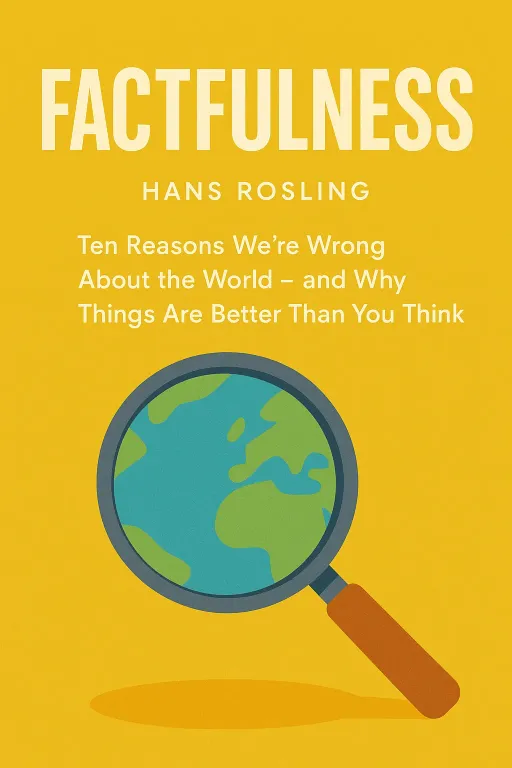
Nova: Exactly. We’re drawing wisdom from two absolute titans in the field: Hans Rosling’s groundbreaking book, "Factfulness," and Rolf Dobelli’s incredibly insightful "The Art of Thinking Clearly."
Atlas: Rosling, the global health legend, whose work really came to prominence after his viral TED Talks. And "Factfulness" itself was published posthumously, a culmination of his life’s mission to combat widespread ignorance with data. It’s a powerful legacy.
Nova: Absolutely. And Dobelli, he's fascinating because he came to this from a background as a novelist and entrepreneur. He’s not a dry academic; he’s a practical thinker who wanted to understand why we make such predictable mistakes. His book is a catalog of those errors, designed for real-world application.
Atlas: So, one gives us the big picture of the world, and the other zooms in on the internal workings of our own minds. I’m curious, Nova, let’s start with Rosling. What's the biggest illusion he shatters for us?
The Fact-Based Worldview: Overcoming Emotional Biases with Data
SECTION
Nova: The biggest illusion, the one he absolutely dismantles, is our ingrained tendency to see the world as far more dramatic, negative, and polarized than it actually is. He calls it the 'gap instinct,' the idea that the world is divided into two distinct groups – like 'developed' versus 'developing' countries.
Atlas: Oh, I know that feeling. It’s like when you hear news reports, everything feels like it's going downhill, or there’s a huge chasm between 'us' and 'them.'
Nova: Precisely. Rosling shows us how this instinct, along with our negativity instinct, our fear instinct, our size instinct – they all conspire to create a worldview that's simply not fact-based. He argues that this outdated 'us vs. them' mentality, especially regarding global development, is profoundly misleading.
Atlas: But wait, if our instincts are so powerful, how do we even begin to trust data? My gut tells me certain things, and it’s hard to ignore that. Can you give me an example of how this 'gap instinct' misleads us?
Nova: Of course. Take the common perception of the world being divided into 'developed' and 'developing' countries. Most people, if you ask them, would place the vast majority of the world's population into what they call 'developing,' assuming they live in extreme poverty, poor health, and lack education.
Atlas: Right, like a huge gap between the rich West and everyone else struggling. That feels intuitive.
Nova: And that's exactly where the gap instinct tricks us. Rosling, with undeniable data, shows that this two-category division is completely obsolete. He introduces a four-level income concept. Level 1 is extreme poverty, Level 4 is high-income. What he found, astonishingly, is that the vast majority of the world's population, billions of people, live on Levels 2 and 3.
Atlas: So you're saying it’s not a stark division, but more of a spectrum with a huge middle? That’s kind of groundbreaking.
Nova: It is! He illustrates this with a simple graph, showing how many countries have moved out of Level 1, how child mortality has plummeted, how access to education and electricity has soared across the globe. He’d show a vivid example of a family on Level 2, who might cook on an open fire and walk barefoot, but they have a bicycle and their kids go to school. Then a family on Level 3 might have a cold water tap, a motorbike, and their kids are in secondary school.
Atlas: That’s incredible. It paints a completely different picture than what the news often portrays. So, for someone who wants to be an 'Insight Seeker' and make more informed decisions, how does understanding this 'fact-based worldview' help?
Nova: It’s transformative. It teaches you to question your immediate reactions, to seek out actual data, and to understand trends over dramatic headlines. Rosling's message is that the world, while still facing challenges, is generally getting better by many metrics. And seeing that clearly helps you make decisions based on reality, not on exaggerated fears or outdated narratives. It’s about building a robust mental framework where evidence trumps emotion.
Mapping the Minefield: Recognizing and Avoiding Cognitive Biases
SECTION
Nova: And that naturally leads us to the second key idea we need to talk about, which often acts as a counterpoint to what we just discussed. While Rosling gives us the lens to see the world accurately, Dobelli gives us the internal 'bug report' for our own brains. He shows us that our minds are riddled with predictable thinking errors, or cognitive biases.
Atlas: Oh, I've heard of these! Like little mental shortcuts that sometimes lead us astray. What’s a common one that even smart, analytical people, like our 'Insight Seekers,' fall prey to?
Nova: One of the most pervasive and insidious is 'Confirmation Bias.' It’s our tendency to interpret new information in a way that confirms our existing beliefs, theories, or hypotheses. We actively seek out information that supports what we already think and conveniently ignore or downplay anything that contradicts it.
Atlas: Right, like when you’re researching a new diet, and you only click on articles that praise it, even if there are hundreds of others debunking it. Or when a political candidate only consumes news that validates their own views.
Nova: Exactly! Dobelli illustrates this beautifully. If you believe your new car is the best, you’ll notice every positive review and every time it performs well, while unconsciously dismissing any negative experiences or criticisms. Or, another classic is the 'Sunk Cost Fallacy.'
Atlas: Oh, tell me about that one! I feel like I encounter it all the time.
Nova: It’s the tendency to continue an endeavor, or to continue investing resources, simply because you've already invested a significant amount of time, money, or effort, even if continuing is clearly irrational. Think about sitting through a terrible movie just because you paid for the ticket. The money is already gone, it’s a 'sunk cost,' but you stay because you already invested.
Atlas: Wow, that’s so relatable! I’ve done that with projects at work too, pushing forward on something that clearly isn't working, just because I’ve already put so much into it. But if these biases are so ingrained, what can we actually do? Is it even possible to overcome them?
Nova: Dobelli says it’s not about completely eradicating them – that's probably impossible. It’s about recognizing them and consciously building strategies to counteract them. For confirmation bias, he suggests actively seeking out disconfirming evidence. Make it a deliberate practice to find arguments your pet theory.
Atlas: So, if I’m convinced about something, I should go out and try to prove myself wrong? That feels… counterintuitive.
Nova: It does, but it’s incredibly powerful. It forces your brain to engage with different perspectives. For the sunk cost fallacy, it’s about acknowledging that past investments are gone and making decisions solely based on future costs and benefits. It’s tough, but it's how you make truly rational choices. It’s a constant practice of self-awareness and intentional thought.
Synthesis & Takeaways
SECTION
Nova: So, bringing it all together, what Rosling and Dobelli teach us is that critical thinking isn't just about being "smart" or "analytical." It's a two-pronged approach. First, it’s about cleaning our external lens, using data to see the world as it actually is, free from the dramatic narratives we often internalize.
Atlas: And then, it’s about cleaning our internal lens, understanding the predictable bugs and biases in our own mental software so we can make better decisions. It’s like a mental tune-up.
Nova: Exactly. For the 'Insight Seeker' and 'Growth Architect,' this isn't just academic; it’s fundamental. It means you approach complex information with a critical eye, not just accepting what's presented, but asking: 'What assumptions am I making? What evidence truly supports this?' It’s your mental gym for making more accurate judgments.
Atlas: And ultimately, what’s the biggest benefit for our listeners who are striving for continuous personal and professional growth?
Nova: The ultimate benefit is a dramatically improved decision-making process. When you understand the world more accurately and can identify your own cognitive blind spots, you make fewer mistakes, you learn more effectively, and you navigate challenges with greater clarity. It empowers you to build knowledge systematically and achieve genuine growth, rather than just spinning your wheels.
Atlas: That’s a powerful promise. So, for our listeners, what’s one thing they can do this week to start applying this?
Nova: Just one simple action: The next time you find yourself strongly believing something, or feeling a strong emotional reaction to information, pause. And then, actively seek out one piece of information that challenges your initial belief. See how it feels to intentionally try to prove yourself wrong.
Atlas: I like that. It's a small step that could lead to a massive shift in perspective. Find that one thing that challenges your assumptions.
Nova: Absolutely. It’s how we truly sharpen our analytical edge.
Atlas: Thank you for that, Nova. This has been incredibly insightful.
Nova: My pleasure, Atlas.
Atlas: This is Aibrary. Congratulations on your growth!