From Data to Discovery: Unlocking Insights in Your Research Journey
Golden Hook & Introduction
SECTION
Nova: Quick, Atlas, what's a number that you absolutely, without a doubt, to be true about the world, but if you had to bet your lunch money, might actually be completely wrong?
Atlas: Oh, man, that's a tough one. I mean, I the world is getting worse, right? All the news... so, maybe the number of people living in extreme poverty? I'd bet it's increasing.
Nova: That's a perfect example of the kind of deeply ingrained assumption we're diving into today. Today we're tackling precisely that kind of assumption, drawing insights from two phenomenal books: Nate Silver's "The Signal and the Noise" and "Factfulness" by Hans Rosling with Ola Rosling and Anna Rosling Rönnlund.
Atlas: Rosling? I've heard that name. Didn't he have those amazing TED Talks where he made data, like,?
Nova: Exactly! What's fascinating about Rosling, in particular, is how he combined his background as a public health physician with his passion for data visualization to literally make data dance, revealing truths that most people, even highly educated ones, consistently get wrong. He was a master at showing how our intuitive understanding of the world is often fundamentally flawed.
Atlas: That's incredible. So, my assumption about poverty... he'd have something to say about that.
Nova: He absolutely would. And that's the core of our podcast today: an exploration of how we can become better navigators of the vast ocean of data, moving from confusion to clarity and from assumption to genuine discovery. Today we'll dive deep into this from two crucial perspectives. First, we'll explore the art of separating the 'signal from the noise' that bombards us daily, then we'll discuss how a fact-based worldview can shatter our deepest preconceptions and reveal a more hopeful reality.
The Signal and the Noise: Discerning Truth in Data
SECTION
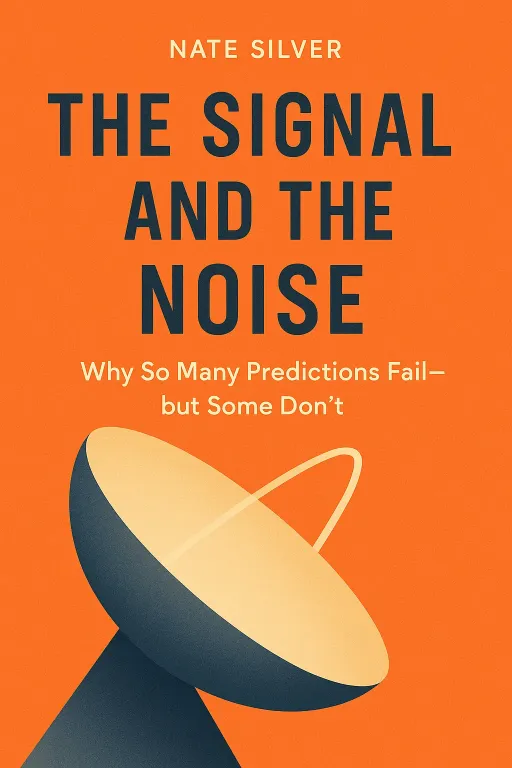
Nova: So, let's start with Nate Silver's "The Signal and the Noise." Silver, as a statistician, really digs into how we make predictions, and more importantly, how we often get them wrong because we confuse the signal with the noise.
Atlas: Okay, but what does that even mean? "Signal and noise"? Sounds like a radio station.
Nova: It's a great analogy, actually. Think of it like trying to listen to your favorite song on an old radio. The song is the signal—the meaningful information you want. All the static, the crackles, the interference—that's the noise. It's random, it's distracting, and if you're not careful, it can completely drown out the signal.
Atlas: Right, like when you're trying to figure out if your team is going to win the championship, and everyone's yelling their opinions, but half of it is just emotional hype.
Nova: Exactly! Silver applies this to everything from poker to economics to, most famously, election forecasting. Before Silver, political predictions were often based on fairly simple polls, sometimes even just gut feelings from pundits. The noise was everywhere – a particularly enthusiastic crowd at a rally, a gaffe caught on camera, a single poll that seemed to buck the trend.
Atlas: So, how did he cut through all that?
Nova: He built sophisticated models that didn't just look at one poll, but aggregated of them, weighting them by their historical accuracy, considering demographic shifts, economic indicators, and even how different polling organizations operate. He understood that each individual poll had its own margin of error, its own 'noise,' but by combining them intelligently, the true 'signal' of public opinion started to emerge.
Atlas: So you're saying he didn't try to find perfect poll, but rather looked at the collective wisdom, or lack thereof, of all the polls? That's a bit out there.
Nova: Precisely. He wasn't looking for certainty, but for probabilities. He’d say there's a 70% chance of X happening, not a 100% chance. This probabilistic thinking is key. The cause of misinterpretation often comes from over-relying on a single, compelling piece of data—a strong signal that might just be a loud piece of noise. His process was to integrate diverse data, apply statistical rigor, and understand the limitations of each input. The outcome was predictions that were often far more accurate than traditional methods, especially when others were caught up in the emotional frenzy of an election cycle.
Atlas: That makes me wonder, though, for our listeners who are trying to make sense of, say, market trends for their business, how do they tell the difference between real market movement and just daily fluctuations? It feels like everything is noise sometimes.
Nova: That's a brilliant question, and it's where Silver's work becomes incredibly practical. For a business, noise could be a single day's stock market dip that's quickly corrected, or a viral social media post that creates a temporary blip in sales but doesn't reflect a long-term shift. The signal is the underlying economic trend, the consistent customer behavior, the sustained growth or decline.
Atlas: So, the challenge is stepping back, not getting caught up in the immediate, and looking for those consistent patterns?
Nova: Exactly. It's about asking: Is this data point an anomaly, or is it part of a larger, coherent story? And for our listeners, it means consciously identifying potential sources of noise in their own data analysis—be it personal, professional, or academic—and having a plan to mitigate them. Like, if you're tracking your health, is one bad night's sleep a signal of illness, or just a noisy data point in an otherwise healthy trend?
Factfulness: Challenging Preconceptions with Data-Driven Reality
SECTION
Nova: And speaking of assumptions and how easily we can be misled, that leads us perfectly to 'Factfulness.' While Silver focuses on predictions, Hans Rosling and his co-authors tackle our entire worldview, showing how our deep-seated instincts often paint a picture of the world that's far grimmer and less progressive than reality.
Atlas: So, they're saying the world isn't as bad as I think it is? My gut reaction is to say, "Come on, Nova, just look around!"
Nova: That's your "negativity instinct" talking, one of the ten instincts Rosling identifies. He says our brains are wired to pay more attention to bad news, because historically, that's what kept us alive. But in today's world, it distorts our perception. He has this famous "chimpanzee test." He'd give audiences—often highly educated groups—a multiple-choice quiz on basic global facts: things like, "What percentage of the world's population lives in extreme poverty?" or "How many girls finish primary school?"
Atlas: Okay, I'm curious. What happened?
Nova: Well, if you gave the quiz to chimpanzees and they picked answers randomly, they'd score around 33%. Humans, even Nobel laureates, consistently scored than the chimpanzees. They got more answers wrong than if they'd just guessed!
Atlas: Whoa. That's actually really surprising. Why? What makes us so bad at understanding the world?
Nova: One of the biggest culprits is what Rosling calls the "gap instinct." We tend to divide the world into two distinct categories—rich and poor, developed and developing—and then focus on the gap between them. But the data shows that most people are actually in the middle. The vast majority of the world isn't living in extreme poverty anymore. Many countries we still label "developing" have made incredible progress in health, education, and economic well-being.
Atlas: So, it's like we see the two extremes of a mountain range, but we miss the huge, fertile valley in between where most people live?
Nova: Exactly! It's a perfect analogy. Our dramatic worldview, fueled by instincts like the gap instinct and the negativity instinct, prevents us from seeing the gradual, data-backed improvements that have been happening for decades. The cause is often our emotional response to headlines, or our reliance on outdated mental models of the world. The process of overcoming it involves actively seeking out data, questioning our assumptions, and understanding these cognitive biases. The outcome is a more fact-based, and often more optimistic, understanding of global progress.
Atlas: Honestly, that sounds like my Monday mornings. I still struggle with that myself. It's hard to reconcile the bad news you see every day with this idea of gradual progress. How do we practically overcome these instincts when they're so deeply ingrained?
Nova: Rosling's solution is simple, but not easy: 'Factfulness.' It's about constantly questioning our instincts with data. Instead of automatically assuming things are getting worse, ask: "What's the trendline here? What are the numbers actually saying?" For example, the number of people living in extreme poverty decreased dramatically over the last few decades, not increased. It's about training ourselves to see the world through a data lens, rather than just an emotional one. It's about understanding that things can be both bad getting better.
Synthesis & Takeaways
SECTION
Nova: So, what we've really explored today, through Nate Silver and Hans Rosling, is the power of rigorous data interpretation and the absolute necessity of challenging our assumptions. Both authors, in their own ways, are urging us to seek truth beyond initial impressions, whether it's in predicting an election or understanding global health.
Atlas: I guess that makes sense, but the idea that our own instincts are actively misleading us, and that we score worse than chimpanzees on basic facts... that gives me chills. It highlights how much noise we're constantly generating for ourselves.
Nova: It’s a powerful reminder that true discovery and progress don't come from intuition alone, or from sensational headlines. They come from the painstaking, often counter-intuitive work of understanding data, filtering out the static, and confronting our own biases. The real tragedy is not just misinterpreting data, but letting fear and bias dictate our understanding of reality and our potential for solutions. It can paralyze us.
Atlas: That’s actually really inspiring. So, what's a tiny step our curious listeners can take to start applying this today?
Nova: For your next data analysis, whether it's for work, personal finances, or even just following the news, explicitly list three potential sources of 'noise' and how you plan to mitigate them. Just becoming aware of the potential for distortion is a huge first step.
Atlas: I love that. It's a tangible way to start seeing the signal.
Nova: Absolutely. This is Aibrary. Congratulations on your growth!