Beyond the Algorithm: Cultivating Human Ingenuity in a Tech World
Golden Hook & Introduction
SECTION
Nova: We live in a world obsessed with algorithms and AI, right? Everyone's talking about the next big tech breakthrough, the latest automation. But what if I told you that the more advanced our technology becomes, the more valuable your uniquely human skills actually are?
Atlas: Oh, I love that. So, you're saying it's not about out-teching the tech, it's about out-humaning the tech? Because honestly, for anyone trying to stay relevant and build real mastery, that's a huge question. We're constantly told to upskill in the digital realm, but sometimes it feels like we're just chasing a moving target.
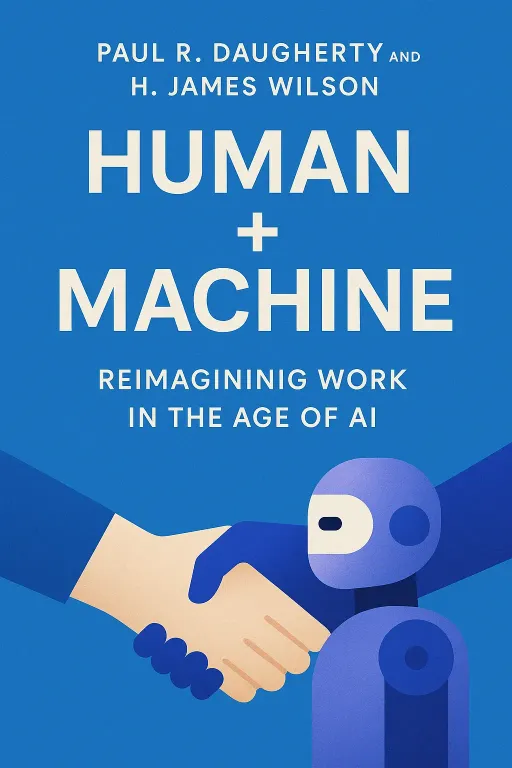
Nova: Exactly! And that's the core insight from what we're exploring today, which is "Beyond the Algorithm: Cultivating Human Ingenuity in a Tech World." This isn't a single book, but rather a powerful synthesis of ideas, drawing heavily from groundbreaking works like Paul R. Daugherty’s "Human + Machine" and Daniel Goleman’s seminal work on "Emotional Intelligence." It's essentially the intellectual roadmap to future-proofing yourself.
Atlas: That makes sense. It sounds like a much-needed perspective for anyone who feels like they're in a constant race to keep up with new tools, but deep down, they want to make a lasting impact that only they can deliver. So, how do these two big ideas — human-machine integration and emotional intelligence — actually fit together to give us that edge?
Deep Dive into Core Topic 1: The Human + Machine Imperative
SECTION
Nova: Well, let's start with the "Human + Machine" imperative. For years, the narrative has been this binary choice: either humans do it, or machines do it. And if machines can do it faster or cheaper, humans are out. But Daugherty's work, and the broader thinking here, totally flips that script. It suggests that the real breakthroughs, the truly innovative solutions, come from intelligently combining human ingenuity with machine capabilities.
Atlas: Okay, but isn’t that just a fancy way of saying "use your tools wisely"? I imagine a lot of our listeners are already integrating AI into their workflows. What's the deeper insight here that moves beyond just being tech-savvy?
Nova: It goes beyond simple tool usage, Atlas. Think of it like this: imagine a team of highly skilled medical diagnosticians. They're brilliant, but still human, prone to fatigue, and can only process so much information. Now, give them an AI that can analyze millions of patient records, genetic markers, and research papers in seconds, identifying subtle patterns that no human eye could ever catch.
Atlas: So the AI finds the needle in the haystack, but the doctor still has to interpret it.
Nova: Precisely. The AI might flag a rare disease, but it's the human doctor who synthesizes that information, considers the patient's unique history, communicates with empathy, and ultimately makes the nuanced, ethical decision about treatment. The human isn't replaced; their cognitive load is reduced on the data crunching, allowing them to focus on the higher-order, distinctly human aspects of medicine. The outcome is a diagnosis that's faster, more accurate, and more humane than either could achieve alone.
Atlas: That’s a great analogy. It’s like the machine handles the brute force data analysis, freeing up the human to do the truly complex, creative, and empathetic thinking. For someone looking to build skills, this means not just learning coding, but learning of the AI, or for optimal collaboration.
Nova: Exactly. It’s about cultivating what we call "new collar" skills: things like critical thinking, ethical reasoning, abstract problem-solving, and contextual understanding. Machines are fantastic at logic and data; humans excel at intuition, creativity, and understanding the messy, unpredictable world we live in. When you bring those together, you get exponential innovation. It's not just about efficiency; it's about creating entirely new possibilities.
Atlas: I can see that. For creative problem-solving, for example, instead of seeing a blank page, the machine can generate a thousand starting points, and the human then applies their unique vision to refine and elevate it. But this collaboration needs a certain kind of "glue," doesn't it? Something distinctly human that even the most advanced AI can't replicate.
Deep Dive into Core Topic 2: Emotional Intelligence: The Uniquely Human Edge
SECTION
Nova: Absolutely, and that glue is emotional intelligence. Daniel Goleman, who really popularized the concept, argues that emotional intelligence — our ability to understand and manage our own emotions, and to recognize and influence the emotions of others — is absolutely crucial for success, especially in complex, human-centric endeavors. When machines handle the data, the 'soft skills' become the hardest and most valuable.
Atlas: That’s fascinating because in the pursuit of mastery, especially in tech, sometimes emotional intelligence feels like a secondary consideration. It's often seen as a 'nice to have' rather than a core competency. But for someone who wants to make an impact and be a leader, I imagine it's non-negotiable.
Nova: It is. Think about a high-stakes negotiation. An AI can analyze all the market data, predict counter-offers, and even suggest optimal pricing strategies. But can it read the subtle facial cues of the other party? Can it sense their underlying anxieties or unspoken desires? Can it build rapport and trust? Can it adapt its communication style on the fly to de-escalate tension or inspire confidence? No.
Atlas: So the human with high emotional intelligence steps in to bridge that gap. They take the data from the AI and then apply empathy, self-awareness, and social skills to navigate the human element. That’s where the deal gets done, or the team gets motivated, or the customer feels truly understood.
Nova: Precisely. Self-awareness helps you understand your own biases and motivations. Self-regulation allows you to manage stress and respond thoughtfully rather than react impulsively. Empathy lets you connect with others, understand their perspectives, and anticipate their needs. And social skills enable you to build effective relationships, communicate persuasively, and resolve conflicts. These are the skills that foster innovation, build resilient teams, and create lasting value in any organization, especially in a world where technical tasks are increasingly automated.
Atlas: So it's not just about being 'nice'; it's about being profoundly effective. I imagine for leaders, this is critical. A machine can optimize a supply chain, but it can't inspire a team through a crisis. It can't mediate a conflict between brilliant but clashing personalities. Those are uniquely human leadership challenges.
Nova: Exactly. And the beauty is, unlike pure technical skills which can become obsolete, emotional intelligence is a timeless capability that only grows in value. It’s the ultimate differentiator because it taps into what makes us uniquely human. It’s about understanding the 'why' behind the 'what,' and connecting with the human element in every interaction.
Atlas: That makes me wonder, for anyone who relies heavily on automation in their work, what’s a tiny step they could take to start cultivating this human-centric skill? Because that's what the 'Practical Innovator' in me is always looking for: actionable steps.
Synthesis & Takeaways
SECTION
Nova: That’s a fantastic question, and it brings us right back to the essence of "Beyond the Algorithm." If you rely heavily on automation in one area of your work, I'd challenge you to identify that area and then consciously introduce a human-centric skill to enhance the outcome.
Atlas: Give me an example.
Nova: Okay, let's say you use AI to generate reports or proposals. Instead of just accepting the AI's output, how could you infuse empathy into it? Could you rephrase sections to better anticipate your audience's emotional response? Could you add a personal touch, a story, or a human insight that the algorithm would miss? Or if you're automating customer service, how can you ensure the human hand-off points are rich with connection and understanding, not just a transfer of data?
Atlas: I love that. It’s about actively looking for opportunities to bring into the process, not just letting the machine do its thing. It's about remembering that the ultimate purpose of most work is to serve other humans. So, combining the machine’s efficiency with your unique emotional intelligence and creativity isn't just a strategy for success; it's a path to true mastery and lifelong adaptability.
Nova: Absolutely. The cold fact is that relying solely on technical prowess limits your impact. The future belongs to those who intelligently integrate human and machine capabilities, with emotional intelligence as their key differentiator. Trust your inherent wisdom, start with that one small, practical project, and build momentum.
Atlas: That's actually really inspiring. It reframes the whole tech discussion from fear into empowerment. This is Aibrary. Congratulations on your growth!