Your Emotional First Aid Kit: Practical Tools for Rejection, Failure, and a Stronger Mind
Golden Hook & Introduction
SECTION
Nova: Think about the last time you got a paper cut. You knew exactly what to do, right? Clean it, put on a bandage, and maybe complain a little. But what about the last time you felt rejected? Or failed at something important? We often just tell ourselves to 'get over it,' but what if that's like telling a broken leg to 'just walk it off'?
Narita: That’s such a powerful analogy. We have this entire education around physical health, but for our emotional health, we're often just left to figure it out on our own.
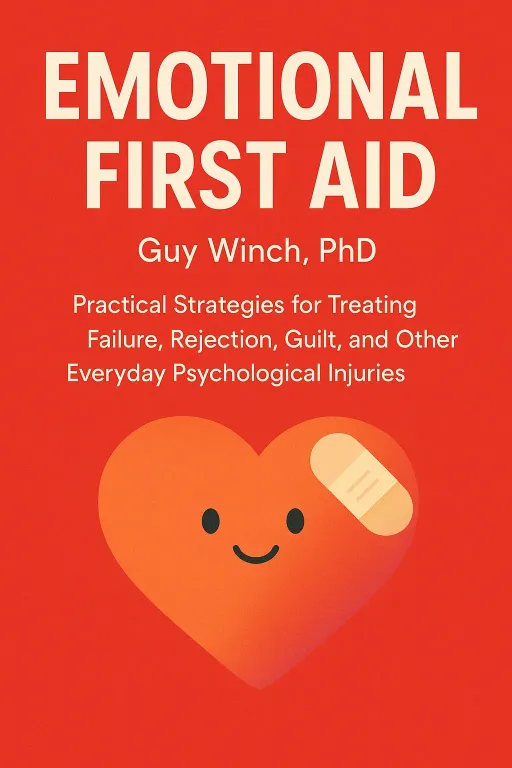
Nova: Exactly! And that's why I'm so excited to talk about this today. We're diving into Dr. Guy Winch's incredible book,, to build our own psychological medicine cabinet. With us is Narita, who is deeply interested in mindset and self-improvement, so this is right up her alley. This book is a game-changer for anyone looking to build real, lasting self-confidence and resilience.
Narita: I’m thrilled to be here. The idea of having a practical toolkit is so appealing.
Nova: It is! So today we'll dive deep into this from two powerful perspectives. First, we'll explore why rejection hurts as much as a physical injury and how to treat that specific pain. Then, we'll discuss the insidious nature of failure, how it can make us our own worst enemy, and the practical steps to reclaim our confidence. This isn't just about feeling better; it's about getting smarter with our emotions.
Deep Dive into Core Topic 1: Rejection, The Physical Pain of an Emotional Wound
SECTION
Nova: So Narita, let's start with rejection. It's universal, but why does getting unfollowed on Instagram or left out of a group chat sometimes feel so... physically painful?
Narita: It's a great question. It feels disproportionate, doesn't it? Logically, you know it's not a big deal, but it can ruin your whole day. There's a real sting to it.
Nova: There is! And the science behind it is mind-blowing. Dr. Winch explains that researchers used fMRI scans to look at people's brains while they were experiencing rejection. And they found that rejection activates the very same areas of the brain that register physical pain. So when you say it 'hurts,' you're not being dramatic. Your brain is processing it in a similar way to a burn or a deep bruise.
Narita: Wow. That's incredible. It completely reframes the experience. It means you're not just 'in your head' or 'being too sensitive'; your brain is literally sending out pain signals. That explains so much about social anxiety.
Nova: It really does. And to show just how deep this runs, there’s a famous experiment called Cyberball. Imagine you're a participant. You're told you're just waiting for an experiment to start, and you're in a virtual room with two other people. To pass the time, you start tossing a digital ball back and forth. You, player one, player two. It’s simple, inclusive.
Narita: Okay, I'm with you.
Nova: After a few tosses, the other two players just start tossing the ball to each other. They completely cut you out. The ball just zips past your avatar, again and again. You're just sitting there, watching. That's it. That's the whole experiment.
Narita: And people get upset by that? Even knowing it's just a silly computer game with strangers?
Nova: Not just upset. They report feeling significant emotional pain, a drop in mood, and even lower self-esteem. It's so consistent. It proves that our brains are hardwired to treat any form of social exclusion as a threat. Evolutionarily, being cast out from the tribe meant death, so our brains developed this incredibly sensitive alarm system.
Narita: That makes so much sense, especially when you think about online spaces. Exclusion is just a click away—being unfollowed, left out of a group chat, seeing friends post pictures from an event you weren't invited to. This research validates that those aren't trivial feelings. They're real psychological events.
Nova: Exactly. But here's where we make it worse. What's our typical first reaction when we feel that sting of rejection?
Narita: Hmm, probably to figure out what I did wrong. Why didn't they invite me? What did I say? Is there something wrong with me?
Nova: Bingo. We add salt to our own wound. Dr. Winch says our first response is almost always self-criticism. We become our own worst enemy, listing our faults and shortcomings, which only deepens the pain and damages our self-esteem even more. We would never punch a physical cut, but we do it to our emotional wounds all the time.
Narita: So how do we stop that downward spiral? This is the key. How do we apply the 'first aid' in that moment?
Nova: The treatment is beautifully simple, yet powerful. Dr. Winch calls it "Arguing with Self-Criticism." When that critical inner voice starts up—'You're so awkward,' 'No one likes you'—you have to treat it like an external person making a ridiculous claim. You stop, and you formulate a compassionate, supportive counterargument.
Narita: So you're essentially becoming your own best friend in that moment.
Nova: Precisely. If a friend was rejected and said, "It's because I'm a loser," you wouldn't agree! You'd say, "That's not true! Maybe they were just busy. You're a wonderful, kind person." The first aid treatment is to give yourself that same compassion. Remind yourself of your positive qualities. It's an act of self-compassion that directly counteracts the damage to your self-worth.
Narita: I love that. It's a very active, conscious process. It's not just 'thinking positive,' it's building a logical case for your own value.
Deep Dive into Core Topic 2: Failure, The Self-Sabotage Cycle
SECTION
Nova: And that tendency to blame ourselves is a perfect bridge to our second topic: failure. Because if rejection is a cut, a big failure can feel like it breaks something inside us, especially if we let the fear take over.
Narita: Right, failure feels like a much bigger indictment of our capabilities. It's not just about being liked; it's about being competent.
Nova: And the fear of it can make us do very strange things. Dr. Winch tells this powerful story about a woman named Lydia. She was a mother in her late thirties who had taken a ten-year break from her marketing career to raise her kids. When her youngest started school, she was excited but also terrified to get back into the workforce.
Narita: A very relatable situation for many people.
Nova: Totally. And she starts getting interviews, which is great! But then, a pattern emerges. For the first interview, she doesn't prepare because her daughter has a basketball game she just to attend. Before the second, she gets stuck on a long phone call with her mother and runs out of time to review her notes.
Narita: Oh no, I think I see where this is going.
Nova: It gets worse. She's late to the third interview because she decided to get a manicure right before. Before the fourth, she develops a sudden, debilitating migraine and forgets her resume. Before the fifth, it's gastrointestinal distress. And for the sixth and final interview, she gets into a heated argument with the receptionist before she even meets the hiring manager.
Narita: That is a spectacular string of bad luck. Or... not luck at all.
Nova: Not luck at all. She was unconsciously sabotaging every single opportunity. Her fear of failing—of being told she wasn't good enough after a decade away—was so profound that her mind created these "uncontrollable" events to give her an out. If she failed because of a migraine or an argument, she didn't have to face the possibility that she failed because she wasn't qualified.
Narita: That's a powerful and slightly terrifying story. It shows how our desire to protect our ego can actually destroy our opportunities. It's a complete paradox. You want something so badly, but the fear of not getting it makes you guarantee you won't.
Nova: It's a perfect example of what the book calls a psychological pneumonia developing from an untreated emotional cold. The initial fear of failure, left unaddressed, infected her behavior.
Narita: It makes me think about the people I admire, like Thomas Edison or Steve Jobs. They were famous for their failures. Edison famously said, "I have not failed. I've just found 10,000 ways that won't work." They must have had a mental framework to bypass that self-sabotage instinct. They weren't afraid to look like they were failing.
Nova: You've hit on the exact treatment. That's the first aid! Dr. Winch says we need to fight that fear by focusing only on the factors that are. Lydia couldn't control whether she got the job, but she control her preparation. Edison couldn't control if a particular filament would work, but he could control his process of methodically testing the next one.
Narita: So it's about shifting your definition of success. Success isn't the final outcome, which is often out of your hands. Success is running a good process. It's about the effort you put in, the things you can actually manage. That feels so much more empowering and way less anxiety-inducing.
Nova: It is! When you focus on what you can control—your preparation, your attitude, your follow-up—you take your ego out of the equation. You're no longer paralyzed by the fear of the final verdict. You're just focused on doing your part well. That's how you break the cycle of self-sabotage.
Synthesis & Takeaways
SECTION
Nova: So, as we wrap up, it feels like we've uncovered two really practical tools for our emotional first aid kit. For rejection, we need to fight that inner critic with active, deliberate self-compassion.
Narita: And for failure, we need to fight the fear of the outcome by focusing our energy entirely on the process and the factors we can actually control.
Nova: It's a huge mindset shift, isn't it? It's about building a proactive emotional immune system, not just waiting to get sick and then wondering why we feel so bad.
Narita: Absolutely. It's about practicing good mental hygiene, just like we brush our teeth to prevent cavities.
Nova: I love that. So, Narita, for you and for everyone listening, what's the first 'bandage' or 'antiseptic' you're going to put in your personal emotional first aid kit after this conversation?
Narita: That's a great question. For me, it's definitely the idea of arguing with my inner critic. I'm an analytical person, so the idea of treating my own self-criticism as a flawed argument that I need to logically debunk... that's a tool I can really use. It turns self-care into a strategic, logical exercise, which I love. It feels less like just 'being nice to myself' and more like 'winning an argument for my own well-being.'
Nova: Winning an argument for your own well-being. That's the perfect way to put it. Thank you so much for this conversation, Narita.
Narita: Thank you, Nova. This was incredibly insightful.