The Sustainable High-Achiever's Blueprint
Golden Hook & Introduction
SECTION
Nova: Forget the "hustle harder" mantra. We're diving into the counter-intuitive truth that your greatest gains often happen when you're doing absolutely nothing.
Atlas: Whoa, hold on. "Doing absolutely nothing"? In a world that constantly screams "optimize, maximize, never stop," that sounds like heresy, Nova. Are we talking about strategically watching cat videos?
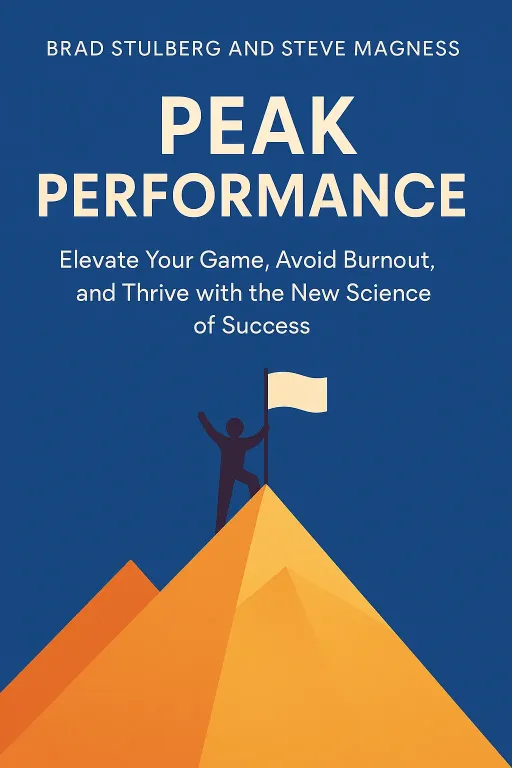
Nova: Not quite cat videos, Atlas, though there’s a time and a place for everything. We're talking about a profound re-evaluation of how high-achievers actually achieve. Today, we're drawing insights from two powerful books: first, "Peak Performance" by the brilliant duo, Brad Stulberg and Steve Magness, and then we’ll layer in "Do What Matters Most" by Steve and Rob Shallenberger.
Atlas: Stulberg and Magness, I know them. One's a leading expert on performance and well-being, the other a world-renowned running coach and sports scientist who’s worked with Olympians. That’s a serious pedigree. So, they’re not just telling us to chill out, there’s actual science behind this, right?
Nova: Absolutely. Their work isn't about slacking off; it's about smarter, more sustainable excellence. They challenge the very notion that constant output equals constant progress. And then, the Shallenbergers, with their background in leadership and productivity, give us the practical framework to actually integrate this into our lives, especially for those of us who are purposeful seekers trying to align our actions with our deeper values.
The Growth Equation: Stress + Rest = Growth
SECTION
Nova: So, let's start with the core thesis from "Peak Performance." Stulberg and Magness distill the secret to avoiding burnout and achieving sustained excellence into a simple, yet revolutionary, formula: Stress + Rest = Growth.
Atlas: Stress plus rest equals growth. That's intriguing. I can definitely relate to the stress part, but it usually feels like the enemy, not half of a growth equation. What exactly do they mean by "stress" in this context?
Nova: Think of "stress" as any challenge that pushes you beyond your current limits. It could be a tough workout, a complex problem at work, learning a new skill, or even navigating a difficult conversation. It’s the stimulus that signals your body and mind to adapt and improve. But here’s the crucial part: without adequate "rest," that stress doesn't lead to growth; it leads to breakdown.
Atlas: So, it’s not about avoiding stress, it's about responding to it intelligently. That makes sense. Like how muscles grow after a workout, not during it. But what does "rest" look like for the brain, for our cognitive and creative capacities?
Nova: Exactly! That muscle analogy is perfect. For our minds, rest isn't just about sleep, though sleep is foundational. It’s about active recovery, allowing for physiological adaptation and neural consolidation. When you're learning something new or grappling with a tough problem, your brain is literally rewiring itself. That rewiring, that strengthening of connections, largely happens during periods of rest – during deep sleep, during periods of diffuse thinking, or even during focused mindfulness.
Atlas: That’s fascinating. I can definitely see how for deep thinkers, the "thinking" doesn't stop just because the workday ends. Sometimes the best ideas pop up when you're in the shower or on a walk. So, what happens if you skip the rest? What's the breakdown look like?
Nova: When you continuously apply stress without sufficient rest, you enter a state of chronic overload. Your body can't repair, your brain can't consolidate, and your emotional reserves deplete. Instead of getting stronger, you get weaker. Performance plateaus, creativity wanes, and eventually, you hit burnout. Stulberg and Magness, from their work with elite athletes and top professionals, have seen this play out repeatedly. They’ve observed that the highest performers aren't the ones who work 24/7, but the ones who master the rhythm of intense work followed by intentional recovery.
Atlas: Can you give me a clear case study, maybe from their work, where someone actually improved by strategically backing off? Because for our listeners who are pushing hard in high-stakes environments, that can feel impossible.
Nova: Think of an Olympic-level swimmer. Their training isn't just constant laps. It's meticulously structured: intense, high-volume sessions followed by active recovery days, cross-training, massage, and ample sleep. If that swimmer just kept pushing, day after day, without rest, their body would break down. Their times would get slower, they'd get injured, and their mental game would suffer. But by embracing the 'rest' component, their body adapts, their muscles grow stronger, and their technique improves in ways that can only happen the pool. It’s the same for a writer, a programmer, or a CEO. The breakthroughs, the insights, the creative leaps, often come after stepping away, allowing the subconscious to work its magic.
Atlas: So, it's not about being weak or lazy; it's about being with your energy and understanding the biological realities of high performance. That really speaks to questioning the status quo, which I appreciate.
Strategic Recovery & Pre-Week Planning
SECTION
Nova: Understanding rest is crucial is one thing, but do you actually do it, especially when your plate is overflowing? This is where Steve and Rob Shallenberger’s "Do What Matters Most" provides an incredibly practical framework.
Atlas: Exactly! For deep thinkers and strategists, "rest" can feel vague. How do we it without it just becoming another item on a never-ending to-do list? When you're driven by a desire for meaning and impact, every hour feels precious.
Nova: The Shallenbergers introduce "Pre-Week Planning." It’s a dedicated, usually 30-60 minute, session at the end of your current week or beginning of the next, where you map out your upcoming week. But it's not just a glorified to-do list. The core of it is identifying your "Most Important Thing" – your MIT – for the week.
Atlas: Okay, "Most Important Thing." That's a powerful concept. But how do you prevent that from just being the thing, rather than the most thing, especially when you're driven by purpose and trying to align with core values? It’s easy to confuse urgent with important.
Nova: That’s where the values alignment comes in. The MIT isn't just about what's urgent or what your boss expects. It's about what will move the needle most significantly towards your long-term goals and, crucially, what truly aligns with your core values. For someone who cares deeply about personal growth or building security, their MIT might be a project that expands their skill set or a financial planning session, even if it’s not screaming for immediate attention. Once you identify that MIT, the Shallenbergers emphasize it first, blocking out the time.
Atlas: So, for someone who already schedules their entire day, this would mean blocking out "deep work" or even "deliberate recovery" time, just like a meeting? Not just hoping it happens?
Nova: Precisely. And this is where the "rest" component from Stulberg and Magness integrates perfectly. Deliberate recovery isn't something you squeeze in if there’s time; it’s a non-negotiable part of your "Pre-Week Plan." You schedule your MIT, and then you schedule your recovery. This could be a block for deep thinking, creative play, spending time in nature, connecting with loved ones, or even just focused downtime where your brain isn't actively problem-solving.
Atlas: What happens when emergencies inevitably derail your perfectly planned week? Because that’s a reality for almost everyone in a high-growth career.
Nova: It's about intention, not rigid perfection. The plan creates a framework, a default. When things go off track, you have a clear understanding of your MIT and your scheduled recovery, making it easier to course-correct. You know what to protect, and what can flex. The point is to make recovery an active decision, an investment in your performance, rather than a passive afterthought. It’s about quality of rest, not just quantity. It’s about giving your brain the space it needs to truly process, consolidate, and innovate, which is essential for any curious strategist.
Synthesis & Takeaways
SECTION
Nova: So, bringing these two powerful ideas together: the scientific imperative of Stress + Rest = Growth, and the practical application through the Shallenbergers' Pre-Week Planning. It’s a complete blueprint for sustained excellence.
Atlas: This really speaks to the idea of purposeful seeking, doesn't it? It’s not just about doing more, but doing what truly matters for sustained growth, and understanding that 'doing' sometimes means strategically 'not doing.' It's about respecting your own human operating system.
Nova: Exactly. For our listeners who are deep thinkers, question the status quo, and are driven by meaning, this isn't just productivity advice. It's a philosophy for living vibrantly and achieving your highest potential without sacrificing your well-being. It's about embracing the journey and trusting your intuition that sometimes, less more, especially when that 'less' is intentional, high-quality recovery.
Atlas: And it aligns perfectly with the idea that consistency matters. Scheduling just 10 minutes daily for focused reading, or 10 minutes of deliberate rest – that consistent, intentional space for growth and recovery builds up over time. It’s not about one grand gesture, but a series of smart, small choices.
Nova: It’s a powerful shift in perspective. Instead of viewing rest as a reward for hard work, view it as the essential ingredient hard work, and for the growth that follows.
Atlas: So, for everyone listening, we challenge you: identify your Most Important Thing for the coming week, and then, crucially, schedule your deliberate recovery around it. Make rest a non-negotiable part of your high-performance strategy.
Nova: It's how you truly build security, optimize your well-being, and live vibrantly.
Atlas: This is Aibrary. Congratulations on your growth!