The Researcher's Superpower: Unlocking Elite Focus with 'Deep Work'
Golden Hook & Introduction
SECTION
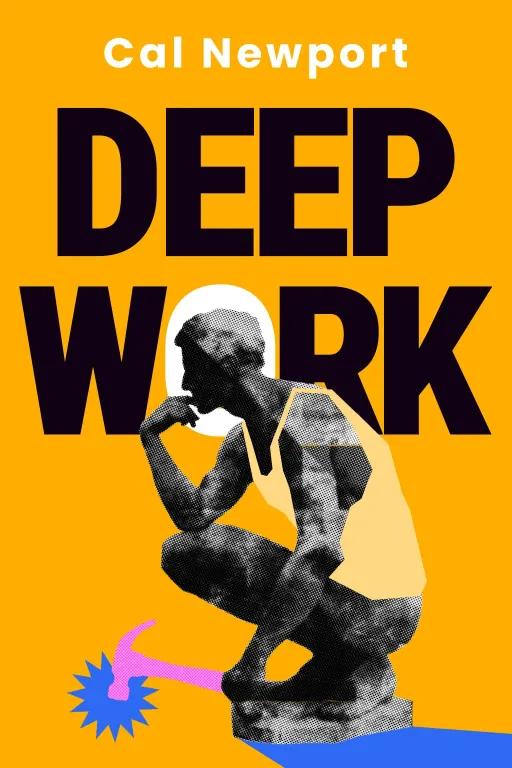
Nova: Priscilla, you have this ambitious list: master R, learn SPSS, ace your grad school applications, excel at your research job... It can feel like you're trying to climb five different mountains at once. But what if I told you there's one single skill, a kind of 'superpower,' that makes climbing all of those mountains not just possible, but faster and more effective? That's the promise of Cal Newport's 'Deep Work,' and it's a game-changer for anyone in a competitive field.
Priscilla Nti: That's a very appealing promise, Nova. Because 'overwhelmed' is definitely the right word sometimes. You know you need to learn these complex things to get ahead, but finding the time and, more importantly, the mental space, feels like a battle.
Nova: It is a battle! And Newport argues we're losing it because we don't even realize what we're fighting. So today, we're going to tackle this book from two different angles. First, we'll explore what 'deep work' truly is and why it's a career superpower for anyone learning complex skills. Then, we'll uncover the hidden workplace traps that silently sabotage our focus and keep us stuck in 'shallow work,' and how to start fighting back.
Priscilla Nti: I'm ready. Let's dive in.
Deep Dive into Core Topic 1: The Deep Work Advantage
SECTION
Nova: So let's start with that core idea. Cal Newport makes a powerful distinction between two types of work: 'Deep Work' and 'Shallow Work'. Priscilla, as a researcher, I'm sure you feel this tension.
Priscilla Nti: Absolutely. There's the work that really moves a project forward—analyzing data, writing a manuscript, deep literature review. And then there's... everything else.
Nova: Exactly. Newport defines Deep Work as professional activities performed in a state of distraction-free concentration that push your cognitive capabilities to their limit. This is the stuff that creates new value, improves your skills, and is hard for other people to replicate.
Priscilla Nti: Like learning a new statistical method in R.
Nova: Precisely. And then there's Shallow Work. These are the non-cognitively demanding, logistical tasks, often done while distracted. Think answering most emails, scheduling meetings, posting on social media. They don't create much new value and are easy to replicate. The scary part is, most of us spend our days drowning in the shallow end.
Priscilla Nti: And we feel busy, so we think we're being productive.
Nova: That's the illusion! To show the real power of choosing the deep end, Newport tells this incredible story about a guy named Jason Benn. Imagine you're Jason, a financial consultant. Your job is okay, but you have this terrifying realization that a simple Excel script could automate most of what you do. It means your skills aren't that valuable.
Priscilla Nti: That's a scary moment for anyone. A career crisis.
Nova: A huge one. So, he makes a radical choice. He quits his job, moves back home with his parents, and decides he's going to become a high-end, sought-after computer programmer. But he struggles. He tries to study, but he keeps getting distracted... YouTube, social media... sound familiar?
Priscilla Nti: A little too familiar. The endless scroll.
Nova: Right? His breakthrough comes when he decides to go to war with distraction. He literally locks himself in a room—no phone, no internet—with just his textbooks and a stack of notecards. For two months, it's nothing but pure, intense, distraction-free focus on programming fundamentals. After this, he attends an elite coding bootcamp. And because he's trained his mind to focus so intensely, he blows everyone away. He graduates at the top of his class and immediately lands a high-paying developer job at a tech start-up. He didn't just learn a skill; he learned it with such intensity that he became elite.
Priscilla Nti: Wow. That's extreme, but it makes so much sense. It's not just about putting in the hours to learn something like R or SPSS. It's the and of those hours. He basically compressed what might take someone years of casual, distracted learning into a few months of intense focus.
Nova: Exactly! That's the Deep Work Hypothesis in action. Newport's big idea is that the ability to perform deep work is becoming increasingly at the exact same time it's becoming increasingly in our economy. So the few who cultivate this skill will thrive. For you, the takeaway isn't to lock yourself in a room for two months...
Priscilla Nti: Right, because I have a job and responsibilities! So how do you apply that in a real-world setting? How do you protect that kind of focus when you're part of a research team with constant demands, and your Principal Investigator needs a quick answer or a collaborator pings you on Slack?
Nova: That is the perfect question, Priscilla. Because it leads right into our second, and maybe most important, point.
Deep Dive into Core Topic 2: The Hidden Traps
SECTION
Nova: If deep work is this powerful, why aren't we all doing it? Newport argues it's because our work culture actively, if unintentionally, pushes us towards the opposite: shallow work. He identifies a few key traps, but the biggest one is what he calls the 'Principle of Least Resistance.'
Priscilla Nti: The Principle of Least Resistance? What does that mean in a work context?
Nova: It means that in a business setting, without clear feedback on what's truly valuable, we will tend towards behaviors that are easiest in the moment. And what's easiest? Firing off a quick email. Responding to a Slack message. It gives us a hit of productive-feeling accomplishment.
Priscilla Nti: It feels like you're clearing a to-do list, even if the items on the list aren't that important.
Nova: Exactly. This leads to the second trap: 'Busyness as a Proxy for Productivity.' Think about the modern office. A 2012 McKinsey study found that the average knowledge worker spends more than 60 percent of their week engaged in electronic communication and internet searching. Sixty percent! That's not deep thinking.
Priscilla Nti: That's a staggering number. It means the majority of the workday is spent on reactive, shallow tasks.
Nova: It is. Newport says that in knowledge work, it's hard to see and measure valuable output, unlike on an assembly line. So, to prove our worth to our colleagues and bosses, we resort to an industrial-age indicator of productivity: being visibly busy. Answering emails instantly, always being in meetings, having a calendar packed with appointments. It like work.
Priscilla Nti: It's performing productivity.
Nova: Perfectly said. A classic, if controversial, example Newport gives was when Marissa Mayer became CEO of Yahoo in 2013. She famously banned employees from working from home. Why? Because she had checked the company's server logs for the remote login network and was upset that people weren't signing in enough throughout the day.
Priscilla Nti: So she was measuring their online presence, not their actual output or the quality of their work.
Nova: Precisely. She was measuring and rewarding visible activity, a proxy for productivity. She was rewarding busyness. And that decision sent a powerful message throughout the company about what was valued.
Priscilla Nti: That resonates so much with the culture in academia and research. There's this unspoken pressure to respond to emails from your Principal Investigator immediately, or to always be available on Slack. It creates this culture where you feel guilty for closing your inbox to actually the research—to do the coding, the analysis, the writing. The very thing you're there to do!
Nova: You've hit the nail on the head. That guilt is the trap! We're rewarded for the shallow, not the deep. We default to what's easiest and most visible, and our capacity for the hard, valuable, deep work just withers away.
Priscilla Nti: So, the first step is just recognizing that this pressure exists and that 'being busy' isn't the same as 'being effective'? It's about consciously separating the two in your own mind, even if the culture around you doesn't.
Nova: That's the first and most powerful step. It's about giving yourself permission to prioritize depth, even if it means you're less visibly 'busy'.
Synthesis & Takeaways
SECTION
Nova: Exactly. So, to bring it all together, we've seen that deep work is this incredible superpower, especially for mastering hard skills like you're doing, Priscilla. But at the same time, our modern work culture has laid all these invisible traps that push us towards shallow busyness instead.
Priscilla Nti: And the key is to become conscious of that trade-off. To see the choice in front of you every day: am I going to do the easy, visible thing, or the hard, valuable thing? And then to start intentionally choosing depth.
Nova: Beautifully put. Now, Cal Newport's book is filled with four big rules and dozens of strategies, and it can feel like a lot to implement at once. So I want to leave our listeners with one simple, powerful first step. It's a strategy from Rule #4, and it's called: 'Schedule Every Minute of Your Day.'
Priscilla Nti: Okay, that sounds even more intense than locking yourself in a room!
Nova: I know, it sounds terrifyingly rigid! But the goal isn't to become a robot and stick to the schedule no matter what. The goal is to be. For just one day, try blocking out your time on a calendar—and be honest. Block out 9:00 to 9:30 for 'Deep Work: Analyze Dataset in R'. But also block out 9:30 to 10:00 for 'Shallow Work: Check and Reply to Emails'. Block out time for lunch. The simple act of planning forces you to confront how you're spending your time and to ask, 'Is this deep or shallow?' It's a diagnostic tool.
Priscilla Nti: I like that framing. It's not a prison; it's a mirror. It's not about a massive life change overnight. It's about gathering data on yourself, which is what any good researcher would do. You can't improve what you don't measure.
Nova: That's it. You gather the data, and then you can start making small, informed changes. Maybe you notice you're spending two hours on email, and you can try to shrink that block to one. It's a small experiment to start reclaiming that focus.
Priscilla Nti: A small experiment to build a superpower. I can definitely try that. It feels like a manageable first step on a very important journey.
Nova: And that's how every great journey begins. Priscilla, thank you for exploring this with us.
Priscilla Nti: Thank you, Nova. This was incredibly insightful.